- Home
- Electric Vehicles
- Compare
- Hyundai Ioniq 5 vs Kia EV5
Hyundai Ioniq 5 vs Kia EV5
Hyundai Ioniq 5 and Kia EV5 sit in the compact to midsize electric crossover class. Both target drivers moving from petrol SUVs toward battery vehicles with modern tech and daily usability. The Ioniq 5 focuses on fast charging and performance-leaning trims. The EV5 targets family SUV buyers who want simple design, practical space, and lower entry pricing.
Range figures sit close. The Hyundai model reaches about 507 km WLTP in long-range rear-drive form. The Kia model reports about 500 km WLTP-equivalent depending on battery pack. Charging tech shows a clear difference. The Ioniq 5 uses an 800-volt platform which supports ultra-fast DC charging up to about 350 kW with 10–80 percent refill near 18 minutes. The EV5 runs a 400-volt system with DC speeds near 140 kW. A 10–80 percent refill usually lands near 30 minutes.
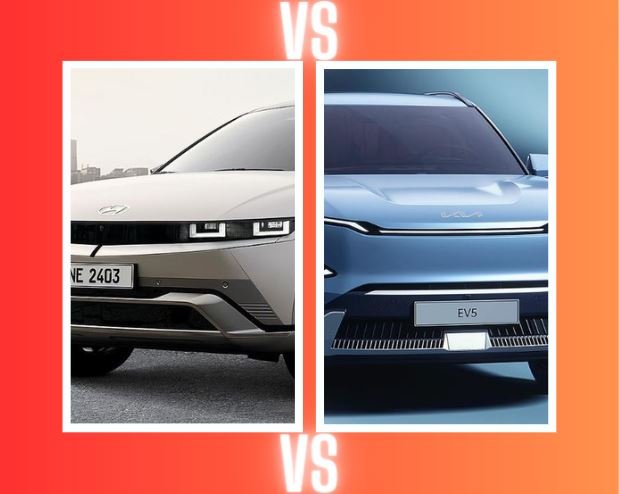
Price structure separates the two. The Ioniq 5 sits in a higher bracket across Europe, Korea, and North America. The EV5 enters the market as a lower priced compact electric SUV. Market reach also differs. The Hyundai model sells globally across major EV markets. The Kia EV5 started in China and Australia with gradual expansion. This comparison guides buyers choosing between faster charging performance and a lower priced family EV.
Within the same brands, each model sits beside other electric vehicles. Hyundai builds a wider Ioniq line which includes the sedan-focused Hyundai Ioniq 6 and the smaller Hyundai Kona Electric. Kia places the EV5 between the sporty Kia EV6 and the large three-row Kia EV9 in its EV lineup.
Ioniq 5 pros include ultra-fast charging capability, strong acceleration in dual-motor trims, and a spacious flat-floor interior. Ioniq 5 cons include higher purchase price and range drop in AWD trims. EV5 pros include lower entry cost, practical SUV cabin layout, and competitive driving range for daily use. EV5 cons include slower charging speeds and fewer global trim options.
QUICK VERDICT; Choose the Ioniq 5 for faster charging, stronger performance trims, and wider global support. Choose the EV5 for lower price positioning and straightforward family SUV practicality.
Related EV comparisons
- Kia EV4 sedan vs Kia EV3
- Kia EV4 sedan vs Kia EV6
- Kia EV4 hatchback vs Kia EV3
- Kia EV4 hatchback vs Kia EV6
- Hyundai Ioniq 9 vs Hyundai Ioniq 5
MODEL
| Models |
Hyundai Ioniq 5 63kWh RWD Hyundai Ioniq 5 84kWh RWD Hyundai Ioniq 5 84kWh AWD Kia EV5 Standard Range FWD Kia EV5 Long Range FWD Kia EV5 Long Range AWD Kia EV5 GT |
LAUNCH
| Announced |
2024, March 04
2023, October 12 - Kia EV5 Standard Range FWD 2023, October 12 - Kia EV5 Long Range FWD 2023, October 12 - Kia EV5 Long Range FWD 2026, January 9 - Kia EV5 GT |
| Status |
Available to order. Released 2024, July
Coming soon. Expected release 2025 - Kia EV5 Standard Range FWD Coming soon. Expected release 2025 - Kia EV5 Long Range FWD Coming soon. Expected release 2025 - Kia EV5 Long Range FWD Coming soon. Expected release 2026, Q2 - Kia EV5 GT |
| Country of origin | South Korea South Korea |
| Base Price |
€ 44,000 £ 40,000 - Hyundai Ioniq 5 63kWh RWD € 51,700 £ 43,400 - Hyundai Ioniq 5 84kWh RWD € 59,400 £ 50,900 - Hyundai Ioniq 5 84kWh AWD |
PERFORMANCE
| Power |
RWD 170 hp (125 kW) - Hyundai Ioniq 5 63kWh RWD RWD 228 hp (168 kW) - Hyundai Ioniq 5 84kWh RWD AWD 325 hp (239 kW) - Hyundai Ioniq 5 84kWh AWD FWD 218 hp (160 kW) - Kia EV5 Standard Range FWD FWD 218 hp (160 kW) - Kia EV5 Long Range FWD AWD 306 hp (225 kW) - Kia EV5 Long Range FWD AWD 302 hp (225 kW) - Kia EV5 GT |
| Torque |
350 Nm (258 lb-ft) - Hyundai Ioniq 5 63kWh RWD 350 Nm (258 lb-ft) - Hyundai Ioniq 5 84kWh RWD 605 Nm (446 lb-ft) - Hyundai Ioniq 5 84kWh AWD 310 Nm (229 lb-ft) - Kia EV5 Standard Range FWD 310 Nm (229 lb-ft) - Kia EV5 Long Range FWD 310 Nm (229 lb-ft) - Kia EV5 Long Range FWD |
| Acceleration The acceleration numbers are an easy way to compare car performance. We list either time from 0 to 100 km/h or time from 0 to 60mph, depending on which number(s) the manufacturers provide. The lower the acceleration time, the higher performance the car is. |
8.5 sec 0-62 mph - Hyundai Ioniq 5 63kWh RWD 7.5 sec 0-62 mph - Hyundai Ioniq 5 84kWh RWD 5.3 sec 0-62 mph - Hyundai Ioniq 5 84kWh AWD 6.2 sec 0-62 mph - Kia EV5 GT |
| Max Speed | 115 mph (185 km/h) |
| transmission | Single-speed Single-speed |
BATTERY
| Capacity |
63 kWh total - Hyundai Ioniq 5 63kWh RWD 84 kWh total - Hyundai Ioniq 5 84kWh RWD 84 kWh total - Hyundai Ioniq 5 84kWh AWD 60.3 kWh total - Kia EV5 Standard Range FWD 81.4 kWh total - Kia EV5 Long Range FWD 81.4 kWh total - Kia EV5 Long Range FWD 81.4 kWh total - Kia EV5 GT |
| Tech | Liquid-cooled Li-Po (800V type) Liquid-cooled Li-ion (400V type) |
| Range |
273 mi WLTP (240 mi EPA) - Hyundai Ioniq 5 63kWh RWD 320 mi WLTP (310 mi EPA) - Hyundai Ioniq 5 84kWh RWD 308 mi WLTP (280 mi EPA) - Hyundai Ioniq 5 84kWh AWD 336 mi WLTP - Kia EV5 Long Range AWD |
| Consumption |
251 Wh/mi WLTP - Hyundai Ioniq 5 63kWh RWD 277 Wh/mi WLTP - Hyundai Ioniq 5 84kWh RWD 293 Wh/mi WLTP - Hyundai Ioniq 5 84kWh AWD |
| Recuperation | 4 levels, with steering wheel paddles Yes |
| Heat Pump | |
| AC Charging |
Type 2 11 kW
Type 2 7 kW Type 2 11 kW |
| DC Charging |
CCS 180 kW, 10-80% in 18 min - Hyundai Ioniq 5 63kWh RWD CCS 235 kW, 10-80% in 18 min - Hyundai Ioniq 5 84kWh RWD CCS 235 kW, 10-80% in 18 min - Hyundai Ioniq 5 84kWh AWD CCS, 30-80% in 27 min - Kia EV5 Standard Range FWD CCS, 30-80% in 27 min - Kia EV5 Long Range FWD CCS, 140 kW max, 30-80% in 27 min - Kia EV5 Long Range FWD CCS, 140 kW max, 10-80% in 30 min - Kia EV5 GT |
| Others |
Vehicle to load (V2L) 230V electrical outlet (3.6 KW max) Vehicle to load (V2L) Vehicle to grid (V2G) |
BODY
| Type | 5 door crossover, 5 seats 5 door SUV, 5 seats |
| Platform | E-GMP E-GMP |
| Dimensions | 4655 x 1890 x 1605 mm (183.3 x 74.4 x 63.2 in) 4615 x 1875 x 1715 mm (181.7 x 73.8 x 67.5 in) |
| Drag Co-Efficient | 0.288 Cd |
| Wheelbase | 3000 mm (118.1 in) 2750 mm (108.3 in) |
| Clearance | 160 mm (6.3 in) |
| Weight |
EU: 1965 kg unladen, 2470 kg gross - Hyundai Ioniq 5 63kWh RWD EU: 2070 kg unladen, 2590 kg gross - Hyundai Ioniq 5 84kWh RWD EU: 2175 kg unladen, 2685 kg gross - Hyundai Ioniq 5 84kWh AWD EU: 1870 kg unladen - Kia EV5 Standard Range FWD |
| Suspension | Front MacPherson struts, rear multi-link |
| Wheels | R19, R20 R18, R19, R20 |
| Trunk/Boot | EU: 527 l, 1587 l max |
| Frunk/Bonnet |
57 l 57 l 24 l Yes |
| Towing |
EU: 750 kg unbraked, 750 kg braked - Hyundai Ioniq 5 63kWh RWD EU: 750 kg unbraked, 1600 kg braked - Hyundai Ioniq 5 84kWh RWD EU: 750 kg unbraked, 1600 kg braked - Hyundai Ioniq 5 84kWh AWD Yes |
| Others |
Battery thermal pre-conditioning Smart Frequency Dampers Digital Centre Mirror Digital Side Mirrors |
DISPLAYS
| Centre | 12.3" touchscreen 12.3" touchscreen |
| Driver's Display | 12.3" 12.3" |
| Head-Up | Yes, projector type Yes |
COMFORT
| Seats | Heated and ventilated front seats, heated rear seats Heated, ventilated with massage front seats |
| Roof | Panoramic glass roof, solar roof Glass sunroof |
| Parking Aids | Front and rear sensors, 360 camera, front and reversing camera, Remote Smart Parking Assist 2 Front and rear sensors, 360 camera, reversing camera |
| Connectivity | Wireless Android Auto and Apple CarPlay Wireless Android Auto and Apple CarPlay |
| Others | 3-zone climatronic |
SAFETY
| Airbags | 8 airbags: side, front and rear, including head airbag system Airbags: front, side, rear, head airbag system, driver's knee airbag |
| Driving Aids | Front and corner radars, cameras. Forward/Side/Reverse Parking Collision-Avoidance Assist, Autonomous Emergency Braking with Pedestrian and Cyclist Recognition, Blind Spot Collision-Avoidance Assist, Rear Cross-Traffic Collision-Avoidance Assist, Lane Keeping Assist 2, Safe Exit Assist, High Beam Assist, Intelligent Speed Limit Assist, Driver Attention Warning, Hands-On Detection Front radar, cameras, 12 front/rear sensors. Forward Collision-Avoidance Assist, Lane Keeping Assist, Lane Following Assist, Driver Attention Warning, High Beam Assist, Blind-Spot Collision-Avoidance Assist, Rear Cross-Traffic Collision-Avoidance Assist, Autonomous Emergency Braking with Pedestrian Recognition, Reverse Parking Collision-Avoidance Assist, Front/Rear Parking Distance Warning, Safe Exit Assist |
Note
| disclaimer | We can not guarantee that the information on this page is 100% correct We can not guarantee that the information on this page is 100% correct |

|
Disclaimer Note
We can not guarantee that the information on this page is 100% correct