- Home
- Electric Vehicles
- Compare
- Rimac Nevera vs Lotus Evija
Rimac Nevera vs Lotus Evija
The Rimac Nevera and Lotus Evija sit at the top of the EV market. Both are limited-production electric hypercars built for extreme performance, not daily use. Buyers include collectors, track-focused drivers, and high-net-worth enthusiasts who want cutting-edge EV engineering with exclusivity.
Range differs in real use. The Nevera delivers around 300 miles WLTP, making it more usable beyond short bursts. The Evija targets about 215 miles WLTP, with a focus on peak performance over distance. Charging also splits them apart. The Nevera supports fast DC charging up to 500 kW, among the fastest in any EV. The Evija targets 350 kW charging, still high but behind the Nevera in peak capability.
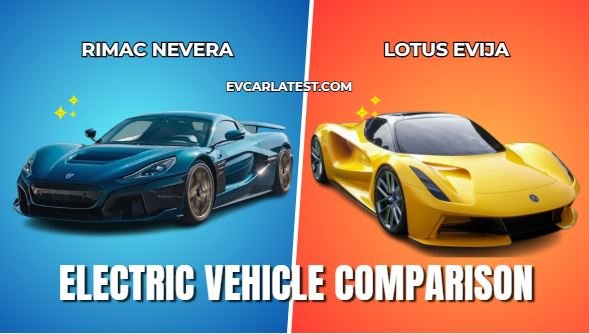
Pricing sits deep in hypercar territory. The Nevera costs around $2.2 million, while the Evija pushes closer to $2.3 million depending on spec. Availability remains limited for both, with strict production caps and most units already allocated. This comparison helps you decide between better usability and charging advantage in the Nevera versus extreme design focus and brand heritage in the Evija.
Within Rimac, the Nevera stands as the brand’s flagship, alongside projects like the Rimac Concept One. It competes with other high-performance EVs such as the Pininfarina Battista and Tesla Roadster. On the Lotus Cars side, the Evija leads an EV shift that includes the Lotus Emeya and Lotus Eletre, while also rivaling the Battista and Nevera directly in the hypercar space.
The Nevera offers unmatched acceleration, higher real-world range, and leading charging speed, but it carries high weight and limited emotional design appeal for some buyers. The Evija delivers extreme lightweight engineering, standout design, and strong brand identity, but it falls short in range and charging peak while remaining hard to access due to ultra-low production.
Quick verdict: Choose the Nevera for performance metrics and usability edge. Choose the Evija for design purity and brand-driven exclusivity.
Related EV Comparisons


MODEL
| Models |
Rimac Nevera 120kWh
Lotus Evija Lotus Evija Fittipaldi Lotus Evija X |
LAUNCH
| Announced |
2021, June 01
July 2019 October 2022 Revealed in 2023 |
| Status | Available to order. Released 2021, December In production (limited to 130 units) |
| Country of origin | Croatia Britain |
| Base Price | € 2,000,000 ~$2.3 million USD |
PERFORMANCE
| Power | AWD 1914 hp (1427 kW) ~2,000 hp, Quad-motor AWD (one motor per wheel) |
| Torque | 2360 Nm (1741 lb-ft) ~1,700 Nm |
| Acceleration The acceleration numbers are an easy way to compare car performance. We list either time from 0 to 100 km/h or time from 0 to 60mph, depending on which number(s) the manufacturers provide. The lower the acceleration time, the higher performance the car is. | 1.7 sec 0-60 mph (1.8 sec 0-62 mph) 0–100 km/h < 3.0 s; 0–300 km/h < 9.0 s |
| Max Speed | 256 mph (412 km/h) ~350 km/h (217 mph) |
BATTERY
| Capacity |
120 kWh total
~93 kWh lithium-ion 70 kWh |
| Tech |
Liquid-cooled 730V (800V-type), Lithium Nickel Manganese Cobalt Oxide Integrated with Williams Advanced Engineering, liquid-cooled |
| Range | 340 mi WLTP, 402 mi NEDC ~346 km (215 mi) WLTP |
| Consumption | ~27 kWh/100 km (est.) |
| Recuperation | Yes, up to 300 kW Regenerative braking |
| Heat Pump | |
| AC Charging | Type 2 22 kW 22 kW, ~6 hours full |
| DC Charging | CCS 500 kW max, 0-80% in 22 min 350 kW, 0–80% ~12 min, 100% ~18 min |
| Others | Future-proofed for 800 kW charging (possible 9 min full) |
BODY
| Type | 2 door coupe, 2 seats 2-door, 2-seat hypercar |
| Platform | Lotus custom carbon-fiber monocoque |
| Dimensions | 4750 x 1986 x 1208 mm (187.0 x 78.2 x 47.6 in) L 4,459 mm | W 2,000 mm | H 1,122 mm |
| Drag Co-Efficient | 0.3 Cd ~0.35 (est., active aero) |
| Wheelbase | 2745 mm (108.1 in) 2,700 mm |
| Clearance | Low-slung (track-oriented) |
| Weight | EU: 2150 kg unladen ~1,680 kg |
| Suspension | Double wishbone, electronically controlled dampers, active ride height adjustment Race-inspired double wishbone (front & rear) |
| Wheels | R20 20” front, 21” rear, carbon wheels optional |
| Trunk/Boot | EU: 100 l Small rear luggage compartment |
| Frunk/Bonnet | No None (space used for aero & cooling) |
| Towing | No None |
| Others | Venturi tunnels for airflow through body |
DISPLAYS
| Centre | Yes Minimal infotainment screen |
| Driver's Display | Yes Digital cluster with performance data |
| Head-Up | No Not Available |
| Others | Camera-based side mirror displays |
COMFORT
| Seats | Heated front seats Carbon-fiber racing seats with Alcantara/leather |
| Roof | No glass roof Fixed carbon roof |
| Parking Aids | Front and rear sensors, 360 camera, reversing camera Rearview camera, parking sensors |
| Connectivity | Bluetooth, navigation, telemetry data logging |
| Others | Lightweight interior focus, minimal distractions |
SAFETY
| Airbags | Front, side, head airbag system Front airbags |
| Driving Aids | 6 radars, 13 cameras, 12 sensors (up to 160m object detection) ABS, traction control, stability control, torque vectoring |
| Self Driving | Autopilot with full Self-Driving capability None |
Note
| Others | Carbon-fiber monocoque body (70000 Nm/degree torsional stiffness) The Lotus Evija is built for extreme performance and exclusivity, prioritizing power-to-weight ratio and aerodynamics over everyday practicality. |
| disclaimer | We can not guarantee that the information on this page is 100% correct |


|
Disclaimer Note
We can not guarantee that the information on this page is 100% correct