

- Electric Vehicles
- Compare Electric Cars
- NIO ET5 vs XPeng P7
NIO ET5 vs XPeng P7
The NIO ET5 and the XPeng P7 are both mid-size electric sedans developed and primarily sold by Chinese electric vehicle manufacturers. The ET5 is built by NIO and sits as the brand’s entry point into the sedan segment, positioned below the larger ET7 in NIO’s lineup. The XPeng P7, now in its second generation as the P7+, is XPeng’s flagship sedan and one of the brand’s longest-running nameplate entries. Both vehicles target buyers in China’s growing premium electric sedan market — consumers who are moving away from conventional German and Japanese sedans toward locally developed electric alternatives with advanced technology, competitive range, and strong software integration at a lower price than equivalent European offerings.
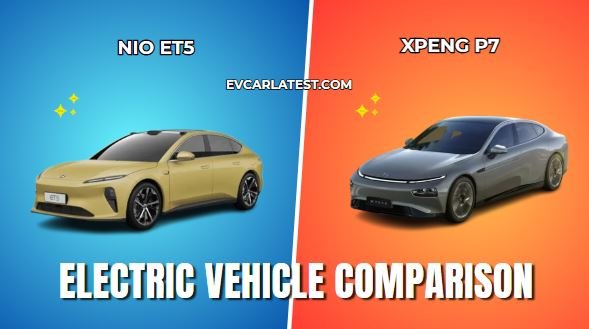
The NIO ET5 is rated at approximately 550 km CLTC on the standard 75 kWh battery and up to 720 km CLTC on the 100 kWh long range pack. NIO’s battery-as-a-service model also allows access to a 150 kWh pack through its swap network, with claimed range up to 1,000 km CLTC on that configuration. The XPeng P7+ Long Range rear-wheel drive version is rated at up to 710 km CLTC, which is competitive with the NIO ET5 on the 100 kWh pack. On charging, the XPeng P7+ carries a meaningful hardware advantage on its 5C fast-charging variant, supporting up to 400 kW DC charging — one of the higher rates currently available in the segment. The NIO ET5 supports up to 240 kW DC fast charging on conventional chargers, which is fast by most standards but trails the P7+’s ceiling. However, the ET5’s battery swap capability through NIO Power Swap stations allows a full battery exchange in approximately five minutes, which sidesteps the charging time conversation entirely for buyers near NIO’s swap network.
The XPeng P7+ starts at approximately RMB 209,900 in China, sitting meaningfully below the NIO ET5, which starts at around RMB 298,000 under NIO’s standard ownership model. NIO also offers a battery-as-a-service subscription that lowers the upfront purchase price but adds a monthly fee, which changes the cost comparison depending on how a buyer structures ownership. Outside China, the NIO ET5 is sold in Norway, Germany, the Netherlands, Denmark, and Sweden, giving it a limited but active European presence. The XPeng P7+ has a narrower international footprint, with availability concentrated in China and select European markets on a more limited basis. This page helps buyers in China — and to a lesser extent in Europe — decide between a more affordable sedan with fast charging hardware and a higher-priced alternative that introduces battery swapping as a solution to charging time entirely.
NIO’s broader lineup includes the ET7 large sedan, ES6 and ES7 SUVs, EC6 coupe-SUV, and the EL8 large SUV, with the ET5 Touring estate variant also available for buyers who want more cargo space in the same sedan family. XPeng’s other current models include the G6 mid-size SUV, G9 large SUV, X9 large MPV, and the G7 SUV, with the brand also developing flying car technology under its AeroHT division. Outside these two brands, the main rivals in this segment are the Tesla Model 3, which competes directly on price and software integration in China and globally, and the BYD Han, which undercuts both on price while offering competitive range and strong sales volume in the domestic Chinese market.
The NIO ET5’s three main strengths are its battery swap network which eliminates charging wait times entirely for buyers near a NIO Power Swap station, its over-the-air software ecosystem and NIO House ownership experience which extends the product beyond the vehicle itself, and its availability in European markets which gives it reach that most Chinese EV brands have not yet established. Its two weaknesses are its significantly higher starting price compared to the XPeng P7+ at equivalent configurations, and its battery swap infrastructure, which is geographically limited and only delivers its full value to buyers in cities where NIO has built sufficient swap station density. The XPeng P7+’s three main strengths are its lower starting price which positions it more accessibly within China’s premium sedan segment, its 5C fast-charging capability on compatible variants which supports up to 400 kW DC and makes it one of the faster-charging sedans in its class, and its XNGP intelligent driving assistance system which XPeng has been developing aggressively and deploys across more road types than most domestic rivals. Its two weaknesses are its more limited international availability compared to the ET5, which restricts its buyer base largely to China, and its brand recognition outside China, where XPeng remains less established than NIO in the European markets both brands are attempting to enter.
Quick Verdict: The XPeng P7+ is the more accessible choice on price and brings a strong argument on fast-charging hardware with its 5C variant. The NIO ET5 costs more but introduces battery swapping as a genuine alternative to charging stops for buyers within range of NIO’s swap network, and it has a more established footprint in Europe for buyers considering cross-market use. In China, buyers who prioritise lower cost and raw charging speed have a clear reason to look at the P7+. Buyers who want the swap network, a broader ownership ecosystem, or a path to European use will find the ET5’s premium harder to dismiss.
Related EV Comparsions
- XPeng MONA M03 vs BYD Dolphin
- XPeng MONA M03 vs BYD Qin Plus EV
- XPeng G9 vs BMW iX3
- Lynk & Co 02 vs XPeng G6
- Xiaomi YU7 vs XPeng G6
| |
| Price | $46,000.00 $45,000.00 |
| Our Rating | |
| Brand | NIO XPeng |
| Category | Electric Cars Electric Cars |
MODEL
| Available Trims / Variants |
NIO ET5
XPeng P7 Long Range RWD XPeng P7 Performance AWD |
LAUNCH
| Reveal Date | December 2021 2021, August 24 |
| Availability Status | In production Available to order. Released 2021 |
| Country of origin | China China |
| Base Price (USD) |
$46,000
€ 44,650 - XPeng P7 Long Range RWD € 50,560 - XPeng P7 Performance AWD |
BATTERY
| Battery Capacity | 75 kWh or 100 kWh 80 kWh total |
| Battery Chemistry | Lithium ion. Semi solid state for swap battery Liquid-cooled Li-ion (IP68 certified) |
| Range (WLTP/CLTC/EPA) |
75 kWh: about 350 miles WLTP 100 kWh: about 435 miles WLTP 329 mi WLTP - XPeng P7 Long Range RWD 292 mi WLTP - XPeng P7 Performance AWD |
| Energy Consumption |
16 to 17 kWh per 100 km
270 Wh/mi WLTP - XPeng P7 Long Range RWD 312 Wh/mi WLTP - XPeng P7 Performance AWD |
| Regen Braking (Max kW) | Adjustable regenerative braking Yes |
| Heat Pump | |
| AC Charging (Max kW) |
Up to 11 kW. Full charge in about 8 to 10 hours
Home charging, 30-80% in 6h 50 min Type 2, 30-80% in 4h 15 min |
| DC Charging (Max kW) | Up to 140 kW. 10 to 80 percent in about 30 minutes CCS, 30-80% in 31 min |
| Additional Notes | Battery swap support |
PERFORMANCE
| Power Output (kW / hp) |
483 hp, dual motor AWD
RWD 266 hp (196 kW) - XPeng P7 Long Range RWD AWD 430 hp (316 kW) - XPeng P7 Performance AWD |
| Torque (Nm) |
700 Nm
288 lb-ft (390 Nm) - XPeng P7 Long Range RWD 655 Nm (483 lb-ft) - XPeng P7 Performance AWD |
| 0–100 km/h / 0-60 mph (seconds) The acceleration numbers are an easy way to compare car performance. We list either time from 0 to 100 km/h or time from 0 to 60mph, depending on which number(s) the manufacturers provide. The lower the acceleration time, the higher performance the car is. |
0 to 100 km/h in 4.0 seconds
6.9 sec 0-62 mph - XPeng P7 Long Range RWD 4.5 sec 0-62 mph - XPeng P7 Performance AWD |
| Top Speed (km/h / mph) | 200 km/h 106 mph (170 km/h) |
BODY
| Body Style | 4 door sedan, 5 seats 4 door sedan, 5 seats |
| Platform / Architecture | NIO NT 2.0 B platform (Edward) |
| Dimensions (L×W×H mm) |
Length: 4,790 mm Width: 1,960 mm Height: 1,499 mm 192.1 x 74.6 x 57.1 in (4880 x 1896 x 1450 mm) |
| Drag Coefficient (Cd) | 0.24 0.236 Cd |
| Wheelbase (mm) | 2,888 mm 118.0 in (2998 mm) |
| Ground Clearance (mm) | 150 mm |
| Kerb Weight (kg) |
2,200 kg
EU: 4381 lb unladen - XPeng P7 Long Range RWD EU: 2097 kg unladen - XPeng P7 Performance AWD |
| Suspension (Front / Rear) | Multi link front and rear Front double wishbone, rear multi-link |
| Wheel Size (inches) | 19 or 20 inch R18, R19 |
| Trunk/Boot Capacity (L) | 386 liters EU: 15.5 ft³ |
| Frunk/Bonnet Capacity (L) | Yes |
| Towing Capacity (kg) | Up to 1,400 kg No |
| Additional Notes | Near 50 50 weight distribution |
SAFETY
| Airbags (count) | 7 airbags Front, side, rear, head airbag system |
| Driver Assistance (ADAS) | Adaptive cruise, lane assist, blind spot monitoring 3 Front/Rear radars, 5 cameras, 12 sensors. Forward/Rear/Lateral Collision Prevention, Lane Centering, Lane Change Assist, Lane Departure Warning, Traffic Jam Assist, Emergency braking with pedestrian and cyclist monitoring, High beam Assist, Blind Spot Alert, Door Open Warning |
| Autonomous Driving Level | NIO Pilot with advanced assist features |
| Crash Test Ratings | 5 star rating in major markets |
COMFORT
| Seating Capacity | Heated, ventilated, massage optional Heated and ventilated front seats |
| Roof Type | Panoramic glass roof Panoramic glass sunroof |
| Bluetooth / Wi-Fi | 5G, wireless Android Auto and Apple CarPlay dependent on market |
| Parking Aids | Cameras, sensors, auto park Front and rear sensors, 360 camera, reversing camera, Automatic Parking Assistance System |
| Additional Notes | Ambient lighting, premium audio |
DISPLAYS
| Centre Screen (inches) | 15.6 inch AMOLED 15" touchscreen |
| Driver's Display (inches) | 10.2 inch digital cluster 10.25" |
| Head-Up Display (HUD) | 18.8 inch AR HUD No |
| Additional Notes | NOMI AI assistant |
LIGHTING
INFOTAINMENT & AUDIO
TECHNOLOGY
OWNERSHIP
Note
| Additional Notes | Battery subscription and swap stations reduce upfront cost in supported regions |


|
Disclaimer Note
Specifications sourced from manufacturer data and may reflect WLTP, CLTC, or EPA test conditions. Import prices in your local are estimates based on grey-market landing costs and exclude duties, clearing fees, and local taxes. Figures are subject to change without notice. Always verify with your local importer before purchase. We can not guarantee that the information on this page is 100% correct