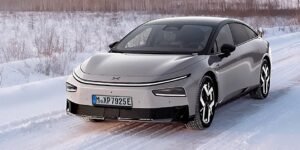
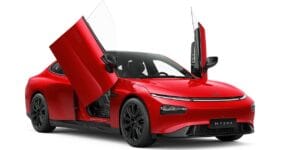
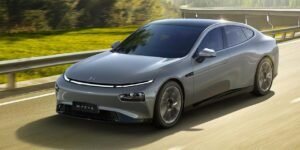
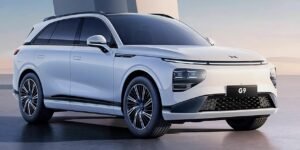
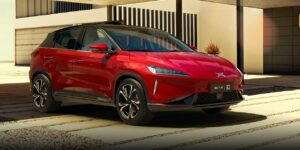
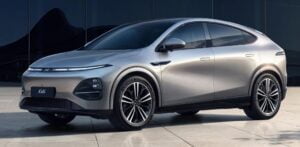
If you’ve been tracking the electric SUV market, you’ve probably noticed a flood of new models from China. The XPENG G7 is one of the most interesting — not because it reinvents the wheel, but because it packages genuinely advanced tech into a mid-size crossover that costs thousands less than a base Tesla Model Y. Let’s walk through what it offers, what it lacks, and where it fits in a crowded field.
The XPENG G7 is a fully electric, five-door mid-size crossover built by XPENG Motors — one of China’s more tech-focused EV startups. It sits at the entry point of the brand’s SUV lineup, sharing its SEPA 2.0 platform with the smaller G6 and the larger, more luxurious G9.
This is a rear-motor, rear-wheel-drive (RWD) vehicle. No all-wheel-drive variant has been announced yet, which tells you something about its priorities: efficiency and affordability over all-weather traction. What makes the G7 genuinely notable is that it’s the first production car to run on XPENG’s self-developed Turing AI chips and feature an augmented reality head-up display co-developed with Huawei. That’s not a marketing gimmick — it’s a real hardware debut that points to where XPENG is heading with smart cockpit and driver-assistance systems.
XPENG offers two lithium iron phosphate (LFP) battery packs for the G7, both designed for longevity and cost savings rather than outright energy density.
Standard Range: 68.5 kWh usable capacity. CLTC range is quoted at 577–602 km (roughly 358–374 miles), though variations come down to wheel size and trim.
Long Range: 80.8 kWh usable capacity. CLTC range jumps to 677–702 km (about 420–436 miles).
Now, an important note: these figures use China’s CLTC cycle, which is generally more optimistic than WLTP or EPA tests. Real-world highway range will be lower. No WLTP or EPA numbers have been published yet, so treat the CLTC ratings as a best-case benchmark.
Where the G7 genuinely shines is charging speed. It supports 5C-rate DC fast charging, which lets the battery go from 10% to 80% in just 12 minutes when connected to a compatible high-power charger. That’s rapid even by 2025 standards. AC home charging details haven’t been confirmed, but typical XPENG models support 7–11 kW onboard chargers, so overnight top-ups should be straightforward.
Performance is adequate rather than exhilarating. The single electric motor puts out 218 kW (292 hp), good for 0–100 km/h in 6.5–6.6 seconds and a top speed of 202 km/h. It’s quick enough for daily driving and highway merging, but it’s no performance SUV.
In China, the XPENG G7 carries a sticker price between ¥195,800 and ¥225,800. At current exchange rates, that’s roughly €23,200–€26,700 or 25,000–29,000. For context, a base Tesla Model Y in China starts significantly higher, which means the G7 undercuts its most famous rival by more than 25%.
That price gap defines the target buyer. The G7 suits tech-forward families and commuters who want a spacious electric crossover with modern driver-assistance smarts but don’t want to pay a premium for the Tesla badge or dual-motor all-weather grip. If you live in a city, rarely venture off paved roads, and charge mostly at home or at work, this vehicle checks a lot of boxes.
Internally, the G7 slots neatly between two siblings:
XPENG G6: A slightly smaller, sportier electric SUV with a coupe-like roofline.
XPENG G9: The brand’s flagship SUV, offering more luxury, space, and all-wheel-drive options.
If the G6 feels a bit snug and the G9 stretches your budget, the G7 aims to be the practical middle ground.
The G7 enters a fiercely competitive segment. Its most obvious competitors are:
Tesla Model Y (RWD): The global benchmark for mid-size electric crossovers.
BYD Sealion 7: Another value-focused electric SUV from China’s largest EV maker.
When you line up specs and pricing, the direct comparison that matters most is the XPENG G7 versus the Tesla Model Y RWD. Both are rear-wheel-drive mid-size electric SUVs. Both prioritize efficiency. But the XPENG undercuts the Tesla’s price by a wide margin in the Chinese market, offers faster peak charging, and packs a next-generation smart cockpit with that Huawei AR head-up display. Whether that’s enough to sway buyers outside China will depend heavily on final WLTP range figures, local pricing, and after-sales support.
A sensible choice with a tech edge — if the numbers translate
The XPENG G7 doesn’t pretend to be a luxury vehicle or a performance machine. It’s a thoughtfully built electric family crossover that bets on smart hardware and aggressive pricing to win over buyers who might otherwise default to a Tesla. The 5C charging is genuinely impressive, the AR head-up display is a forward-looking touch, and the CLTC range figures — while optimistic — suggest real-world capability well above 400 km even in less ideal conditions.
| Available Trims / Variants | XPENG G7 |
| Reveal Date | Mid 2025 |
| Availability Status | In production |
| Country of origin | China |
| Base Price (USD) | 27,300–32,000 (China) |
| Battery Capacity | 68.5 or 80.8 kWh |
| Battery Chemistry | 800V platform, LFP cells |
| Range (WLTP/CLTC/EPA) | mi WLTP ~340–355 |
| Energy Consumption | 10.8–13.2 kWh/100 km |
| Regen Braking (Max kW) | Standard regen |
| Heat Pump | |
| AC Charging (Max kW) | Home AC times vary |
| DC Charging (Max kW) | 10–80% ~10–12 min |
| Power Output (kW / hp) | 292 HP, rear‑wheel drive |
| Torque (Nm) | 450 Nm |
| 0–100 km/h / 0-60 mph (seconds) The acceleration numbers are an easy way to compare car performance. We list either time from 0 to 100 km/h or time from 0 to 60mph, depending on which number(s) the manufacturers provide. The lower the acceleration time, the higher performance the car is. | 6.5 sec |
| Top Speed (km/h / mph) | 202 km/h |
| Body Style | 5‑seat SUV |
| Platform / Architecture | XPENG 800V |
| Dimensions (L×W×H mm) | 4892 × 1925 × 1655 mm |
| Drag Coefficient (Cd) | 0.238 Cd |
| Wheelbase (mm) | 2890 mm |
| Kerb Weight (kg) | 2145 kg |
| Suspension (Front / Rear) | Adaptive comfort focus |
| Wheel Size (inches) | 18 or 20 inch |
| Trunk/Boot Capacity (L) | 819 L |
| Frunk/Bonnet Capacity (L) | 42 L |
| Airbags (count) | Multiple standard |
| Driver Assistance (ADAS) | ADAS suite |
| Autonomous Driving Level | Level 3 support OTA |
| Crash Test Ratings | China NCAP scores high |
| Seating Capacity | Heated, ventilated |
| Roof Type | Panoramic option |
| Bluetooth / Wi-Fi | Wireless charging |
| Parking Aids | Sensors and cameras |
| Centre Screen (inches) | 15.6 inch |
| Driver's Display (inches) | AR HUD |
| Head-Up Display (HUD) | Yes |
Specifications sourced from manufacturer data and may reflect WLTP, CLTC, or EPA test conditions. Import prices in your local are estimates based on grey-market landing costs and exclude duties, clearing fees, and local taxes. Figures are subject to change without notice. Always verify with your local importer before purchase. We can not guarantee that the information on this page is 100% correct