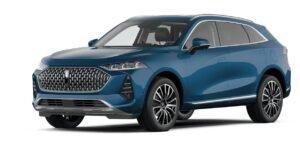
The Roewe D6 and BYD Dolphin sit in the affordable compact EV segment, built by Chinese brands SAIC Motor and BYD. The D6 is a compact electric sedan aimed at buyers who want a traditional car shape with longer range for daily commuting and ride-hailing use. The Dolphin targets urban drivers who need a small, easy-to-drive hatchback for city traffic and short trips. This comparison matters now as more Chinese EVs enter African markets, with rising interest in budget-friendly electric options.

The Roewe D6 offers a claimed range of about 450–520 km (CLTC), while the BYD Dolphin delivers 340–427 km (WLTP depending on variant). In real use, expect around 350–420 km for the D6 and 280–350 km for the Dolphin. The D6 supports AC charging up to 7 kW and DC fast charging around 80–100 kW. The Dolphin supports 7–11 kW AC and up to 88 kW DC. Charging from 10–80% takes about 35–40 minutes in the D6 and 30–40 minutes in the Dolphin. For daily use, both handle overnight home charging well, but the Dolphin charges slightly faster on compatible AC setups.
The Roewe D6 starts around $16,000–$20,000 (about ₦20–₦28 million depending on import costs), while the BYD Dolphin starts near $20,000–$25,000 (about ₦25–₦35 million). The D6 focuses on value trims with fewer variants, while the Dolphin offers multiple versions like Active, Boost, and Premium with different battery sizes. The Dolphin is already present in markets like South Africa and Kenya, while the D6 remains limited to China and select export regions. This page helps you decide: pick the D6 if you want lower cost and longer range, or the Dolphin if you want better availability and stronger resale support.
Within SAIC Motor, buyers can also consider models like the Roewe Ei5 estate for more space. Within BYD, alternatives include the larger Atto 3 SUV and the Seagull for lower budgets. Rivals outside both brands include the MG4 Electric and GWM Ora Good Cat. This comparison stands out since it balances price, range, and real-world usability in one view, which many rivals fail to combine.
The Roewe D6 offers strong range for its price, which matters if you drive long distances or deal with limited charging stations. It has a sedan design, which suits buyers who prefer stability on highways and a traditional boot layout. It also comes at a lower entry price, which helps reduce upfront cost. On the downside, the D6 lacks strong global availability, which affects parts access and resale value. It also has limited brand recognition outside China, which can impact long-term support.
The BYD Dolphin delivers better global support and availability, which matters if you plan to own the car long term in Africa. It has a compact hatchback design, which makes it easier to park and drive in tight city spaces. It also offers more refined software and interior quality in higher trims. On the downside, the Dolphin costs more at entry level, which increases initial spend. Its range is lower than the D6, which affects longer trips.
QUICK VERDICT
Choose the Roewe D6 if you prioritize range and lower upfront cost. Choose the BYD Dolphin if availability, support, and city driving ease matter more. The trade-off sits between distance per charge and ownership convenience. Both fit urban and semi-urban use, but the Dolphin suits buyers who want fewer risks with servicing and parts.
Related EV Comparisons
| Models |
D6 450 (Standard), D6 520 (Long Range)
BYD Dolphin Active BYD Dolphin Boost BYD Dolphin Comfort/Design |
| Announced | April 2025 (Auto Shanghai) 2023, April 11 |
| Status | On Sale Available. Released 2023, June |
| Country of origin | China |
| Base Price | $10,900 (RMB 79,800) — China only € 33,000 |
| Power |
127 hp (95 kW) - D6 450 143 hp (105 kW) - D6 520 FWD 204 hp (150 kW) |
| Torque | 201 Nm (confirmed) - D6 520 290 Nm (214 lb-ft) |
| Acceleration The acceleration numbers are an easy way to compare car performance. We list either time from 0 to 100 km/h or time from 0 to 60mph, depending on which number(s) the manufacturers provide. The lower the acceleration time, the higher performance the car is. | 7 sec 0-62 mph |
| Max Speed | 150 km/h 99 mph (160 km/h) |
| transmission | Single-speed fixed ratio |
| Capacity |
42.8 kWh - D6 450 53.9 kWh - D6 520 60 kWh total |
| Tech | LFP (Lithium Iron Phosphate) CTB (Cell-to-Body) Liquid-cooled Li-ion LFP battery |
| Range |
450 km / 280 mi (CLTC) - D6 450 520 km / 323 mi (CLTC) - D6 520 265 mi WLTP |
| Consumption | 9.125 kWh/100km - D6 450 |
| Recuperation | Yes, 4 modes |
| Heat Pump | |
| AC Charging | Type 2 11 kW |
| DC Charging |
20 min (30–80%)
CCS 88 kW, 30-80% in 29 min Vehicle to load (V2L) - 3.3 kW max |
| Type | 4-door compact sedan, 5 seats 5 door hatchback, 5 seats |
| Platform | SAIC Nebula 2nd-gen pure electric architecture e-platform 3.0 |
| Dimensions |
Length: 4,792 mm Width: 1,828 mm Height: 1,496 mm 4290 x 1770 x 1570 mm (168.9 x 69.7 x 61.8 in) |
| Drag Co-Efficient | 0.27 Cd |
| Wheelbase | 2,750 mm 2700 mm (106.3 in) |
| Wheels | Alloy R16, R17 |
| Trunk/Boot | EU: 345 l, 1310 l max |
| Frunk/Bonnet | No |
| Towing | No |
| Centre | 12.8-inch floating touchscreen 12.8" rotating touchscreen |
| Driver's Display | Full LCD instrument panel 5" |
| Head-Up | No |
| Seats | Mosaic micro-perforated matrix seats Heated front seats |
| Roof | Glass roof, tilt & slide |
| Parking Aids | Front and rear sensors, 360 camera, reversing camera |
| Connectivity | Bluetooth key, remote app control (pre-conditioning, charging), USB/Type-C ports, keyless entry, push-button start |
| Others | Single-zone automatic, heat pump standard |
| Airbags | 6 airbags: front, side, rear, including head airbag system |
| Driving Aids | L2 ADAS — adaptive cruise control, lane keep assist, auto lane change, highway assist Front radar, multiple cameras. Blind Spot Warning, High Beam Assist, Lane departure Warning, Lane Keep Assist, Front/Rear Cross Traffic Alert, Front/Rear Cross Traffic Brake, Traffic Sign Recognition, Automatic Emergency Braking System |
| Self Driving | L2 (not L3) |
| disclaimer | We can not guarantee that the information on this page is 100% correct. |
|
We can not guarantee that the information on this page is 100% correct