

- Electric Vehicles
- Compare Electric Cars
- Avatr 12 Four-LiDAR Edition vs NIO ET5T Tron Edition
Avatr 12 Four-LiDAR Edition vs NIO ET5T Tron Edition
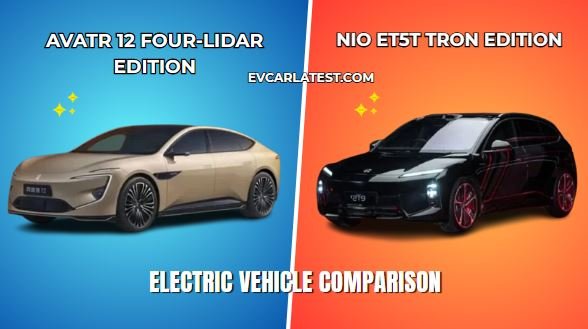
The Avatr 12 Four-LiDAR Edition is a large Chinese electric fastback from Avatr — the Changan, CATL, and Huawei joint venture — positioned squarely at buyers who want flagship-level intelligent driving in a premium, coupe-influenced body. The NIO ET5T Tron Edition is a mid-size electric touring estate aimed at buyers who want a practical family-oriented EV wrapped in distinctive styling, backed by NIO’s battery-swap ecosystem. Both sit at the premium end of the Chinese EV market and are increasingly visible as grey-market import options in Nigeria, Kenya, and South Africa — making the comparison timely for African buyers evaluating top-tier Chinese alternatives to European brands.
Range & Charging
The Avatr 12 Four-LiDAR Edition is rated at approximately 680 km CLTC (roughly 490–520 km estimated real-world). It supports 800V fast charging with peak DC speeds around 200 kW, enabling a 10–80% charge in approximately 25–30 minutes. AC onboard charging runs at 11 kW. The NIO ET5T Tron Edition pairs with NIO’s 100 kWh battery for a CLTC rating of around 710 km (estimated real-world 510–540 km). NIO’s DC peak sits at 130 kW — slower than the Avatr on a cable — but the battery swap station network changes the equation entirely, with a full swap completing in under five minutes where infrastructure exists. AC charging is 11 kW. Note: WLTP figures for both models are not officially confirmed; CLTC figures quoted here should be treated as manufacturer-claimed ceiling numbers.
Price, Availability & Market Fit
The Avatr 12 Four-LiDAR Edition starts at approximately CNY 369,900 in China (≈ USD 51,000), with grey-market import estimates into Nigeria landing around ₦85–95 million depending on specification and agent. The NIO ET5T Tron Edition is priced from approximately CNY 298,000 (≈ USD 41,000), with Nigerian grey-market estimates around ₦68–78 million. Neither brand has official dealerships in Nigeria, Kenya, or South Africa as of mid-2026, so purchases in these markets go through independent importers — with the usual caveats around warranty, parts, and after-sales support. This page helps you decide: do you need Huawei’s four-LiDAR ADAS and a more overtly flagship presence, or does the ET5T Tron’s lower price, estate practicality, and battery-swap option better match your daily use?
Ecosystem & Rival Context
Within Avatr’s lineup, the smaller Avatr 11 SUV and the Avatr 07 offer this buyer a step down in price without a major drop in technology. On NIO’s side, the ET7 sedan and the ES6 SUV are relevant alternatives — the ET7 in particular competes directly with the Avatr 12 at a similar price point. Outside both brands, the Zeekr 001 and the Xpeng G9 are worth considering for buyers at this segment and budget, offering strong performance specs and comparable intelligent driving features. The Avatr 12 vs ET5T Tron comparison still makes more sense than pivoting to Zeekr or Xpeng if Huawei-grade ADAS or NIO’s swap infrastructure is a primary requirement — neither Zeekr nor Xpeng can match either of those specific advantages.
Pros & Cons
Avatr 12 Four-LiDAR Edition
The four-LiDAR Huawei ADS 2.0 setup is one of the most capable intelligent driving systems currently available in a production EV, which matters to buyers who want highway and urban autonomy without aftermarket upgrades. The 800V fast-charging architecture keeps long-distance charging stops short enough to be genuinely practical. The large fastback cabin gives rear passengers genuinely usable headroom — something coupe-styled EVs in this class often sacrifice.
On the downside, the Avatr 12’s higher entry price relative to the ET5T Tron adds meaningful cost for buyers who don’t need the full ADAS package. Parts availability outside China is also limited, and sourcing Huawei-specific sensor components through grey-market channels in Africa remains difficult.
NIO ET5T Tron Edition
The battery-swap capability is a real differentiator — buyers in cities where NIO swap stations exist can avoid charging entirely, which solves range anxiety in a way no competitor currently matches. The touring estate body makes the ET5T Tron more practical for families or buyers carrying bulky cargo regularly, without the compromise in boot space that most sedans carry. The lower starting price leaves meaningful budget for local insurance, import duties, and servicing costs.
The ET5T Tron’s DC charging peak of 130 kW is noticeably slower than the Avatr 12 when swap stations are not available, which is a real limitation for buyers in regions where NIO’s infrastructure doesn’t yet reach — including most of sub-Saharan Africa. The Tron Edition’s distinctive styling is bold, but less conservative than the Avatr 12’s execution, which may not suit every buyer’s taste.
Quick Verdict
Choose the Avatr 12 Four-LiDAR Edition if your priority is the most capable intelligent driving system available in a Chinese EV at this segment, and you’re willing to pay for it. Choose the NIO ET5T Tron Edition if estate practicality, a lower purchase price, and the possibility of battery-swap access matter more than ADAS specification. For African buyers importing through grey-market channels, where swap infrastructure doesn’t yet exist, the ET5T Tron’s charging speed disadvantage becomes more pronounced — and the Avatr 12’s self-contained 800V system becomes a more practical daily choice.
Related EV Comparisons
- NIO ES6 vs Tesla Model Y
- Xpeng GX vs Nio ES9
- Hongqi Tiangong 05 (EH5) vs NIO ET5
- Hongqi Tiangong 06 vs NIO ES6
- NIO ET5 vs Tesla Model 3


| |
| Price | $41,000.00 |
| Our Rating | |
| Brand | Avatr NIO |
| Category | Electric Cars Electric Cars |
MODEL
| Available Trims / Variants |
Avatr 12 Four-LiDAR Edition RWD Avatr 12 Four-LiDAR Edition AWD ET5T Tron Edition |
LAUNCH
| Reveal Date | October 2025 2025 |
| Availability Status | Pre-order / Upcoming (China) In production |
| Country of origin | China China |
| Base Price (USD) | $41,870 |
BATTERY
| Battery Capacity | 75 kWh / 100 kWh |
| Battery Chemistry | CATL Lithium-ion, 800 V SiC architecture Lithium-ion (LFP + NMC) |
| Range (WLTP/CLTC/EPA) |
755 km (470 mi) (CLTC) - RWD 705 km (438 mi) (CLTC) - AWD Up to 440 mi (710 km, CLTC) |
| Energy Consumption | 14.8 kWh/100 km |
| Regen Braking (Max kW) | Yes |
| Heat Pump | |
| AC Charging (Max kW) | 7 h (0–100%) 11 kW ≈ 9 h full |
| DC Charging (Max kW) | 0–80% ≈ 15 min 180 kW ≈ 10–80% in ≈ 30 min |
| Additional Notes | Battery Swap System compatible |
PERFORMANCE
| Power Output (kW / hp) |
RWD: 237 kW (318 hp) AWD: 402 kW (539 hp) Dual-motor AWD (360 kW / 490 hp) |
| Torque (Nm) | 700 Nm |
| 0–100 km/h / 0-60 mph (seconds) The acceleration numbers are an easy way to compare car performance. We list either time from 0 to 100 km/h or time from 0 to 60mph, depending on which number(s) the manufacturers provide. The lower the acceleration time, the higher performance the car is. | 3.8 s 4.0 s |
| Top Speed (km/h / mph) | 220 km/h 200 km/h |
BODY
| Body Style | 4-door Gran Coupe / Lift-back, 5 seats 5-door electric touring wagon (5 seats) |
| Platform / Architecture | CHN platform NIO NT2.0 / NT2.5 |
| Dimensions (L×W×H mm) | 5020 × 1999 × 1460 mm 4,790 × 1,960 × 1,499 mm |
| Drag Coefficient (Cd) | 0.25 Cd |
| Wheelbase (mm) | 3020 mm 2,888 mm |
| Kerb Weight (kg) | 2250 kg 2,225 kg |
| Suspension (Front / Rear) | Front double-wishbone, rear multi-link, optional air suspension 5-link independent (front & rear) |
| Wheel Size (inches) | 20″ / 21″ alloys 19″ standard / 20″ optional |
| Trunk/Boot Capacity (L) | Rear liftback 450 L → 1,300 L max |
| Frunk/Bonnet Capacity (L) | ~65 L Minimal |
| Towing Capacity (kg) | 1,400 kg (braked) |
| Additional Notes | Active spoiler, electronic side mirrors Steel-aluminum hybrid body |
SAFETY
| Airbags (count) | Full-coverage (front, side, curtain) Standard (full cabin coverage) |
| Driver Assistance (ADAS) | 4 LiDAR + cameras + radar (Huawei ADS 4) ADAS suite + L2 assist |
| Autonomous Driving Level | Advanced assist (high-level autonomy, driver-supervised) Level 2 capable |
| Crash Test Ratings | Designed for 5-star Euro NCAP and C-NCAP |
COMFORT
| Seating Capacity | 5 – heated, ventilated, massage (front) 5; front heated/ventilated/massage (Top trim) |
| Roof Type | Panoramic glass roof Panoramic glass |
| Bluetooth / Wi-Fi | 5G / Wi-Fi / voice / gesture control OTA updates, NOMI voice AI, BaaS |
| Parking Aids | 360° camera / auto valet park 360° cameras, auto park assist |
| Additional Notes |
Audio: Meridian 25-speaker system Extras: Facial recognition, ambient lighting Multiple drive modes (Sport+, Eco, Snow, etc.) |
DISPLAYS
| Centre Screen (inches) | 15.6-inch touchscreen 15.6″ AMOLED infotainment |
| Driver's Display (inches) | 35.4-inch 4K panoramic screen 10.25″ digital cluster |
| Head-Up Display (HUD) | AR-HUD (50″ projection) |
| Additional Notes | Huawei HarmonyOS 5 cockpit NOMI AI assistant |
LIGHTING
INFOTAINMENT & AUDIO
TECHNOLOGY
OWNERSHIP
Note
| Additional Notes |
New features include Master Drift Mode, In-Place Turn, and Wellness Cabin. OTA updates support continuous software upgrades. Edition: Limited Tron Edition (555 units worldwide) Unique Feature: Tron-inspired interior lighting and styling Battery Swap: Standard on Chinese models |


|
Disclaimer Note
Specifications sourced from manufacturer data and may reflect WLTP, CLTC, or EPA test conditions. Import prices in your local are estimates based on grey-market landing costs and exclude duties, clearing fees, and local taxes. Figures are subject to change without notice. Always verify with your local importer before purchase. We can not guarantee that the information on this page is 100% correct