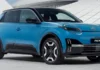
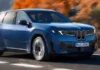
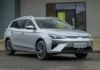
The Hongqi Tiangong 05 and the NIO ET5 are both mid-size electric sedans from China — the Tiangong 05 built by state-owned FAW’s Hongqi brand as a more affordable flagship alternative, and the ET5 developed by NIO as a tech-forward executive sedan competing directly with Tesla’s Model 3. The comparison matters now because both models are increasingly visible in grey-market import circles across Nigeria, Kenya, and South Africa, where buyers want premium EV styling without European price tags.

The Tiangong 05 offers CLTC-rated range of 550 km (62 kWh LFP battery) or 750 km (85 kWh LFP battery) — note that CLTC figures are typically 15–20% higher than real-world equivalents, so expect roughly 440–600 km in mixed driving. Both variants fast-charge from 10–80% in 20 minutes, which is a strong result for a 400V platform. The NIO ET5 is rated at 445 km WLTP (75 kWh) or 580 km WLTP (100 kWh) — these are stricter figures than CLTC, making real-world results more reliable. DC fast charging peaks at 140–180 kW depending on variant, with a 10–80% charge taking around 29–30 minutes. AC charging on the ET5 tops out at 11 kW. The Tiangong 05 edges ahead on charge speed; the ET5 wins on range transparency.
The Tiangong 05 launches at RMB 159,800 (~$22,020 USD), rising to RMB 185,800 across four variants. That’s roughly NGN 33.5M–NGN 28.2M at current grey-market import estimates — before shipping and duties. The NIO ET5 started at around $38,000–$46,000 USD in its home market, making it significantly pricier. Neither car is officially sold in Africa, so both require grey-market import. If your goal is premium Chinese EV styling at the lowest entry point, the Tiangong 05 is the more accessible option; if brand ecosystem and long-term software support matter, the ET5 justifies its premium.
Hongqi’s growing electric lineup includes the Tiangong 08 SUV (from RMB 239,800) and the larger EH7 sedan for buyers who want to stay in the family. NIO surrounds the ET5 with the ES6 SUV and the ET7 executive sedan — all supported by NIO’s battery-swap network, which does not yet exist in Africa. Outside both brands, the BYD Han EV and the Zeekr 007 compete at similar price points and are increasingly available through official or grey-market channels in South Africa and Kenya, with better parts availability than either car here.
Hongqi Tiangong 05: Its 20-minute 10–80% fast charge means shorter stops on intercity runs where DC infrastructure is scarce. The LFP battery chemistry handles heat and irregular charging better, which matters in Nigerian and Kenyan climates. The lower starting price gives it a clear entry advantage for budget-conscious grey-market importers. However, Hongqi has no aftersales presence in Africa, so sourcing parts will require China-based contacts. The CLTC-only range rating also makes real-world performance harder to verify before you buy.
NIO ET5: WLTP-rated range gives you a more honest performance expectation from day one. The ET5’s dual-motor AWD configuration offers better wet-road traction, which matters during rainy seasons in Lagos or Nairobi. Its Euro NCAP five-star rating adds verified safety credibility. On the other hand, NIO’s battery-swap feature — one of its key selling points — is completely unavailable in Africa, removing a major benefit. The higher import cost also narrows its audience significantly compared to the Tiangong 05.
Quick Verdict
Choose the Hongqi Tiangong 05 if fast charging, lower cost of entry, and LFP battery durability are your priorities — it’s the more practical import for African conditions. Choose the NIO ET5 if you want a WLTP-verified range, a proven safety record, and a more internationally recognised brand profile. The ET5 costs more and delivers less of its ecosystem here in Africa, but it’s a more established product globally. Both are grey-market imports with limited local support, so budget for that reality before committing to either.
On paper, the Tiangong 05’s 750 km CLTC variant claims more range, but CLTC figures are optimistic. The NIO ET5’s WLTP rating is stricter and more reliable for real-world planning. For long Nigerian or Kenyan routes with limited DC infrastructure, the Tiangong 05’s faster 20-minute charge cycle gives it a practical edge over the ET5’s 29–30 minutes.
Both use LFP battery chemistry in their base variants, which generally degrades more slowly in hot climates. Maintenance costs are comparable for the drivetrain, but neither brand has authorised service centres in Africa — so labour and parts costs will depend on your local EV mechanic and grey-market supply chains from China.
The NIO ET5 is not officially sold anywhere in Africa as of 2025. It can be sourced through grey-market import agents, primarily via China or Europe. Expect total landed costs of NGN 60M or above after shipping, port charges, and duties in Nigeria. The Hongqi Tiangong 05 faces the same import-only reality but at a lower base price.
Related EV Comparisons
| Models | Tiangong 05 800V (2026 update) NIO ET5 |
| Announced | April 2026 December 2021 |
| Status | On sale — China market In production |
| Country of origin | China China |
| Base Price | ~$23,900 (¥171,800) $46,000 |
| Power | 282 hp (210 kW), single rear motor, RWD 483 hp, dual motor AWD |
| Torque | 317 Nm 700 Nm |
| Acceleration The acceleration numbers are an easy way to compare car performance. We list either time from 0 to 100 km/h or time from 0 to 60mph, depending on which number(s) the manufacturers provide. The lower the acceleration time, the higher performance the car is. | 6.8 seconds 0 to 100 km/h in 4.0 seconds |
| Max Speed | 200 km/h 200 km/h |
| transmission | Single-speed direct drive |
| Capacity | 75 kWh or 100 kWh |
| Tech | LFP (Lithium Iron Phosphate), supplied by CATL Lithium ion. Semi solid state for swap battery |
| Range |
Up to 650 km CLTC (~404 mi estimated WLTP equivalent)
75 kWh: about 350 miles WLTP 100 kWh: about 435 miles WLTP |
| Consumption | 16 to 17 kWh per 100 km |
| Recuperation | Adjustable regenerative braking |
| Heat Pump | |
| AC Charging | Up to 11 kW. Full charge in about 8 to 10 hours |
| DC Charging | 800V architecture; 10%–80% in 12 minutes Up to 140 kW. 10 to 80 percent in about 30 minutes |
| Others | V2L (Discharge) - 6 kW external discharge supported Battery swap support |
| Type | 4-door fastback sedan, 5 seats 4 door sedan, 5 seats |
| Platform | Hongqi Tiangong HME pure electric platform NIO NT 2.0 |
| Dimensions |
4,820 / 1,915 / 1,480 mm
Length: 4,790 mm Width: 1,960 mm Height: 1,499 mm |
| Drag Co-Efficient | 0.213 Cd 0.24 |
| Wheelbase | 2,900 mm 2,888 mm |
| Clearance | 150 mm |
| Weight | 1,890 – 2,018 kg (curb, variant-dependent) 2,200 kg |
| Suspension | Front: double-wishbone; Rear: multi-link independen Multi link front and rear |
| Wheels | 18-inch standard 19 or 20 inch |
| Trunk/Boot | 386 liters |
| Towing | Up to 1,400 kg |
| Others | Colours - 7 exterior colour options including new Yunmeng Silver Near 50 50 weight distribution |
| Centre | 15.6-inch touchscreen 15.6 inch AMOLED |
| Driver's Display | 10.2 inch digital cluster |
| Head-Up | Optional 60-inch augmented reality HUD 18.8 inch AR HUD |
| Others | 50W wireless charging pad NOMI AI assistant |
| Seats | 5 seats; optional front seats with 14-position adjustment, heating, ventilation, massage Heated, ventilated, massage optional |
| Roof | Panoramic skylight Panoramic glass roof |
| Parking Aids | Full-scene intelligent parking (part of Sinan system) Cameras, sensors, auto park |
| Connectivity | AI-based voice interaction; OTA updates 5G, wireless Android Auto and Apple CarPlay dependent on market |
| Others |
8 speakers standard; 12-speaker Dynaudio optional 4-zone voice recognition with DeepSeek AI Ambient lighting, premium audio |
| Airbags | 7 airbags |
| Driving Aids | L2.9 system; 23 sensors; Qualcomm Snapdragon Ride SA8650P processor Adaptive cruise, lane assist, blind spot monitoring |
| Self Driving | Urban NOA and highway NOA (Navigation on Autopilot); driver monitoring required NIO Pilot with advanced assist features |
| Crash Tests | 5 star rating in major markets |
| Others |
All range figures are CLTC-rated (China standard). Real-world range will be lower, particularly at highway speeds. The 2026 update specifically introduces the 800V architecture. The 2025 400V variants (62 kWh / 85 kWh) remain in the lineup from ¥159,800. Battery capacity for the 800V variant has not been officially confirmed at time of publication. The car is currently sold in China only. No confirmed international rollout. Battery subscription and swap stations reduce upfront cost in supported regions |
|
We can not guarantee that the information on this page is 100% correct