

- Electric Vehicles
- Compare Electric Cars
- Hongqi Tiangong 06 vs NIO ES6
Hongqi Tiangong 06 vs NIO ES6
The Hongqi Tiangong 06 and NIO ES6 sit in the mid-size electric SUV segment, both from Chinese premium brands. Hongqi targets buyers who want a luxury feel with strong road presence, while NIO focuses on tech-driven users who value software, performance, and battery flexibility. This comparison matters now as more Chinese EVs enter global markets, including Africa through gray imports and private dealers.
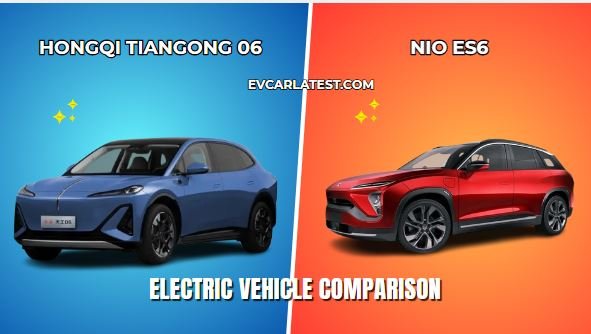 The Hongqi Tiangong 06 delivers an estimated 520–600 km (CLTC), which translates to about 420–480 km in real driving. The NIO ES6 offers up to 625 km (CLTC), with real-world range closer to 450–520 km depending on battery size. AC charging on both sits around 11 kW for home setups. DC fast charging differs: the ES6 supports up to 180 kW, while the Tiangong 06 stays lower around 120–150 kW. In daily use, the ES6 charges from 10 to 80 percent in about 30 minutes, while the Hongqi takes closer to 40–45 minutes. NIO also supports battery swapping in supported regions, which cuts downtime.
Pricing varies by region, but the Tiangong 06 starts around $35,000 to $40,000, which converts to roughly ₦45M to ₦60M when imported into Nigeria. The NIO ES6 starts higher at about $48,000 to $55,000, or around ₦70M to ₦90M landed. Hongqi offers fewer trims with focus on comfort packages, while NIO provides multiple battery options and performance variants. Both models are mainly sold in China, though the ES6 has presence in Europe. In Nigeria, both come through importers. This comparison helps you decide between lower upfront cost and premium tech with higher pricing.
Hongqi’s lineup includes models like the Hongqi E-HS9, which targets larger luxury SUV buyers. NIO offers alternatives such as the NIO EC6 and NIO ES8 for buyers needing more space or sportier styling. Outside both brands, rivals include the Tesla Model Y and BYD Tang EV. This comparison stands out because it focuses on two Chinese premium SUVs where design, comfort, and ecosystem differ more than raw specs.
The Hongqi Tiangong 06 offers a strong interior design with high-end materials, which matters if you value comfort and rear-seat experience during long city drives. It also costs less upfront, making it easier to enter the premium EV segment. Its ride comfort suits rougher roads, which helps in markets like Nigeria. On the downside, its charging speed is slower, which increases downtime on long trips. Its software ecosystem also lacks the depth seen in competitors.
The NIO ES6 delivers stronger performance and faster acceleration, which suits drivers who want responsive handling. Its fast charging and battery swap support reduce waiting time, which matters for frequent travelers. The infotainment and driver assistance systems feel more advanced and receive updates often. On the downside, it costs significantly more, which raises the barrier for entry. Access to NIO services like battery swap is limited outside core markets, which reduces its advantage in Africa.
Choose the Hongqi Tiangong 06 if you prioritize lower cost, comfort, and a luxury-focused cabin. Choose the NIO ES6 if faster charging, stronger performance, and advanced tech matter more to you. Both deliver similar real-world range, so your decision depends more on ecosystem and price gap. The ES6 fits tech-focused buyers, while the Hongqi suits comfort-focused buyers.
Related EV Comparisons
- Hongqi E-HS9 vs Volvo EX90
- NIO ET5 vs Tesla Model 3
- NIO ET5 vs XPeng P7
- Nio EL8 vs Porsche Macan
- Nio EL8 vs Hongqi E-HS9

| |
| Price | $26,000.00 $55,995.00 |
| Our Rating | |
| Brand | Hongqi NIO |
| Category | Electric Cars Electric Cars |
MODEL
| Available Trims / Variants | 400V (RWD & AWD) and 800V (RWD & AWD); 2026 update applies to 800V series ES6 (Performance) |
LAUNCH
| Reveal Date |
Pre-sale opened March 2025 800V trims launched April 2026 December 15, 2018 |
| Availability Status | On sale — China market only In production / available |
| Country of origin | China China |
| Base Price (USD) | ~$26,700 (191,800 yuan) — 800V entry trim RMB 398,000 (pre-subsidy) for Performance version |
BATTERY
| Battery Capacity |
62 kWh or 85 kWh (400V trims) 98 kWh (800V trims) Variants include 84 kWh (original) and 100 kWh (long-range) |
| Battery Chemistry |
LFP — 400V trims Ternary lithium (NMC) — 800V trims Lithium-ion (NCM) |
| Range (WLTP/CLTC/EPA) |
520–610 km depending on trim (800V: up to 610 km CLTC) 370–380 mi / ~595–610 km — WLTP 84 kWh: ~510 km (NEDC) 100 kWh: up to ~610 km (NEDC) |
| Energy Consumption | 16.1 kWh/100 km (CLTC) |
| Heat Pump | |
| AC Charging (Max kW) | 7 kW AC charging for 100 kWh version |
| DC Charging (Max kW) | 800V: 10%–80% in 12 minutes 0–80% in ~60 minutes (for 100 kWh) |
| Additional Notes | V2L (vehicle-to-load) external discharge at 6 kW Supports NIO battery swap (common for NIO vehicles) — helps with “charging” via swapping. |
PERFORMANCE
| Power Output (kW / hp) |
400V RWD: 282 hp (210 kW) 400V AWD: 553 hp (412 kW) 800V RWD: 402 hp (300 kW) 800V AWD: ~643 hp (480 kW) 544 hp (544 PS), 400 kW total (dual-motor AWD) — 160 kW permanent magnet motor (front) + 240 kW induction motor (rear) |
| Torque (Nm) |
400V RWD: 317 Nm 400V AWD: 623 Nm 800V RWD: 450 Nm 800V AWD: 770 Nm 725 Nm |
| 0–100 km/h / 0-60 mph (seconds) The acceleration numbers are an easy way to compare car performance. We list either time from 0 to 100 km/h or time from 0 to 60mph, depending on which number(s) the manufacturers provide. The lower the acceleration time, the higher performance the car is. | 5 sec (AWD) 4.7 seconds |
| Top Speed (km/h / mph) | 230 km/h / 143 mph 200 km/h |
| Transmission / Drive | Single-speed direct drive |
BODY
| Body Style | 5-door midsize SUV, 5 seats 5-seat SUV (5-door) |
| Platform / Architecture | Hongqi Tiangong Architecture (400V or 800V variant) Uses NIO’s hybrid body construction (aluminum + carbon fiber) for strength and lightness. |
| Dimensions (L×W×H mm) |
4,750 mm (L) × 1,900 mm (W) × 1,640 mm (H)
Length: ~4,850 mm Width: ~1,965 mm Height: ~1,731 mm (for 100 kWh version) |
| Drag Coefficient (Cd) | 0.259 Cd 0.25 Cd (newer versions) |
| Wheelbase (mm) | 2,900 mm 2,900 mm |
| Kerb Weight (kg) | For 2025 100 kWh model, curb weight ~2,336 kg |
| Suspension (Front / Rear) | Five-link front and rear, with Continuous Damping Control (CDC) and optional active air suspension. |
| Wheel Size (inches) | 19-inch or 20-inch alloy; 235/55 R19 or 235/50 R20 255/55 R19 |
| Trunk/Boot Capacity (L) | 472 L standard / 1,611 L seats folded 584 L |
| Additional Notes | Hidden door handles; double-layer acoustic laminated glass (front) Very stiff body (torsional stiffness ~44,930 Nm/degree) thanks to aluminum-carbon construction |
SAFETY
| Driver Assistance (ADAS) | Hongqi Sinan system (camera-only); highway NOA; urban NOA; L2.9 ADAS rating NIO Pilot (ADAS) hardware (with sensors) |
| Autonomous Driving Level | L2.9 (advanced driver assistance, not autonomous) Level-2 capabilities (driver must remain engaged) — NIO Pilot system |
| Crash Test Ratings | Five-star safety rating (C-NCAP & Euro NCAP) claimed by NIO |
COMFORT
| Seating Capacity | Zero-gravity passenger seat; heated, ventilated, and massage seats (higher trims) 5 seats; rear seats fold in a 40/20/40 layout for cargo flexibility |
| Roof Type | Standard hard roof |
| Bluetooth / Wi-Fi | Bluetooth, Wi-Fi (assumed); Lingxi cockpit with AI voice NIO digital cockpit, voice assistant “NOMI”, over-the-air updates (FOTA) |
| Parking Aids | Auto parking; multi-level memory parking; trace reverse parking Likely includes parking sensors, but exact spec not broadly published in early press; NIO Pilot (driver assistance) is present |
| Additional Notes |
14-speaker Dynaudio system (higher trims) Warm ambient lighting; large bed/flat mode; 5 interior colour options Intelligent Chassis Controller (ICC) works with CDC for ride comfort. |
DISPLAYS
| Centre Screen (inches) | 15.6-inch 2.5K floating touchscreen Large central touchscreen (multitouch) — NIO uses its own digital cockpit |
| Driver's Display (inches) | Digital instrument cluster (fully digital) |
| Head-Up Display (HUD) | AR-HUD (standard) |
| Additional Notes | Lingxi smart cockpit OS with AI voice assistant; multi-zone voice recognition NIO’s NOMI AI assistant is integrated in the cockpit (voice-based interaction) |
LIGHTING
INFOTAINMENT & AUDIO
TECHNOLOGY
OWNERSHIP
Note
| Additional Notes |
Solid-state battery prototype has been installed in a Tiangong 06 test vehicle; production version targeting 2027, not confirmed for this model. CLTC figures are China-specific and typically read 15–20% higher than real-world range. The 800V/900V trims are the same architecture referenced under different names across sources — the 2026 launch specifically used the 800V designation. No confirmed export markets as of April 2026. The ES6 Performance version uses both a permanent magnet motor and induction motor — this gives a good mix of efficiency and performance. Strong body stiffness due to hybrid structure (aluminum + carbon fiber) The Performance trim is more “sporty” with faster acceleration vs base/standard versions. NIO offers a “battery as a service” (BaaS) model (optional), though exact cost depends on region (mostly China). |

|
Disclaimer Note
Specifications sourced from manufacturer data and may reflect WLTP, CLTC, or EPA test conditions. Import prices in your local are estimates based on grey-market landing costs and exclude duties, clearing fees, and local taxes. Figures are subject to change without notice. Always verify with your local importer before purchase. We can not guarantee that the information on this page is 100% correct