- Home
- Electric Vehicles
- Compare Electric Cars
- Hyundai Kona Electric vs Chevrolet Bolt EUV
Hyundai Kona Electric vs Chevrolet Bolt EUV
The Hyundai Kona Electric and the Chevrolet Bolt EUV are both compact electric crossovers positioned at the more affordable end of the EV market. The Kona Electric is built by Hyundai and is the electric version of its Kona compact SUV, now on a second generation platform introduced for 2024. The Bolt EUV is built by Chevrolet under General Motors and is the crossover-styled variant of the Bolt EV hatchback, offering slightly more interior space and a taller roofline. Both vehicles target cost-conscious buyers entering the EV segment for the first time, urban commuters, and small families who want a practical electric vehicle without the higher price tags that come with larger or more premium options.
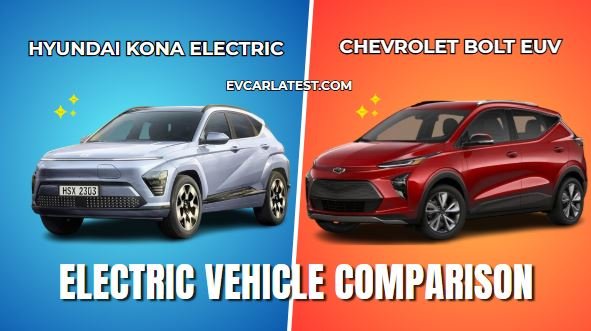
The Hyundai Kona Electric is EPA-rated at up to 261 miles of range on the long range version for the US market. The Chevrolet Bolt EUV is rated at 247 miles of range. The range gap is modest and unlikely to be decisive for most buyers. On charging, the difference is more significant. The Kona Electric supports up to 100 kW DC fast charging, allowing a reasonably quick top-up at public fast chargers. The Bolt EUV is limited to 55 kW DC fast charging, which is one of the slower rates in the current EV market and means noticeably longer stops at public charging infrastructure. For buyers who rely on public fast charging regularly, the Bolt EUV’s charging ceiling is a practical limitation worth factoring into the decision.
The Chevrolet Bolt EUV carried a starting price of around $27,800 in its final 2023 model year before GM discontinued it, making it one of the most affordable electric crossovers sold in the US at the time. The Hyundai Kona Electric starts at approximately $33,550 in the US for the 2024 model year, sitting meaningfully higher at the entry point. GM brought back the Bolt EV hatchback for 2025 but did not relaunch the Bolt EUV, which means new Bolt EUV units are limited to remaining 2023 dealer stock in North America. The Kona Electric is in active production and available across North America, Europe, Australia, and other markets through Hyundai’s dealership network. This page helps buyers decide between an affordable but discontinued crossover with limited availability and a newer, more expensive model with full market access and faster charging hardware.
Hyundai’s other electric vehicles include the Ioniq 5, Ioniq 6, and the Ioniq 9 SUV, alongside the Ioniq sub-brand’s expanding lineup. The Kona Electric sits as the most affordable entry point in Hyundai’s EV range. Chevrolet’s current active electric lineup includes the Equinox EV and the Blazer EV, with the Bolt EV hatchback returning for 2025 as the brand’s most affordable option. Outside these two brands, the main rivals in this segment are the Nissan Leaf, which competes on price and availability in multiple markets, and the Volkswagen ID.3, which targets a similar compact buyer in European markets.
The Hyundai Kona Electric’s three main strengths are its 100 kW DC fast charging rate which is nearly double the Bolt EUV’s ceiling, its active production status with full global availability across dealerships, and its updated 2024 platform which brings a larger interior and a more modern feature set. Its two weaknesses are its higher starting price compared to the Bolt EUV and its smaller cargo volume relative to some other compact crossovers in the same price range. The Chevrolet Bolt EUV’s three main strengths are its low starting price which made it one of the most accessible electric crossovers in the US market, its one-pedal driving system which received consistent positive feedback from owners, and its comfortable rear seat space relative to its exterior footprint. Its two weaknesses are its 55 kW DC fast charging limit which significantly extends charging stops compared to most current competitors, and its discontinued production status which removes it from active inventory in most markets.
Quick Verdict: The Bolt EUV was a strong value option when it was in active production. Its charging limitation was always a real-world drawback, and its discontinuation narrows the buying window to remaining dealer stock. The Kona Electric costs more but is currently produced, widely available, and charges considerably faster. Buyers who find a new Bolt EUV at a significant discount and primarily charge at home overnight may find the deal worth it. Buyers who need a compact EV they can purchase, service, and charge reliably going forward will find the Kona Electric the more straightforward choice.
Related EV Comparisons

| |
| Price | $40,000.00 $32,999.99 |
| Our Rating | |
| Brand | Hyundai Chevrolet |
| Category | Electric Cars Electric Cars |
MODEL
| Available Trims / Variants |
Hyundai Kona Electric 48.4kWh Hyundai Kona Electric 65.4kWh |
PRICE & AVAILABILITY
| Base Price (USD) |
€ 42,640 £ 35,000 - Hyundai Kona Electric 48.4kWh $ 35,000 € 47,840 £ 38,600 - Hyundai Kona Electric 65.4kWh $ 33,500 |
| Availability Status | Available to order. Released 2023, July Available to order. Released 2021, Q3 |
BATTERY & CHARGING
| Battery Capacity |
48.4 kWh total - Hyundai Kona Electric 48.4kWh 65.4 kWh total - Hyundai Kona Electric 65.4kWh 65 kWh usable |
| Range (WLTP/CLTC/EPA) |
234 mi WLTP - Hyundai Kona Electric 48.4kWh 319 mi WLTP (261 mi EPA) - Hyundai Kona Electric 65.4kWh 247 mi EPA |
| DC Charging (Max kW) | CCS, 10-80% in 41 min Up to 55 kW |
| AC Charging (Max kW) |
Type 2 11 kW, 0-100% in 5 hours - Hyundai Kona Electric 48.4kWh Type 2 11 kW, 0-100% in 6.42 hours - Hyundai Kona Electric 65.4kWh Up to 11 kW |
| Energy Consumption |
235 Wh/mi WLTP - Hyundai Kona Electric 48.4kWh 237 Wh/mi WLTP (290 Wh/mi EPA) - Hyundai Kona Electric 65.4kWh 290 Wh/mi EPA |
PERFORMANCE
| Power Output (kW / hp) |
FWD 156 hp (115 kW) - Hyundai Kona Electric 48.4kWh FWD 218 hp (160 kW) - Hyundai Kona Electric 65.4kWh FWD 200 hp (150 kW) |
| 0–100 km/h / 0-60 mph (seconds) The acceleration numbers are an easy way to compare car performance. We list either time from 0 to 100 km/h or time from 0 to 60mph, depending on which number(s) the manufacturers provide. The lower the acceleration time, the higher performance the car is. |
8.8 sec 0-62 mph - Hyundai Kona Electric 48.4kWh 7.9 sec 0-62 mph - Hyundai Kona Electric 65.4kWh 7 sec 0-60 mph |
| Torque (Nm) | 255 Nm (188 lb-ft) 266 lb-ft (360 Nm) |
| Top Speed (km/h / mph) |
101 mph (162 km/h) - Hyundai Kona Electric 48.4kWh 107 mph (172 km/h) - Hyundai Kona Electric 65.4kWh 90 mph (145 km/h) |
BODY & DIMENSIONS
| Dimensions (L×W×H mm) | 4355 x 1825 x 1580 mm (171.5 x 71.9 x 62.2 in) 169.5 x 69.7 x 63.6 in (4306 x 1770 x 1616 mm) |
| Trunk/Boot Capacity (L) | EU: 466 l, 1300 l max US: 16.3 ft³, 56.9 ft³ max |
| Body Style | 5 door crossover, 5 seats 5 door SUV, 5 seats |
| Kerb Weight (kg) |
EU: 1765 kg unladen - Hyundai Kona Electric 48.4kWh EU: 1870 kg unladen - Hyundai Kona Electric 65.4kWh US: 3679 lb curb |
| Ground Clearance (mm) | 151 mm (5.9 in) 6.0 in (152 mm) |
| Frunk/Bonnet Capacity (L) | 27 l No |
SAFETY & DRIVER ASSISTANCE
COMFORT & SEATING
| Seating Capacity | Heated and ventilated front seats, heated outer rear seats Heated and ventilated front seats |
DISPLAYS & CONNECTIVITY
| Centre Screen (inches) | 12.3" touchscreen 10.2" touchscreen |
| Driver's Display (inches) | 12.3" 8" |
| Head-Up Display (HUD) | Retractable combiner type (12" projection) No |
TECHNOLOGY
ADDITIONAL SPECS
Note

|
Disclaimer Note
Specifications sourced from manufacturer data and may reflect WLTP, CLTC, or EPA test conditions. Import prices in your local are estimates based on grey-market landing costs and exclude duties, clearing fees, and local taxes. Figures are subject to change without notice. Always verify with your local importer before purchase. We can not guarantee that the information on this page is 100% correct