Electric motors turn electricity into motion. That’s the whole thing. An EV motor takes power from the battery, creates a magnetic field, and that field spins a shaft — which turns your wheels. No combustion, no pistons, no gearbox in most cases.
If you want to stop there, you can. But if you’re shopping for an EV in Nigeria, Kenya, or South Africa — or just trying to understand why two cars with the same battery capacity feel completely different to drive — the details below actually matter.
Quick Summary: How EV Motors Work
| What You Want to Know | The Short Answer |
|---|---|
| What powers the motor? | The battery pack (high-voltage DC) |
| How does spinning happen? | Magnetic fields repel and attract a rotor |
| Most common motor type? | Permanent Magnet Synchronous Motor (PMSM) |
| Best for efficiency? | PMSM — used in BYD, Tesla, Hyundai, most modern EVs |
| Best for durability/low cost? | Induction motor — fewer moving parts, cheaper to repair |
| Does motor type affect real-world range? | Yes — PMSM extracts more km per kWh |
The Basic Physics (Without the Degree)
Every electric motor — in your fan, your phone’s vibration, your blender — runs on one principle: electricity and magnetism interact. Run current through a wire inside a magnetic field and the wire moves. Make that wire into a coil wrapped around a shaft and the shaft rotates.
That rotation is your torque. Torque is what pushes you into your seat when you floor an EV.
Here’s why this matters for EVs versus petrol engines: a petrol engine produces almost no torque at low RPM — it needs to rev up first. An electric motor produces maximum torque from the first millisecond. Zero RPM to full pull, instantly. That’s why even a ₦25 million grey-import BYD Dolphin feels faster off the line than a ₦40 million petrol saloon.
How the Battery Connects to the Motor
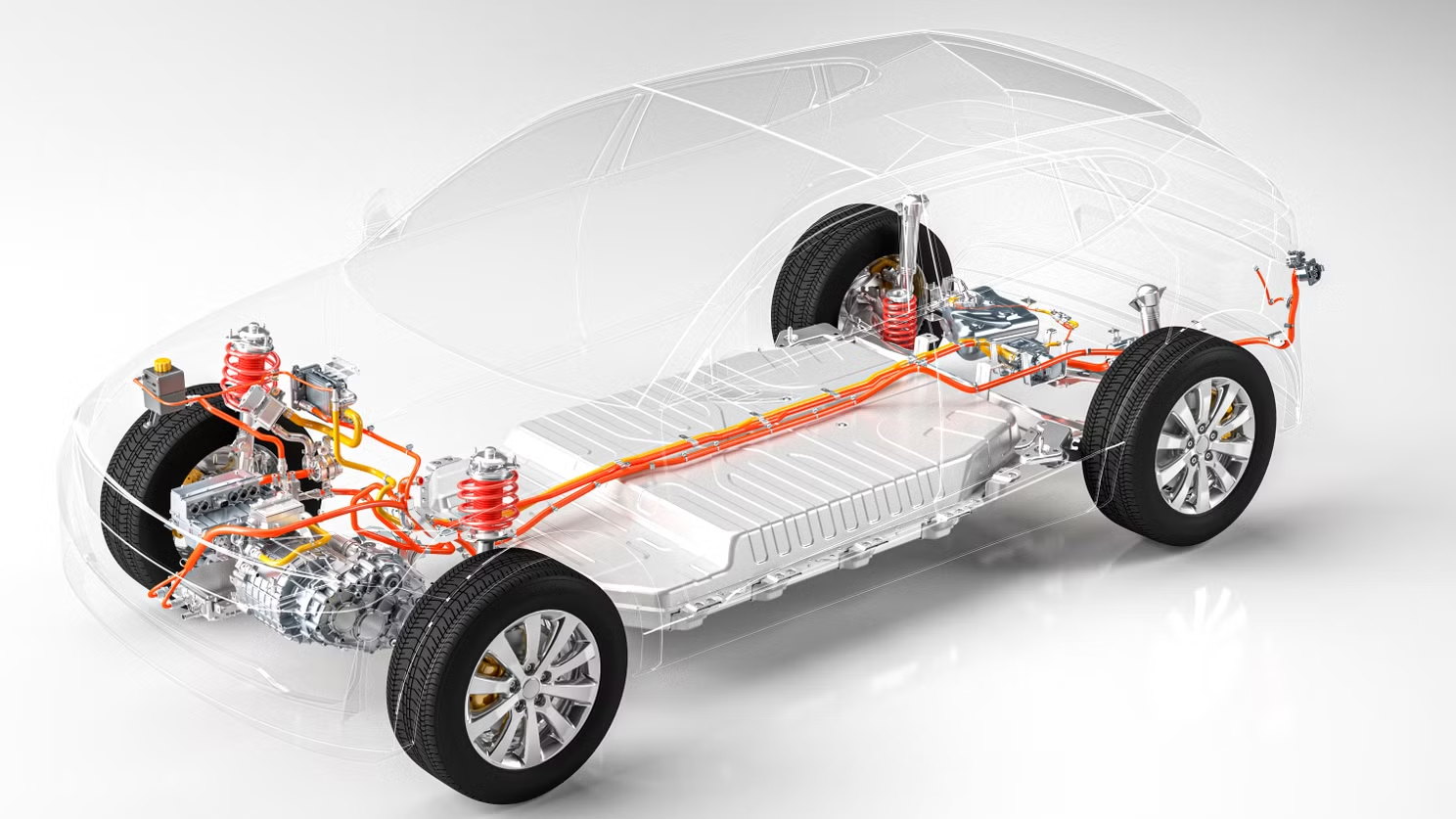
Your EV battery stores DC (direct current). Most motors, especially the efficient ones, want AC (alternating current). So between the battery and the motor sits an inverter — a component that converts DC to AC and controls how much power reaches the motor at any moment.
The inverter is also what handles regenerative braking. When you lift off the throttle, the motor runs backwards as a generator, converts kinetic energy back to electricity, and feeds it into the battery. It’s not magic — it’s the same electromagnetic principle in reverse.
On most EVs sold into African markets today, the inverter, motor, and reduction gear are packaged into a single sealed unit called an e-axle. BYD calls theirs the “8-in-1 electric powertrain.” It’s compact, sealed against dust and water, and generally low-maintenance — a real advantage for markets where service infrastructure is still developing.
What Types of Electric Motors Do EVs Use?
This is where buying decisions start to separate. There are four motor types found in production EVs. Two dominate.
1. Permanent Magnet Synchronous Motor (PMSM)
The most common motor in EVs today. Used by BYD, Hyundai, Kia, Toyota, Honda, Xiaomi, and most Chinese brands entering African markets.
The rotor — the spinning part — contains permanent magnets. The stator — the fixed outer ring — generates a rotating magnetic field using AC power. The rotor chases that field and spins in sync with it.
Why it’s popular: High efficiency across a wide RPM range, strong peak torque, compact size, and relatively high power density. On real-world driving cycles, PMSM motors recover more usable range per kWh than alternatives.
The trade-off: Permanent magnets use rare earth materials (mainly neodymium). Supply chains for these materials are geopolitically sensitive, and repair costs if the rotor is damaged are higher than alternatives.
2. Induction Motor (AC Induction)
Used by Tesla (on rear-wheel-drive and older Model S/X), Rivian, and some commercial EVs. The rotor has no magnets — instead, the rotating magnetic field from the stator induces current in the rotor, which then experiences a force.
Why some manufacturers prefer it: No rare earth magnets, simpler rotor construction, extremely robust. For commercial EVs and buses — like the BasiGo electric buses now operating in Kenya — induction motors handle high-duty cycles with fewer failure points.
The trade-off: Slightly lower efficiency than PMSM at partial loads. Generates more heat at lower speeds.
3. Switched Reluctance Motor (SRM)
Still largely in development for passenger cars. Jaguar Land Rover has invested in SRM research. No magnets at all — the rotor is just shaped steel that rotates to minimize magnetic reluctance. Cheap, robust, rare-earth-free.
The problem: SRMs produce significant torque ripple (roughness) and acoustic noise. Not yet competitive for premium passenger EVs. Worth watching over the next five years.
4. Wound Rotor Synchronous Motor (WRSM)
Renault uses a version of this in the Zoe and some older models. The rotor is an electromagnet, not a permanent magnet — its field strength is adjustable. This gives engineers more control over performance across different speed ranges.
Fewer manufacturers use it because the rotor requires slip rings (rotating electrical contacts), which add a wear surface. But it avoids rare-earth dependency entirely.
Motor Specs That Actually Matter When Buying an EV
When you look at a spec sheet on evcarlatest.com’s EV comparison tool, you’ll see numbers like “150 kW / 310 Nm.” Here’s what those mean in practice.
Power (kW): The motor’s maximum output. Divide by 1.36 if you want horsepower. 150 kW = ~204 hp. This sets your top speed and high-speed acceleration.
Torque (Nm): The rotational force. This determines how hard the car pulls from a standstill. High torque at zero RPM is the defining characteristic of an electric motor — and why EVs feel fast even when their power figures look modest on paper.
Peak vs. Continuous: Most EV spec sheets list peak figures. A motor rated at 150 kW may only sustain 100 kW continuously before thermal limiting kicks in. Sustained performance matters more for highway overtaking and loaded driving on gradients — relevant on routes like Lagos–Ibadan or Nairobi–Mombasa.
Motor voltage: Higher-voltage systems (800V platforms, used in Hyundai Ioniq 6, Kia EV6, and upcoming Xiaomi models) allow faster charging and thinner cabling. Most affordable EVs entering African markets still use 400V systems — adequate, but slower to charge at high-speed stations.
Motor Type Comparison Table
| Motor Type | Efficiency | Peak Torque | Rare Earth Needed? | Cost to Repair | Example EVs |
|---|---|---|---|---|---|
| PMSM | ★★★★★ | Very High | Yes (neodymium) | Higher | BYD Seal, Hyundai Ioniq 5, Xiaomi SU7 |
| AC Induction | ★★★★ | High | No | Lower | Tesla Model S (rear), BasiGo K6 bus |
| WRSM | ★★★★ | High | No | Medium | Renault Zoe, Renault Megane E-Tech |
| SRM | ★★★ | Medium | No | Low (theoretically) | Mostly prototype/research stage |
Efficiency ratings are relative comparisons, not absolute figures. Real-world efficiency depends on vehicle weight, aerodynamics, thermal management, and driving conditions.
Single vs. Dual Motor: What’s the Difference?
Single-motor EVs drive either the front or rear axle. Most affordable EVs — BYD Dolphin, MG4, Leapmotor T03 — are single-motor front-wheel drive. Fine for most urban use.
Dual-motor EVs put a motor on each axle. This gives you true AWD, faster 0–100 km/h times, and better traction in wet or loose conditions. The BYD Seal AWD, for instance, uses a PMSM at both ends: 390 kW combined, 0–100 km/h in 3.8 seconds.
The practical question for African roads: dual motor adds cost (expect ₦5–10 million premium on most models in the grey market), but the AWD capability on unpaved laterite roads in the rainy season is genuinely useful — not just a performance spec. We covered this in detail in our BYD Seal vs BYD Atto 3 comparison and our breakdown of which EVs handle Nigerian road conditions best.
Why Motor Type Matters for Africa-Market Buyers
Most of the EVs arriving in Nigeria, Kenya, and South Africa via grey import are PMSM-motor vehicles — BYD, MG, Chery, and similar Chinese brands. That’s generally good for efficiency. The concern is serviceability.
PMSM motors are sealed units in most applications — they’re designed to last the vehicle’s lifetime without service. But if the inverter or motor does fail outside warranty, finding a technician who can diagnose it with the right diagnostic software is difficult in most African cities outside Lagos, Nairobi, Johannesburg, and Accra.
Induction motor EVs — particularly commercial models — have a slight edge here. The rotor has no magnets to demagnetise and fewer precision components to fail. For fleet operators running high-mileage routes, this is worth factoring into the total cost of ownership calculation.
Bottom Line Verdict
For most buyers in Nigeria, Kenya, and South Africa, motor type won’t be the reason you pick an EV — price, range, and charging access will. But knowing that a PMSM motor is what gives the BYD Seal its 700 km range claim, and that the same motor type needs an authorised diagnostic tool to properly troubleshoot, is exactly the kind of detail that protects you when something goes wrong two years after purchase. If you’re buying for a fleet or high-mileage commercial use, an induction motor EV deserves serious consideration on durability grounds alone.
Related EV Updates
- What Is V2G (Vehicle-to-Grid) and Will It Work in Nigeria?
- How Regenerative Braking Works — And Why It Matters
- EV Market Growth Statistics 2026: The Numbers
- Is It Worth Buying an Electric Car in 2026?
- EV Battery Degradation: How Much Range Will You Lose Over Time?