

- Home
- Electric Vehicles
- Compare Electric Cars
- Citroen e-C3 vs Dacia Spring Electric
Citroen e-C3 vs Dacia Spring Electric
The Citroën ë-C3 and the Dacia Spring Electric are both entry-level electric vehicles sold primarily in European markets. The ë-C3 is built by Citroën, a brand under the Stellantis group, and represents the brand’s push toward affordable urban electric mobility on a new low-cost EV platform developed specifically for accessible price points. The Dacia Spring is built by Dacia, a brand under the Renault Group, and has held the position of Europe’s cheapest electric car since its launch in 2021, with a refreshed version arriving in 2024. Both vehicles target the same buyer clearly — first-time EV adopters, urban commuters, retirees, and low-mileage drivers who want to enter the electric segment at the lowest possible cost without the financial exposure of a mid-range or premium EV purchase.
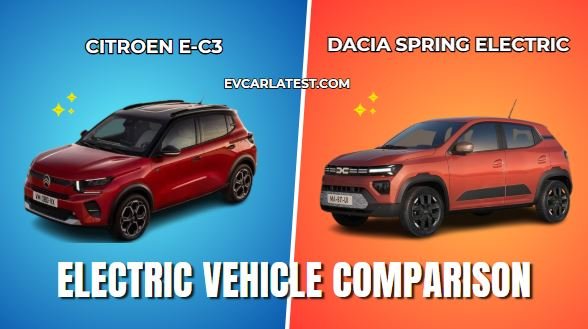
The Citroën ë-C3 is rated at up to 320 km on the WLTP cycle, which is a meaningful step up for the budget segment. The Dacia Spring Electric is rated at approximately 220 km WLTP on the updated 2024 version, sitting noticeably below the ë-C3 on paper. For urban use and short commutes, both figures are adequate, but the gap becomes relevant for buyers who occasionally need to cover longer distances between charges. On charging, the ë-C3 supports up to 100 kW DC fast charging, allowing a reasonably quick top-up at public infrastructure. The Dacia Spring supports only 30 kW DC fast charging, which is one of the slowest rates in the current EV market and results in significantly longer public charging stops. The ë-C3 holds a clear advantage on both range and charging speed, with the Spring’s 30 kW ceiling being a notable real-world limitation for any buyer who depends on public fast chargers.
The Dacia Spring starts at approximately €16,990 in France, making it the least expensive new electric car available in Europe at this price point. The Citroën ë-C3 starts at around €23,300 in France, sitting roughly €6,000 higher at entry level. The gap is consistent across most European markets where both are sold. Both vehicles are available across Western and Central Europe through their respective dealer networks. Neither is sold in North America or Australia in meaningful volumes. The Spring has broader name recognition in Eastern Europe and price-sensitive markets where Dacia has an established buyer base. This page helps buyers in Europe decide whether the Spring’s lower purchase price is worth accepting considerably shorter range and significantly slower charging, or whether the ë-C3’s higher cost is justified by its more capable hardware.
Citroën’s other electric vehicles within the Stellantis group include the ë-C4, ë-Berlingo, and the larger ë-SpaceTourer, with the ë-C3 sitting as the brand’s most affordable electric entry point. Stellantis siblings on the same low-cost platform include the Opel Frontera Electric and the Fiat Grande Panda Electric, which share architecture with the ë-C3 and target the same buyer. Dacia’s other electric offering is the Spring alone for now, though the Renault Group parent brand sells the Renault 5 E-Tech Electric and the Renault 4 E-Tech Electric at higher price points above the Spring. Outside these two brands, the main rivals in this segment are the Leapmotor T03, now distributed across Europe through Stellantis’s dealer network, which competes directly on price, and the upcoming BYD Seagull, which is expected to enter European markets and will apply further pricing pressure at the bottom of the EV segment.
The Citroën ë-C3’s three main strengths are its 320 km WLTP range which is significantly longer than the Spring for a budget-segment vehicle, its 100 kW DC fast-charging capability which is competitive well beyond its price category, and its modern platform which gives it a more current feature set and longer relevant product life than the Spring’s older architecture. Its two weaknesses are its higher starting price which places it out of reach for buyers whose budget ceiling aligns with the Spring, and its interior quality, which reflects its low-cost positioning and falls short of what buyers moving down from conventional hatchbacks might expect. The Dacia Spring Electric’s three main strengths are its starting price which remains the lowest of any new electric vehicle currently on sale in Europe, its low running and insurance costs which appeal to buyers on fixed incomes or tight monthly budgets, and its compact dimensions which make it genuinely easy to park and manoeuvre in dense urban environments. Its two weaknesses are its 30 kW DC fast-charging ceiling which makes public charging stops considerably longer than almost any rival in the segment, and its 220 km WLTP range, which leaves less buffer for real-world driving variation than the ë-C3’s longer-range configuration.
Quick Verdict: The Dacia Spring holds its position as Europe’s cheapest electric car, and for buyers who charge exclusively at home overnight and drive short distances daily, its limitations matter less in practice. The Citroën ë-C3 costs more but delivers meaningfully better range and charging speed that make it usable in a wider set of real-world conditions. Buyers on the tightest budget who rarely exceed 100 km per day and have home charging access will find the Spring adequate. Buyers who occasionally need more range or rely on public charging infrastructure at any point in their routine will find the ë-C3’s extra cost justified by what it removes from the equation.
Related EV Comparisons
- Renault 4 E-Tech vs Citroen e-C4
- Citroen e-C4 vs Citroen e-C3 Aircross
- Citroen e-C4 vs Citroen e-C3
- Hyundai Inster vs Dacia Spring
- Citroen e-C3 Aircross vs Lancia Ypsilon

| |
| Price | $23,500.00 |
| Our Rating | |
| Brand | CITROEN DACIA |
| Category | Electric Cars Electric Cars |
MODEL
| Available Trims / Variants |
Citroen e-C3 44kWh - For Europe Citroen e-C3 29kWh - For India and South America Dacia Spring Electric 45 Dacia Spring Electric 65 |
PRICE & AVAILABILITY
| Base Price (USD) |
€ 23,300
€ 17,000 - Dacia Spring Electric 45 € 19,000 - Dacia Spring Electric 65 |
| Availability Status |
Available to order. Released 2024, February - For Europe Available to order. Released 2023, February - For India and South America Available to order. Released 2024, April |
BATTERY & CHARGING
| Battery Capacity |
44 kWh total - For Europe 29.2 kWh total - For India and South America 26.8 kWh usable, 27.4 kWh total |
| Range (WLTP/CLTC/EPA) |
199 mi WLTP - For Europe 199 mi MIDC - For India and South America 140 mi WLTP - Dacia Spring Electric 45 142 mi WLTP - Dacia Spring Electric 65 |
| DC Charging (Max kW) |
CCS 100 kW max, 20-80% in 26 min - For Europe CCS, 10-80% in 57 min - For India and South America CCS 30 kW, 20-80% in 45 min |
| AC Charging (Max kW) |
Type 2 7.4 kW, 20-80% in 4 hours 10 min - For Europe Type 2 11 kW, 20-80% in 2 hours 50 min AC 3.3kW, 10-80% in 10 hours 30 min - For India and South America Type 2 7 kW, 20-100% in 4 hours |
| Energy Consumption |
264 Wh/mi WLTP
222 Wh/mi WLTP - Dacia Spring Electric 45 211 Wh/mi WLTP - Dacia Spring Electric 65 |
PERFORMANCE
| Power Output (kW / hp) |
FWD 113 hp (83 kW) - For Europe FWD 57 hp (42 kW) - For India and South America FWD 45 hp (33 kW) - Dacia Spring Electric 45 FWD 65 hp (48 kW) - Dacia Spring Electric 65 |
| 0–100 km/h / 0-60 mph (seconds) The acceleration numbers are an easy way to compare car performance. We list either time from 0 to 100 km/h or time from 0 to 60mph, depending on which number(s) the manufacturers provide. The lower the acceleration time, the higher performance the car is. |
11 sec 0-62 mph - For Europe 0-60 km/h in 6.8 sec - For India and South America 19 sec 0-62 mph - Dacia Spring Electric 45 14 sec 0-62 mph -Dacia Spring Electric 65 |
| Torque (Nm) |
120 Nm (89 lb-ft) - For Europe 143 Nm (105 lb-ft) - For India and South America 125 Nm (92 lb-ft) - Dacia Spring Electric 45 113 Nm (83 lb-ft) -Dacia Spring Electric 65 |
| Top Speed (km/h / mph) |
84 mph (135 km/h) - For Europe 66 mph (107 km/h) - For India and South America 78 mph (125 km/h) |
BODY & DIMENSIONS
| Dimensions (L×W×H mm) |
4010 x 1760 x 1570 mm (157.9 x 69.3 x 61.8 in) - For Europe 3981 x 1733 x 1604 mm (156.7 x 68.2 x 63.1 in) - For India and South America 3701 x 1583 x 1485 mm (145.7 x 62.3 x 58.5 in) |
| Trunk/Boot Capacity (L) |
EU: 310 l - For Europe EU: 315 l - For India and South America EU: 308 l, 1004 l max |
| Body Style | 5 door hatchback, 5 seats 5 door crossover, 2/4 seats |
| Kerb Weight (kg) |
EU: 1419 kg unladen, 1910 kg gross - For Europe EU: 1302 kg unladen, 1716 kg gross - For India and South America EU: 976 kg unladen, 1315 kg gross - Dacia Spring Electric 45 EU: 984 kg unladen, 1315 kg gross - Dacia Spring Electric 65 |
| Ground Clearance (mm) | 163 mm (6.4 in) 150 mm (5.9 in) |
| Frunk/Bonnet Capacity (L) | No 35 l |
SAFETY & DRIVER ASSISTANCE
COMFORT & SEATING
| Seating Capacity |
Heated front seats - For Europe No heated seats - For India and South America No heated seats |
DISPLAYS & CONNECTIVITY
| Centre Screen (inches) | 10.25" touchscreen 10" touchscreen |
| Driver's Display (inches) |
Yes
7" |
| Head-Up Display (HUD) |
Yes - For Europe No - For India and South America No |
TECHNOLOGY
ADDITIONAL SPECS
Note
| Additional Notes | Also known as Citroën ë-C3 |


|
Disclaimer Note
Specifications sourced from manufacturer data and may reflect WLTP, CLTC, or EPA test conditions. Import prices in your local are estimates based on grey-market landing costs and exclude duties, clearing fees, and local taxes. Figures are subject to change without notice. Always verify with your local importer before purchase. We can not guarantee that the information on this page is 100% correct