- Home
- Electric Vehicles
- Compare Electric Cars
- MG MG4 2026 vs Dacia Spring Electric 2026
MG MG4 2026 vs Dacia Spring Electric 2026
The MG MG4 and Dacia Spring are both affordable electric hatchbacks built around the same core promise — getting buyers into an EV without spending on a premium brand — but they occupy meaningfully different positions in the market. The MG4 is a purpose-built C-segment hatchback from Chinese manufacturer SAIC, designed for buyers who want competitive range, fast charging, and a full-sized everyday car at a price well below European rivals. The Dacia Spring is an A-segment city car built around one clear mission: the lowest purchase price for a new electric vehicle in Europe, targeting urban commuters whose daily trips rarely exceed 30–40 km. The 2026 update to both models — the MG4 gaining a new interior and LFP chemistry, and the Spring receiving a new platform, stronger motors, and faster charging — makes this the right moment to compare them directly.
Range & Charging
The 2026 MG4 Premium Long Range uses a 64 kWh LFP battery delivering 280 miles (451 km) WLTP, with the Extended Range reaching 338 miles (544 km) on a 77 kWh pack. Real-world range is typically 230–290 miles. DC fast charging peaks at 154 kW, with 10–80% achievable in approximately 25 minutes; AC charging is 11 kW standard.
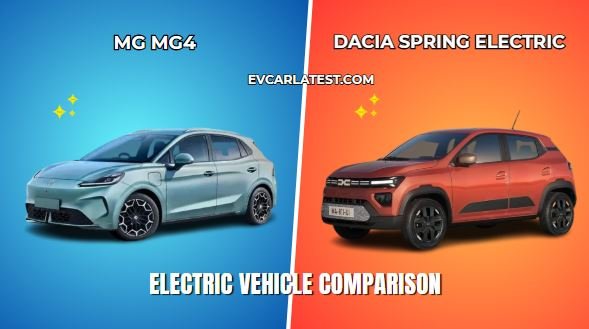
The 2026 Dacia Spring carries a 24.3 kWh LFP battery with up to 140 miles (225 km) WLTP range, and supports 40 kW DC fast charging with 20–80% achievable in 29 minutes. AC charging runs at 7 kW, completing a 20–100% charge in 3 hours 20 minutes from a wallbox. Real-world range in city conditions can stretch the rated figure, but motorway driving reduces it noticeably.
Price, Availability & Market Fit
The 2026 Dacia Spring starts at £12,240 in the UK after the Dacia Electric Car Grant, with the top Extreme trim at £13,240 with the grant applied. Across Europe it starts at €16,900, with all variants priced under €20,000. The MG4 Premium Long Range starts at £29,995 in the UK, more than double the Spring’s entry price. The Spring is Europe-only with no confirmed African market availability; MG has official dealer presence in South Africa. This comparison answers whether the Spring’s dramatically lower price is worth the sacrifice in range, size, and charging speed — or whether the MG4 is the more rational purchase over a three-to-five year ownership horizon.
Ecosystem & Rival Context
MG buyers should also consider the MG4 Urban as a cheaper entry point and the MG ZS EV for more cargo space. Dacia buyers have no pure EV alternative within the brand currently, though the Dacia Bigster is a larger hybrid option. Outside both brands, the Citroën ë-C3 and Leapmotor T03 compete in the same affordable city EV space as the Spring, while the Renault 5 E-Tech sits between the two in price and capability. The MG4 versus Spring comparison remains the most useful because it forces a clear choice between two fundamentally different EV philosophies at their respective price floors.
Pros & Cons
The MG4’s 280-mile WLTP range means it works as a single-vehicle household without range anxiety on longer trips, which the Spring cannot credibly claim. Its 154 kW peak DC charging gives it genuine road-trip capability — a 25-minute stop recovers most of the battery, making intercity travel practical. Official South African dealership support means buyers outside Europe have a legitimate service option, unlike the Spring. Its cons are pricing — at double the Spring’s cost, it requires a larger financial commitment — and its C-segment footprint is harder to park in dense urban environments where the Spring’s compact dimensions are a daily advantage.
The Dacia Spring’s starting price of around €16,900 makes it the most affordable new EV in Europe, allowing first-time buyers to transition to electric without a significant loan or lease commitment. Its new LFP battery offers improved thermal stability and longevity, which matters for buyers who plan to keep the car long-term. Its compact footprint and light weight make it genuinely easy to drive and park in city conditions. The Spring’s weaknesses are real, however: 140 miles of WLTP range rules it out as a primary vehicle for anyone who occasionally drives between cities, and its 40 kW DC charging cap means fast-charge sessions are slow by 2026 standards, even if the small battery fills up quickly in absolute time.
Quick Verdict
Choose the MG4 2026 if you need a single vehicle that handles both daily commuting and occasional long-distance driving, and if range and fast-charging reliability matter to your routine. Choose the Dacia Spring 2026 if your daily driving is entirely urban, you have reliable home charging, and minimising purchase cost is your most important factor. The Spring is not a practical replacement for the MG4; it is a different product for a different use case. Buyers who drive more than 80 miles on any regular basis will find the Spring frustrating; buyers who never do will likely find the MG4 unnecessary.
FAQ
Is the Dacia Spring available in South Africa or Nigeria?
The Dacia Spring is sold exclusively in European markets as of 2026, with no confirmed launch in Africa. Buyers in South Africa or Nigeria cannot purchase it through official channels, and grey-market importation would add significant cost and complexity relative to its budget pricing.
Can the Dacia Spring handle motorway driving?
The 2026 Spring’s new 70 hp and 100 hp motors are a meaningful improvement over previous versions, with the higher-output model reaching 62 mph in 9.6 seconds. Sustained motorway speeds do reduce its range significantly below the WLTP figure, making it best suited to urban and suburban use rather than regular highway journeys.
Is the MG4 worth twice the price of the Dacia Spring?
For buyers who need more than 140 miles of range or regular access to fast public charging, the MG4 justifies its price premium with a larger battery, faster DC charging, and a genuinely full-sized cabin. For purely urban use with home charging, the Spring’s lower price and running costs may make more financial sense over the ownership period.
Does the 2026 Dacia Spring have fast charging?
Yes — the 2026 Spring supports 40 kW DC fast charging, achieving 20–80% in approximately 29 minutes. While 40 kW is slow by modern standards, the Spring’s small 24.3 kWh battery means the absolute charge time remains manageable for city top-ups
Related EV Comparisons
- MG MG4 2026 vs Nissan Leaf 2025
- MG MG4 EV vs Cupra Born
- MG MG4 2026 vs Volkswagen ID.3 2026
- Hongqi Tiangong 05 (EH5) vs MG MG4 2026
- Roewe D6 vs MG MG4 2026
| |
| Price | $30,000.00 $18,000.00 |
| Our Rating | |
| Brand | MG DACIA |
| Category | Electric Cars Electric Cars |
MODEL
| Full Model Name | Dacia Spring Electric (2nd generation, 2026) |
| Segment / Class | A-segment electric city car |
| Available Trims / Variants |
Standard Range Long Range XPower performance Expression, Journey |
| Powertrain Options | Single front motor, 82 PS standard; optional Fast-Charge Pack adds DC charging + V2L |
PRICE & AVAILABILITY
| Base Price (USD) | $30,000 From €17,900 (Europe, Expression trim) |
| Availability Status | Production Just unveiled (Sept 10, 2026) |
| Markets Available | Europe confirmed |
| Brand / Manufacturer | Dacia (Renault Group) |
BATTERY & CHARGING
| Battery Capacity |
51 kWh 64 kWh 77 kWh 27.5 kWh (LFP) |
| Range (WLTP/CLTC/EPA) |
About 218 mi Standard About 281 mi Long Range About 323 mi Extended (WLTP): Up to 250 km (~155 miles) |
| DC Charging (Max kW) |
Up to about 135 kW DC 10 to 80 percent about 30 to 35 min 50 kW — only with optional Fast-Charge Pack; base version has no DC charging |
| Charging Time (10–80%) | (15–80%): 28 min (50 kW DC, optional pack) · 9 hrs (standard 6.6 kW AC home socket) |
| AC Charging (Max kW) |
7 kW to 11 kW AC Full charge about 6 to 8 h 6.6 kW standard; 11 kW with Fast-Charge Pack |
| Battery Warranty | Not disclosed |
| Energy Consumption | 15 to 17 kWh per 100 km Not disclosed |
PERFORMANCE
| Power Output (kW / hp) |
168 HP RWD Standard 201 HP RWD Long Range 429 HP AWD XPower 60 kW / 82 PS (80 hp) |
| 0–100 km/h / 0-60 mph (seconds) The acceleration numbers are an easy way to compare car performance. We list either time from 0 to 100 km/h or time from 0 to 60mph, depending on which number(s) the manufacturers provide. The lower the acceleration time, the higher performance the car is. |
0 to 62 mph about 7.7 s Standard 0 to 62 mph about 7.0 s Long Range 0 to 62 mph about 3.8 s XPower 12.1 seconds |
| Motor Configuration | Single motor, front-wheel drive |
| Torque (Nm) |
184 lb ft Standard 184 lb ft Long Range 443 lb ft XPower 175 Nm |
| Top Speed (km/h / mph) |
About 100 mph Standard About 112 mph XPower 130 km/h / ~81 mph |
BODY & DIMENSIONS
| Dimensions (L×W×H mm) |
Length about 168.7 in Width about 72.8 in Height about 59.1 in 3,850 × 1,740 × 1,520 mm |
| Trunk/Boot Capacity (L) | 12.9 cu ft 337 L (up to 1,283 L with rear seats folded) |
| Body Style | 5 door hatchback, 5 seats 5-door hatchback |
| Kerb Weight (kg) | 3,600 to 4,000 lb depending on battery From 1,212 kg |
| Ground Clearance (mm) | 5.9 in Not disclosed |
| Frunk/Bonnet Capacity (L) | 18 L (optional add-on) |
| Sunroof | Not offered |
SAFETY & DRIVER ASSISTANCE
| ADAS Features | Not disclosed |
| Autonomous Driving Level | Level 2 driver assist Driver-assistance only (no autonomy) |
| Crash Test Ratings | 5 star rating in Euro NCAP testing Not yet tested |
| Over-the-Air (OTA) Safety Updates | Not disclosed |
COMFORT & SEATING
| Seating Capacity | Fabric or synthetic leather 4 |
| Seat Material | Fabric (Expression); mixed fabric/TEP (Journey) |
| Wireless Charging | Not offered |
DISPLAYS & CONNECTIVITY
| Centre Screen (inches) | 10.25 inch touchscreen None on Expression (phone-based "Media Control" app instead); 10.1" Media Nav Live on Journey and above |
| Mirror Link / Apple CarPlay / Android Auto | Via smartphone app on Expression; built-in on Journey+ |
| Driver's Display (inches) | 7 inch digital cluster 7-inch digital cluster (all trims) |
| Head-Up Display (HUD) | Not offered |
TECHNOLOGY
| Vehicle-to-Load (V2L) | Available with optional Fast-Charge Pack |
| Vehicle-to-Grid (V2G) | Not offered |
| Over-the-Air Map Updates | Not disclosed |
ADDITIONAL SPECS
| Headlight Type (LED/Matrix/Laser) | Automatic headlamps |
| Adaptive Headlights | Not offered |
| Sound System Brand | Not disclosed |
| Speaker Count | Not disclosed |
| Navigation System | Media Nav Live (Journey and above) |
| Face Recognition | Not offered |
| Fingerprint Sensor | Not offered |
| Remote Parking | Not offered |
| Official Dealer Network | Confirmed for Europe; other markets |
| Service Interval | Not disclosed |
| Roadside Assistance | Not disclosed |
Note
| Data Source | Dacia press materials, reported via paultan.org (Sept 10, 2026), with cross-checks against Carwow, Parkers, Euro NCAP |
| Last Updated | September 12, 2026 |
| Additional Notes | XPower version uses dual motor AWD performance setup. This is the all-new second-gen Spring, revealed this week — separate from the current facelifted first-gen still sold in the UK (24.3 kWh battery, 225 km WLTP, from ~£11,990–£16,995) |
| Editor's Note | Several fields (crash rating, warranty, full ADAS list, additional trims) haven't been published by Dacia yet |


|
Disclaimer Note
Specifications sourced from manufacturer data and may reflect WLTP, CLTC, or EPA test conditions. Import prices in your local are estimates based on grey-market landing costs and exclude duties, clearing fees, and local taxes. Figures are subject to change without notice. Always verify with your local importer before purchase. We can not guarantee that the information on this page is 100% correct