

- Electric Vehicles
- Compare Electric Cars
- Tata Motors Punch.ev vs Citroen e-C3
Tata Motors Punch.ev vs Citroen e-C3
The Tata Punch.ev and the Citroën ë-C3 are both compact electric SUVs sold in the Indian market, positioned at the more accessible end of the country’s growing EV segment. The Punch.ev is built by Tata Motors on its dedicated acti.ev platform and is the electric version of the Punch, one of India’s best-selling compact SUVs in the conventional segment. The ë-C3 is built by Citroën, a Stellantis brand, and is locally manufactured in India at Citroën’s Thiruvallur plant, making it one of the few European electric vehicles produced on Indian soil. Both vehicles target Indian urban and semi-urban buyers entering the EV segment for the first time — working professionals, small families, and commuters who want a compact electric SUV within a defined budget without stretching into mid-range pricing territory.
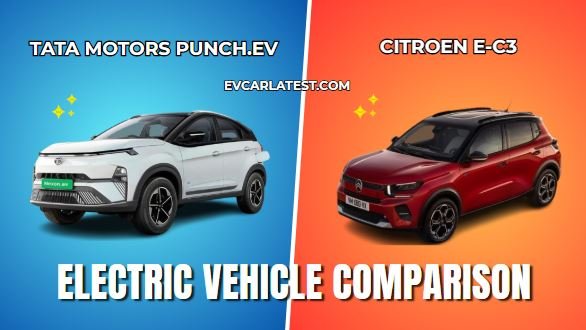
The Tata Punch.ev Long Range is rated at approximately 421 km on the ARAI cycle with its 35 kWh battery, while the standard range 25 kWh version is rated at around 315 km ARAI. The Citroën ë-C3 carries a 29.2 kWh battery and is rated at approximately 320 km under claimed figures, placing it between the two Punch.ev battery options on paper. Real-world range for both vehicles will sit lower than official figures, as is standard across all EVs under varied Indian road and traffic conditions. On charging, the Punch.ev supports up to 25 kW DC fast charging alongside AC charging, allowing a meaningful top-up at public fast chargers where available. The Citroën ë-C3 in its India specification supports AC charging only, with no DC fast-charging capability on the Indian variant. That is a notable real-world limitation for any buyer who relies on public charging infrastructure for top-ups away from home, and it is the most significant hardware difference between the two vehicles in this market.
The Tata Punch.ev starts at approximately ₹9.99 lakh in India for the standard range variant, with the long range version priced up to around ₹14.99 lakh depending on trim. The Citroën ë-C3 starts at approximately ₹11.50 lakh in India, positioning it above the Punch.ev at entry level but within a comparable overall range across configurations. Both vehicles are manufactured and sold in India through their respective dealer networks. The Punch.ev benefits from Tata Motors’ extensive national dealership and service coverage, which spans tier-one through tier-three cities. Citroën’s dealer network in India is considerably smaller and concentrated in larger urban centres, which is a practical consideration for buyers in smaller cities who need accessible after-sales service. The ë-C3 is also sold in Europe, while the Punch.ev is a product developed specifically for the Indian market. This page helps Indian buyers decide between a locally developed EV with stronger service reach and DC fast-charging capability and an imported-brand locally made alternative at a higher entry price with no public fast-charging support in its current India specification.
Tata Motors’ other electric vehicles in the Indian market include the Nexon.ev, Tiago.ev, Tigor EV, Curvv.ev, and the Harrier EV, giving the brand the widest electric model range of any automaker currently operating in India. The Punch.ev sits as one of the most affordable entries in that lineup. Citroën’s other electric offering in India is limited at this stage, with the ë-C3 being the brand’s primary EV product in the market. In Europe, Citroën also sells the ë-C4 and shares platform architecture with Stellantis siblings including the Opel Frontera Electric and Fiat Grande Panda Electric. Outside these two brands, the main rivals in this segment in India are the MG Comet EV, which competes at an even lower price point as a micro urban EV, and the Mahindra BE 6, which enters the market at a higher price but represents a newer and more capable alternative for buyers willing to stretch their budget.
The Tata Punch.ev’s three main strengths are its DC fast-charging capability of up to 25 kW which gives it access to India’s expanding public fast-charging network in a way the ë-C3 cannot match, its lower starting price which makes it accessible to a wider range of first-time EV buyers in the Indian market, and its Tata Motors service network which covers a significantly larger number of cities and towns than Citroën’s current India dealership footprint. Its two weaknesses are its interior quality on base trims, which reflects its mass-market positioning and falls short of the ë-C3’s cabin finish at comparable price points, and its 25 kW DC charging ceiling, which is functional but slower than what newer EVs in adjacent segments are beginning to offer. The Citroën ë-C3’s three main strengths are its interior build quality and material feel, which carry the influence of its European design origins and compare favourably against the Punch.ev inside the cabin, its local manufacturing in India which supports competitive pricing despite the European brand provenance, and its 320 km claimed range on a single 29.2 kWh battery which delivers adequate figures for urban and semi-urban daily use. Its two weaknesses are its absence of DC fast-charging support in the India specification, which restricts top-ups away from home to slow AC charging only, and its limited Citroën dealership and service network in India, which creates a practical after-sales access gap for buyers outside major metropolitan areas.
Quick Verdict: The Punch.ev is the more complete package for most Indian buyers at this price point. Its lower starting price, DC fast-charging capability, and Tata’s national service network address the three concerns that matter most to first-time EV buyers in India — cost, charging practicality, and after-sales support. The ë-C3 offers a better cabin experience and comparable range but asks buyers to accept AC-only charging and limited dealer coverage in exchange. Buyers who charge exclusively at home overnight and live in a city with a Citroën service centre will find the ë-C3 a reasonable alternative. Buyers who want flexibility on public charging and access to service across a wider geography will find the Punch.ev the more straightforward choice.
Related EV Comparsions
- Citroen e-C3 vs Dacia Spring Electric
- Tata Motors Curvv.ev vs XPeng G3
- Tata Motors Curvv.ev vs Togg T10X
- Renault 4 E-Tech vs Citroen e-C4
- Citroen e-C4 vs Citroen e-C3 Aircross

| |
| Price | $15,000.00 $23,500.00 |
| Our Rating | |
| Brand | TATA MOTORS CITROEN |
| Category | Electric Cars Electric Cars |
MODEL
| Available Trims / Variants |
Tata Motors Punch.ev Standard Range Tata Motors Punch.ev Long Range Citroen e-C3 44kWh - For Europe Citroen e-C3 29kWh - For India and South America |
LAUNCH
| Reveal Date |
2024, January 17 2023, October 17 - For Europe 2023, January 19 - For India and South America |
| Availability Status |
Available to order. Released 2024, January
Available to order. Released 2024, February - For Europe Available to order. Released 2023, February - For India and South America |
| Country of origin | India France |
| Base Price (USD) |
$ 15,000 - Tata Motors Punch.ev Standard Range $ 15,650 - Tata Motors Punch.ev Long Range € 23,300 |
BATTERY
| Battery Capacity |
25 kWh usable - Tata Motors Punch.ev Standard Range 35 kWh usable - Tata Motors Punch.ev Long Range 44 kWh total - For Europe 29.2 kWh total - For India and South America |
| Battery Chemistry | Liquid-cooled Li-ion Air-cooled Li-ion LFP battery (400V type) |
| Range (WLTP/CLTC/EPA) |
196 mi MIDC - Tata Motors Punch.ev Standard Range 262 mi MIDC - Tata Motors Punch.ev Long Range 199 mi WLTP - For Europe 199 mi MIDC - For India and South America |
| Energy Consumption | 264 Wh/mi WLTP |
| Regen Braking (Max kW) | Yes, 3 levels on shift paddles Yes |
| Heat Pump | |
| AC Charging (Max kW) |
Type 2 3.3 kW, 10-100% in 9.4 hours - Tata Motors Punch.ev Standard Range Type 2 7.2 kW, 10-100% in 3.6 hours Type 2 3.3 kW, 10-100% in 13.5 hours - Tata Motors Punch.ev Long Range Type 2 7.2 kW, 10-100% in 5 hours Type 2 7.4 kW, 20-80% in 4 hours 10 min - For Europe Type 2 11 kW, 20-80% in 2 hours 50 min AC 3.3kW, 10-80% in 10 hours 30 min - For India and South America |
| DC Charging (Max kW) |
CCS2 50 kW, 10-80% in 56 min
CCS 100 kW max, 20-80% in 26 min - For Europe CCS, 10-80% in 57 min - For India and South America |
PERFORMANCE
| Power Output (kW / hp) |
FWD 82 hp (60 kW) - Tata Motors Punch.ev Standard Range FWD 122 hp (90 kW) - Tata Motors Punch.ev Long Range FWD 113 hp (83 kW) - For Europe FWD 57 hp (42 kW) - For India and South America |
| Torque (Nm) |
114 Nm (84 lb-ft) - Tata Motors Punch.ev Standard Range 190 Nm (140 lb-ft) - Tata Motors Punch.ev Long Range 120 Nm (89 lb-ft) - For Europe 143 Nm (105 lb-ft) - For India and South America |
| 0–100 km/h / 0-60 mph (seconds) The acceleration numbers are an easy way to compare car performance. We list either time from 0 to 100 km/h or time from 0 to 60mph, depending on which number(s) the manufacturers provide. The lower the acceleration time, the higher performance the car is. |
13.5 sec 0-62 mph - Tata Motors Punch.ev Standard Range 9.5 sec 0-62 mph - Tata Motors Punch.ev Long Range 11 sec 0-62 mph - For Europe 0-60 km/h in 6.8 sec - For India and South America |
| Top Speed (km/h / mph) |
87 mph (140 km/h)
84 mph (135 km/h) - For Europe 66 mph (107 km/h) - For India and South America |
| Transmission / Drive | Single-speed Single-speed |
BODY
| Body Style | 5 door SUV, 5 seats 5 door hatchback, 5 seats |
| Platform / Architecture |
acti.ev
Smart Car - For Europe e-CMP - For India and South America |
| Dimensions (L×W×H mm) |
3857 x 1742 x 1633 mm (151.9 x 68.6 x 64.3 in)
4010 x 1760 x 1570 mm (157.9 x 69.3 x 61.8 in) - For Europe 3981 x 1733 x 1604 mm (156.7 x 68.2 x 63.1 in) - For India and South America |
| Wheelbase (mm) | 2445 mm (96.3 in) 2540 mm (100.0 in) |
| Ground Clearance (mm) | 190 mm (7.5 in) 163 mm (6.4 in) |
| Kerb Weight (kg) |
EU: 1419 kg unladen, 1910 kg gross - For Europe EU: 1302 kg unladen, 1716 kg gross - For India and South America |
| Suspension (Front / Rear) |
Front Independent MacPherson strut with coil spring, rear semi-independent twist beam
Citroen Advanced Comfort Suspension with Progressive Hydraulic Cushions Front MacPherson strut, rear twist beam |
| Wheel Size (inches) |
R15, R16
R16, R17 - For Europe R15 - For India and South America |
| Trunk/Boot Capacity (L) |
EU: 366 l
EU: 310 l - For Europe EU: 315 l - For India and South America |
| Frunk/Bonnet Capacity (L) | Yes No |
| Towing Capacity (kg) |
No
EU: 550 kg unbraked - For Europe No - For India and South America |
SAFETY
| Airbags (count) | 6 airbags: front, head airbag system, side, rear airbags 6 airbags: side airbags, front, head airbag system |
| Driver Assistance (ADAS) | 4 cameras. Blind spot assist, High beam assist 4 rear sensors, front/rear camera, rear radar. Active Lane Departure Warning, Active Safety Brake, Driver Attention Alert, High Beam Assist |
COMFORT
| Seating Capacity |
Ventilated front seats
Heated front seats - For Europe No heated seats - For India and South America |
| Roof Type | Small sunroof, tilted No glass roof |
| Bluetooth / Wi-Fi | Wireless Android Auto and Apple CarPlay Wireless Android Auto and Apple CarPlay |
| Parking Aids |
Front and rear sensors, 360 camera, reversing camera, Parking Assist
4 rear sensors, reversing camera - For Europe No parking aids - For India and South America |
DISPLAYS
| Centre Screen (inches) | 10.35" touchscreen 10.25" touchscreen |
| Driver's Display (inches) | 7" Yes |
| Head-Up Display (HUD) |
No
Yes - For Europe No - For India and South America |
LIGHTING
INFOTAINMENT & AUDIO
TECHNOLOGY
OWNERSHIP
Note
| Additional Notes | Punch.ev USD price is converted and is only relevant to the Indian market Also known as Citroën ë-C3 |
| Disclaimer | We can not guarantee that the information on this page is 100% correct We can not guarantee that the information on this page is 100% correct |


|
Disclaimer Note
Specifications sourced from manufacturer data and may reflect WLTP, CLTC, or EPA test conditions. Import prices in your local are estimates based on grey-market landing costs and exclude duties, clearing fees, and local taxes. Figures are subject to change without notice. Always verify with your local importer before purchase. We can not guarantee that the information on this page is 100% correct