- Home
- Electric Vehicles
- Compare
- Polestar 3 vs Lotus Eletre
Polestar 3 vs Lotus Eletre
The Polestar 3 and Lotus Eletre are both all-electric performance-oriented luxury SUVs, but they occupy meaningfully different positions within that description. The Polestar 3 is the brand’s shot at the mainstream midsize luxury SUV segment, sitting in well-established company alongside the BMW iX, Audi Q8 e-tron, and Mercedes-EQ EQE SUV — it targets buyers who want distinctive Scandinavian design and strong everyday usability without straying too far from the familiar luxury crossover formula. The Lotus Eletre, by contrast, is a high-performance all-electric SUV representing the brand’s very first SUV — a dramatic departure from Lotus’s sports car roots, aimed at buyers who want ultra-performance credentials, near-exotic status, and aren’t deterred by a six-figure price.
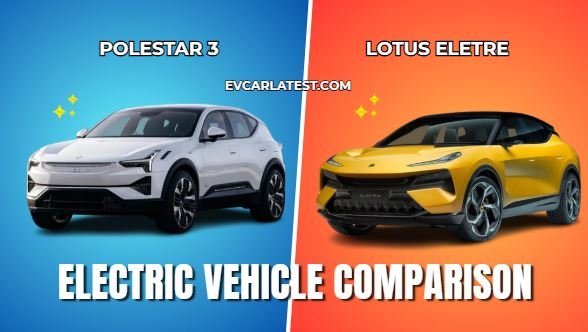
Range separates these two in meaningful ways depending on which variant you’re comparing. The Polestar 3‘s single-motor rear-wheel-drive model delivers 350 miles of EPA-estimated range, while the dual-motor AWD model gets 315 miles, and the Performance Pack-equipped variant drops to 279 miles. The Lotus Eletre is estimated at around 315 miles under US standards, while the more powerful Eletre R drops to approximately 260 miles — the power output of the R variant costs a noticeable amount of range. On charging, the Eletre has a clear structural advantage: its 800-volt architecture supports DC fast charging at 350kW, getting from 10% to 80% in 20 minutes. The Polestar 3 operates on a 400-volt architecture, and charges from 10% to 80% in around 30 minutes using a 250kW DC fast charger — competent but not class-leading.
The price gap between these two vehicles is significant. The Polestar 3 starts at $68,900 with destination for the single-motor model, rising to $73,400 for the dual-motor AWD version and further with the Performance Pack. The Lotus Eletre starts at $107,000 and the Eletre R begins at $145,000, before options and destination fees are applied — placing it in an entirely different spending bracket. The Polestar 3 is available in the US market now, built at Volvo’s South Carolina facility. The Eletre is also available in the US for the 2025 model year but through a significantly smaller dealer network, which is worth factoring into any ownership consideration. This comparison is most useful for buyers who are weighing whether they want an accessible, refined performance-leaning luxury EV or a rarer, more extreme machine where the performance and statement are as important as the practicality.
Beyond the Polestar 3, Polestar’s US lineup currently includes the Polestar 2 sedan and the new-for-2025 Polestar 4 coupe-like SUV. On the Lotus side, the Eletre sits alongside the Emeya, an all-electric grand tourer that shares the same platform and 800-volt architecture. In terms of rivals, the Polestar 3 competes most directly with the BMW iX, Audi Q8 e-tron, Mercedes-EQ EQE SUV, and Tesla Model X. The Lotus Eletre has fewer direct competitors, with the BMW iX in higher spec form, the Mercedes EQE SUV, and the Porsche Macan Electric representing the closest alternatives, though none fully matches the Eletre’s power output or pricing tier.
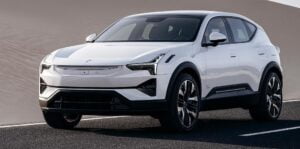
Polestar 3 — The range spread across its powertrain variants gives buyers genuine flexibility, with the 350-mile single-motor model being one of the more practical options in the segment. The interior is well-executed, with sustainable material choices and a clean, minimalist design that reflects a clear design point of view. US assembly at the South Carolina plant keeps it competitively priced within the luxury EV segment and supports potential federal tax credit eligibility. On the downside, the 400-volt charging architecture and peak 250kW speed mean it trails some rivals on charging pace, particularly against 800-volt competitors. Cargo space and the service network are areas where the Polestar 3 comes up short relative to what buyers at this price point might expect.
Lotus Eletre — The 800-volt architecture enables a maximum DC fast-charging speed of up to 367kW, which is among the fastest available in any SUV on sale today. The standard Eletre’s 603 horsepower and the Eletre R’s 905 horsepower give it genuine hyper-SUV performance credentials that are hard to match at any price. The air suspension and adaptive dampers provide a breadth of capability — comfortable on long motorway runs, genuinely sharp when pushed. Against that, the Eletre has not received crash test results from NHTSA or IIHS, which is a notable gap for buyers who weight safety ratings highly. And the dealer and service network in the US remains very limited — owning one outside a major metropolitan area carries real practical risk.
QUICK VERDICT
Choose the Polestar 3 if you want a well-rounded midsize luxury EV that balances range, design, technology, and price — and prefer a brand with a growing service footprint and US-built supply chain stability.
Choose the Lotus Eletre if extreme performance, 800-volt charging capability, and the novelty of owning one of the few genuine hyper-SUVs on sale matter more than dealer accessibility, safety ratings data, or staying under $100,000.
Related EV Comparisons
- Rimac Nevera vs Lotus Evija
- Lotus Emeya vs Porsche Taycan
- Volvo EX90 vs Polestar 3
- Volvo ES90 vs Polestar 4
- Audi A6 Sportback e-tron vs Polestar 4

MODEL
| Models |
Polestar 3 Long range Single motor Polestar 3 Long range Dual motor Polestar 3 Long range Dual motor Performance Lotus Eletre / Eletre S Lotus Eletre R |
LAUNCH
| Announced |
2024, June 27 - Polestar 3 Long range Single motor 2022, October 12 - Polestar 3 Long range Dual motor 2022, October 12 - Polestar 3 Long range Dual motor Performance 2022, March 29 |
| Status |
Available to order. Released 2024, July - Polestar 3 Long range Single motor Available to order. Released 2023, February - Polestar 3 Long range Dual motor Available to order. Released 2023, February - Polestar 3 Long range Dual motor Performance Available to order. Released 2023, June |
| Country of origin | Sweden Britain |
| Base Price |
$ 69,000 € 78,600 £ 69,900 - Polestar 3 Long range Single motor $ 73,400 € 88,600 £ 79,900 - Polestar 3 Long range Dual motor $ 79,400 € 96,500 £ 85,500 - Polestar 3 Long range Dual motor Performance $ 107,000 € 96,000 £ 89,500 - Lotus Eletre / Eletre S $ 145,000 € 151,000 £ 120,000 - Lotus Eletre R |
PERFORMANCE
| Power |
RWD 299 hp (220 kW) - Polestar 3 Long range Single motor AWD 489 hp (360 kW) - Polestar 3 Long range Dual motor AWD 517 hp (380 kW) - Polestar 3 Long range Dual motor Performance AWD 450 kW (603 hp) - Lotus Eletre / Eletre S AWD 905 hp (675 kW) - Lotus Eletre R |
| Torque |
490 Nm (361 lb-ft) - Polestar 3 Long range Single motor 840 Nm (620 lb-ft) - Polestar 3 Long range Dual motor 910 Nm (671 lb-ft) - Polestar 3 Long range Dual motor Performance 710 Nm (524 lb-ft) - Lotus Eletre / Eletre S 985 Nm (726 lb-ft) - Lotus Eletre R |
| Acceleration The acceleration numbers are an easy way to compare car performance. We list either time from 0 to 100 km/h or time from 0 to 60mph, depending on which number(s) the manufacturers provide. The lower the acceleration time, the higher performance the car is. |
7.5 sec 0-60 mph (7.8 sec 0-62 mph) - Polestar 3 Long range Single motor 4.9 sec 0-60 mph (5 sec 0-62 mph) - Polestar 3 Long range Dual motor 4.6 sec 0-60 mph (4.7 sec 0-62 mph) - Polestar 3 Long range Dual motor Performance 4.5 sec 0-100 km/h - Lotus Eletre / Eletre S 2.9 sec 0-60 mph (3 sec 0-62 mph) - Lotus Eletre R |
| Max Speed |
112 mph (180 km/h) - Polestar 3 Long range Single motor 130 mph (210 km/h) - Polestar 3 Long range Dual motor 130 mph (210 km/h) - Polestar 3 Long range Dual motor Performance 265 km/h (165 mph) |
| transmission | Single-speed Single-speed |
BATTERY
| Capacity |
107 kWh usable, 111 kWh total 100 kWh usable, 112 kWh total |
| Tech | Liquid-cooled Li-NMC 400V Li-ion (800V type) |
| Range |
404 mi WLTP (350 mi EPA) - Polestar 3 Long range Single motor 379 mi WLTP (315 mi EPA) - Polestar 3 Long range Dual motor 348 mi WLTP (279 mi EPA) - Polestar 3 Long range Dual motor Performance 373 mi WLTP - Lotus Eletre / Eletre S 304 mi WLTP (304 mi EPA) - Lotus Eletre R |
| Consumption |
351 Wh/mi WLTP - Polestar 3 Long range Dual motor 372 Wh/mi WLTP - Polestar 3 Long range Dual motor Performance 346 Wh/mi WLTP - Lotus Eletre |
| Recuperation | Yes Yes |
| Heat Pump | |
| AC Charging | Type 2 11 kW, 0-100% in 11 hrs Type 2 22 kW, 100% in 5.8 hours |
| DC Charging |
CCS 250 kW max, 10-80% in 30 min CCS 350 kW, 10-80% in 20 min |
| Others |
V2G Plug-and-charge read |
BODY
| Type | 5 door SUV, 5 seats 5 door SUV, 4/5 seats |
| Platform | SPA2 EPA |
| Dimensions |
4900 x 1968 x 1614 mm (192.9 x 77.5 x 63.5 in) 5103 x 2006 x 1630 mm (200.9 x 79.0 x 64.2 in) |
| Drag Co-Efficient | 0.296 Cd 0.26 Cd |
| Wheelbase | 2985 mm (117.5 in) 3019 mm (118.9 in) |
| Clearance | 201 mm (7.9 in) 187 - 194 mm (7.4 - 7.6 in) |
| Weight |
EU: 2584 kg unladen - Polestar 3 Long range Dual motor EU: 2670 kg unladen - Polestar 3 Long range Dual motor Performance EU: 2490 kg unladen - Lotus Eletre / Eletre S EU: 2640 kg unladen - Lotus Eletre R |
| Suspension | Front double wishbone, rear integral link, adaptive air suspension with active dampers Air suspension, continuous damping control, active rear axle steering, rear five-link |
| Wheels | R21, R22 R20, R21, R22, R23 |
| Trunk/Boot | EU: 484 l, 1411 l max EU: 688 l, 1532 l max |
| Frunk/Bonnet | 32 l 46 l |
| Towing |
EU: 750 kg unbraked, 1500 kg braked - Polestar 3 Long range Single motor EU: 2200 kg braked - Polestar 3 Long range Dual motor EU: 2200 kg braked - Polestar 3 Long range Dual motor Performance No |
| Others |
Digital Side Mirrors Active automatic front grille and rear spoiler |
DISPLAYS
| Centre | 14.5" touchscreen 15.1" OLED touchscreen |
| Driver's Display | 9" Yes |
| Head-Up | Yes, projector type Yes, with augmented reality |
| Others | 9" touchscreen infotainment display at the outer rear seats armrest |
COMFORT
| Seats |
Heated and ventilated front seats, heated rear seats
Heated front seats |
| Roof | Panoramic glass roof Panoramic glass sunroof, fixed |
| Parking Aids | Front and rear sensors, 360 camera, reversing camera, Park Assist Front and rear sensors, 360 camera, reversing camera |
| Connectivity |
Apple CarPlay Wireless Android Auto and Apple CarPlay |
| Others | Three-zone air conditioning Four-zone automatic climate control |
SAFETY
| Airbags | 9 airbags: side airbags, front and rear, including head airbag system Front, side, rear, head airbag system, front seats knee airbags |
| Driving Aids | 1 LiDAR, 5 radars, 5 cameras, 2 interior cameras, 12 sensors. Lane Keeping Aid, Blind Spot alert, Collision risk warning, Rear Cross traffic alert, Driver Alert Control, Road Sign information, Active high beam, Emergency brake lights, Collision avoidance (incl. cyclists and pedestrians), Collision warning at night, Lane Departure Warning, oncoming traffic collision avoidance, Cross Traffic Alert with brake support, Post-Impact Braking 4 deployable LIDARs (200m range), several cameras, 12 parking sensors. Front & Rear Collision Mitigation Support, Traffic Sign Information, Door Open Warning, Front & Rear Cross Traffic Alert, Lane Change Assist, Children Presence Detection, Lane Keep Aid with Lane Departure Warning / Prevention, Parking Emergency Brake, Emergency Rescue Call |
| Self Driving | Autonomous self driving |
Note
| Others | Also known as Chevrolet Silverado Work Truck EV |
| disclaimer | We can not guarantee that the information on this page is 100% correct We can not guarantee that the information on this page is 100% correct |


|
Disclaimer Note
We can not guarantee that the information on this page is 100% correct