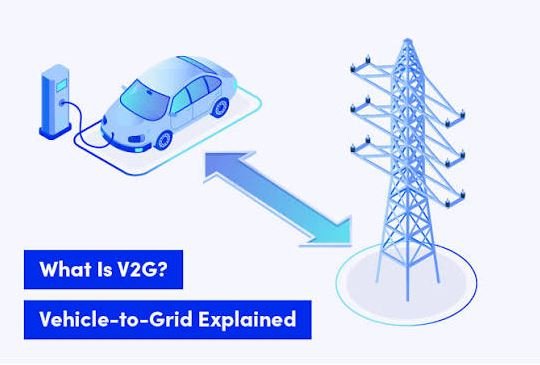
V2G — Vehicle-to-Grid — means your electric car can send electricity back to the power grid, not just pull from it. Instead of a one-way charger that tops up your battery, a V2G-enabled setup turns your EV into a mobile power bank. The grid asks for energy during peak demand, your car delivers it, and you get paid or get credits. In theory, every EV parked at home becomes a small power station.
For Nigeria — where grid reliability is still a work in progress and most households run generators as a backup — V2G sounds almost too useful to be true. Cheaper home power. Fewer blackouts. An EV that pays you back. But the reality is more complicated than the sales pitch. Here’s what the technology actually involves, which cars currently support it, and how realistic any of this is for the Nigerian market right now.
Quick Summary
| Question | Short Answer |
|---|---|
| What is V2G? | Your EV discharges electricity back into the public grid |
| What is V2H? | Same idea, but power goes to your home only |
| Which cars support it? | Nissan Leaf (older), Hyundai Ioniq 5/6, Kia EV6, BYD Atto 3, some CHAdeMO vehicles |
| Does Nigeria have V2G infrastructure? | No — the grid and billing systems aren’t ready yet |
| Is V2H practical in Nigeria now? | Possibly, as a generator replacement — but hardware costs are high |
How V2G Actually Works
Your EV battery stores DC electricity. Your home and the grid run on AC. A standard EV charger only converts AC (from the grid) into DC (for the battery). That’s a one-way street.
V2G requires bidirectional charging — hardware that can also run the conversion in reverse. DC from the battery gets converted back to AC and pushed into the grid or your home circuits.
There are two flavours worth knowing:
V2G (Vehicle-to-Grid): The car interacts directly with the utility grid. A smart meter or energy management system tells the car when to charge (off-peak, cheap power) and when to discharge (peak demand, expensive power). Grid operators benefit from the added buffer. You benefit from lower electricity bills or direct payments, depending on your utility’s scheme.
V2H (Vehicle-to-Home): The car powers your house only. No grid interaction. Think of it as a big UPS — when the power goes out, the car keeps your lights, fridge, and router running. This is the version that makes the most sense for Nigeria right now.
V2L (Vehicle-to-Load): A simpler version available on more vehicles. The car has an AC outlet (220V or 110V) that you plug appliances into directly. It doesn’t interact with your home wiring at all. The Hyundai Ioniq 5 and Kia EV6 both support this out of the box with a standard adaptor.
Which EVs Support V2G or V2H in 2026?
This is where it gets messy. Most EVs are still one-way. Bidirectional charging is only starting to show up in mainstream models.
Confirmed Bidirectional Capability
| Vehicle | Bidirectional Type | Charging Standard | Battery (kWh) |
|---|---|---|---|
| Nissan Leaf (2018–2023) | V2G, V2H | CHAdeMO | 40 / 62 |
| Hyundai Ioniq 5 | V2L + V2H (select markets) | CCS2 | 58 / 77.4 |
| Hyundai Ioniq 6 | V2L | CCS2 | 53 / 77.4 |
| Kia EV6 | V2L + V2H (select markets) | CCS2 | 58 / 77.4 |
| BYD Atto 3 | V2L | CCS2 / GB/T | 49.92 / 60.48 |
| Ford F-150 Lightning | V2H, V2G (US only) | CCS2 | 98 / 131 |
| VW ID.4 (2025+) | V2H (Europe, selected) | CCS2 | 77 |
| Lucid Air | V2H (confirmed for later) | CCS2 | 88 / 118 |
| Zeekr 001 / 007 | V2L standard | CCS2 / GB/T | 75–100 |
| Xpeng G9 | V2L | CCS2 / GB/T | 78 / 98 |
Note: V2H and V2G availability often depends on the market and software version, not just the hardware. A car sold in Nigeria via grey-market import may have the hardware but not the software activation for bidirectional discharge. Confirm before purchase.
The Nigeria Problem: Why V2G Is Still Theoretical Here
The Grid Isn’t Ready
V2G works when the grid and the car talk to each other in real time. That requires smart meters, a utility with an aggregation programme, and a billing system that can credit you for exported power. Nigeria’s electricity sector — run largely through DisCos and NERC — has none of that infrastructure at scale yet. The national grid still struggles with consistent supply. Asking it to manage bidirectional flows from thousands of EVs is a long way off.
There is also a legal and regulatory question. Nigeria has no policy framework for prosumers — households or businesses that both consume and generate electricity commercially. Even solar net metering is not uniformly implemented across DisCos. V2G would require the same kind of policy infrastructure, and it doesn’t exist yet.
Charging Standards Are Fragmented
V2G equipment in most of the world is built around CHAdeMO (Japan/older Nissan) or CCS2 (Europe/US). The Chinese vehicles entering Nigeria through grey-market imports mostly use GB/T connectors. There are no domestic V2G charger manufacturers here, and importing a compatible bidirectional EVSE (Electric Vehicle Supply Equipment) from Europe or Japan currently costs anywhere from ₦2.5 million to ₦6 million installed — before factoring in the exchange rate risk.
NEPA Doesn’t Pay You Back
In a working V2G market, your utility pays you for power you export during peak periods. That financial incentive is what makes V2G attractive to EV owners. In Nigeria, there is no mechanism for a DisCo to compensate you for grid export. Even if the hardware existed, you’d be giving power away for free.
Where V2H Makes More Sense Than V2G for Nigeria
V2H is a different story. It doesn’t need grid interaction — just a bidirectional charger, a compatible EV, and an automatic transfer switch (ATS) to isolate your home circuits from the DisCo line during an outage.
A 77 kWh battery pack (like the Ioniq 5 long range) can run an average Nigerian household for roughly 2–3 days on moderate load — fridge, fans, lights, phone charging, router. That’s better than a 3.5 kVA petrol generator for most use cases, and without the fuel cost or noise.
The math looks roughly like this:
| Item | Generator (Monthly) | V2H Setup (Amortised Monthly) |
|---|---|---|
| Fuel (₦1350/litre × ~100L) | ₦135,000 | ₦0 |
| Maintenance | ₦15,000 | ₦2,000 (estimate) |
| Noise / fumes | Yes | No |
| Bidirectional charger cost | — | ₦3–5M one-time (hardware only) |
| Works during NEPA outage | Yes | Yes |
| Pays back via grid? | No | No (not in Nigeria yet) |
The hardware cost is genuinely steep. But for households already spending ₦80,000–₦120,000 per month on generator fuel, the amortisation math starts to look reasonable over 3–5 years — especially if you’re also charging the EV primarily off cheaper nighttime NERC-tariff power or a home solar setup.
V2G in Other African Markets
Nigeria isn’t the only market where V2G is mostly theoretical right now, but some African countries are moving faster.
South Africa has the most developed solar prosumer policy on the continent. Eskom and some municipalities have piloted net metering, and at least one EV project (driven by Hyundai SA) has tested V2G in a controlled environment. The infrastructure gaps are still large, but the regulatory groundwork is more advanced.
Kenya is ahead on EV adoption overall, with KPLC (Kenya Power) running a time-of-use tariff that rewards off-peak charging. V2H interest is growing among solar-EV households. No commercial V2G programme exists yet, but the grid management systems are more digitized than Nigeria’s.
Morocco and Egypt have stronger grid infrastructure and more European EV imports, making V2G technically closer — but neither has launched a consumer programme.
What Needs to Happen Before V2G Works in Nigeria
To be direct: V2G for Nigerian consumers needs at minimum four things to come together, and none of them are close to ready.
- Smart metering rollout — NERC’s metering programme is ongoing but coverage is patchy. Without smart meters, real-time grid communication isn’t possible.
- DisCo prosumer policy — Regulation allowing households to sell power back to the grid at a fair rate. Currently non-existent.
- Local V2G charger supply — At present, compatible bidirectional EVSEs have to be imported. No local manufacturer or major importer stocks them.
- EV market scale — V2G only benefits the grid when there are enough EVs to create meaningful buffer capacity. Nigeria’s EV fleet is still in the hundreds, not thousands.
That combination is probably 5–8 years away under optimistic assumptions.
Bottom Line
V2G is real technology and it works well in markets that have the infrastructure for it. Nigeria isn’t one of those markets yet — the grid, the regulations, and the hardware ecosystem all need to catch up first. What is achievable right now, for someone with a compatible EV and the budget for it, is V2H: using your car battery as a home backup during NEPA outages. That’s a practical, generator-replacing use case that doesn’t need any DisCo cooperation. If you’re buying an EV in Nigeria and backup power matters to you, prioritise vehicles with confirmed V2L or V2H capability. V2G can wait — it has no choice anyway.
Related EV Updates
- EV Market Growth Statistics 2026: The Numbers
- Is It Worth Buying an Electric Car in 2026?
- What Is a Solid State Battery and Why It Could Change EVs Forever
- 10 EV myths people still believe