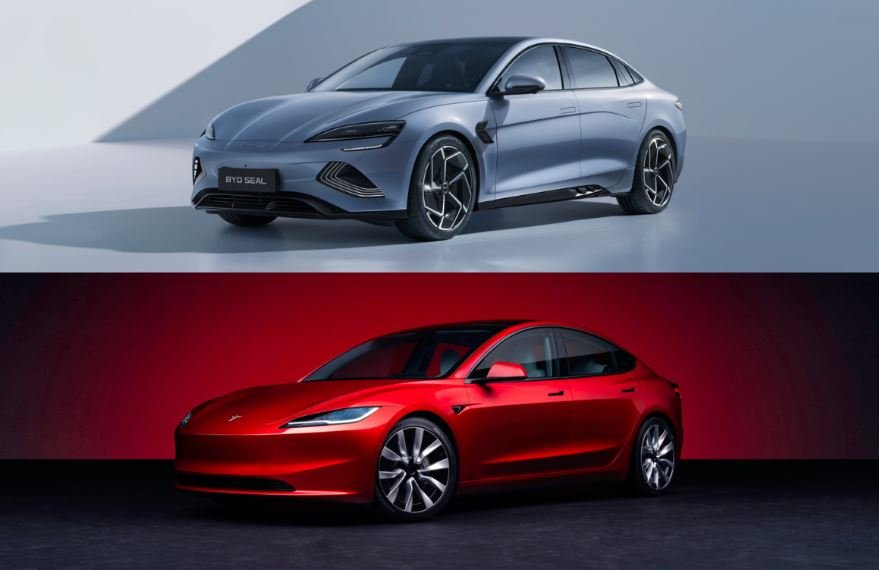
BYD generally undercuts Tesla on price in the UK, but Tesla still wins on charging infrastructure and range-per-pound at the entry level. The BYD Seal starts at £45,730, well above the Tesla Model 3’s £40,390 starting price — but BYD’s Atto 3 Evo and Dolphin models compete lower down the market where Tesla has no direct rival. The right choice depends on whether you value price, charging network, or interior tech more. Below, we break down every model, spec, and price point so you can decide for yourself.
Quick Summary Box
- Cheapest entry point: BYD Dolphin Surf (from £18,650) undercuts every Tesla by a wide margin
- Best value like-for-like: Tesla Model 3 RWD (£40,390) beats the BYD Seal (£45,730) on price, but the Seal edges it on 0-62mph time
- Longest WLTP range: Tesla Model 3 Long Range AWD at up to 421 miles WLTP (confirm current spec sheet before quoting)
- Charging network: Tesla’s Supercharger network (roughly 2,000 UK locations) remains the single biggest practical advantage over BYD
- Company car tax: Both brands’ fully electric models qualify for the same low Benefit-in-Kind rates, so tax treatment is not a deciding factor
BYD vs Tesla UK: The Full Picture
Why This Comparison Matters Right Now
BYD has moved from a niche import to a genuine volume seller in the UK, with year-on-year registration growth running into triple digits according to SMMT figures. Tesla, meanwhile, remains the UK’s best-selling EV brand overall, powered by the Model Y’s continued dominance of the mid-size SUV segment. With both brands refreshing their line-ups for 2026, UK buyers now have a genuinely competitive choice for the first time — not just on price, but on range, tech, and ownership experience.
BYD’s UK Line-Up in 2026
BYD currently sells five core models in the UK, spanning from city car to premium saloon:
- BYD Dolphin Surf — from £18,650, a compact city car aimed at first-time EV buyers
- BYD Dolphin — from £30,205 RRP, compact hatchback rivalling the MG4 and Renault 5 EV, up to roughly 265 miles WLTP
- BYD Atto 3 Evo — from £38,990, compact SUV with a 74.8kWh battery and up to 316 miles WLTP
- BYD Seal — from £45,730 (Design) to £48,730 (Excellence), BYD’s Tesla Model 3 rival
- BYD Sealion 7 — mid-size electric SUV, BYD’s answer to the Model Y
BYD’s pricing advantage is real, but it’s concentrated at the lower end of its range. Once you reach the Seal, which is the closest direct Tesla Model 3 competitor, the price gap actually flips in Tesla’s favour.
Tesla’s UK Line-Up in 2026
Tesla’s UK range has been simplified into clearer Standard, Long Range, and Performance tiers:
- Model 3 RWD — from £40,390, up to 344 miles WLTP
- Model 3 Long Range AWD — up to 421 miles WLTP (verify current trim naming before publishing final figure)
- Model Y Standard (RWD) — from £41,990, up to 314 miles WLTP
- Model Y Long Range RWD — from £44,990, up to 383 miles WLTP
- Model Y Premium Long Range — from £48,990
Tesla dropped its “Standard” naming convention for parts of the range in early 2026, so buyers should double-check exact trim names on Tesla’s UK configurator before comparing.
Price: Who’s Actually Cheaper?
At the very bottom of the market, BYD wins outright — there’s no Tesla equivalent to the £18,650 Dolphin Surf or the sub-£31,000 Dolphin. But the moment you move up to BYD’s Tesla-rivalling saloon, the picture changes. The Seal Design (£45,730) costs roughly £5,300 more than the Model 3 RWD (£40,390) for a shorter WLTP range (354 miles vs 344 miles is close, but real UK pricing puts Tesla ahead on value). The same pattern holds in the SUV segment: the Model Y Standard undercuts most Sealion 7 trims once options are factored in.
Range and Efficiency
Tesla continues to lead on range efficiency across most of its line-up. The Model 3 Long Range AWD’s WLTP figure sits comfortably ahead of the Seal Excellence’s 323 miles, and Tesla’s lower kWh/mile consumption figures generally translate into cheaper running costs per mile at home charging rates. BYD’s Blade Battery — a cobalt-free LFP chemistry — trades some outright efficiency for improved thermal stability and a longer battery warranty (up to eight years or 155,350 miles on the Seal), which matters more to buyers planning to keep a car long-term.
Performance
BYD has quietly closed the performance gap. The entry-level rear-wheel-drive Seal Design does 0-62mph in 5.9 seconds — faster than the equivalent Tesla Model 3 RWD (confirm current Model 3 RWD 0-60 figure against Tesla’s live spec sheet). Step up to the Seal Excellence and its dual-motor setup produces 523bhp for a 3.8-second 0-62mph time, which puts it in the same territory as Tesla’s quicker Long Range and Performance variants.
Charging Network
This remains Tesla’s clearest practical advantage in the UK. Tesla operates roughly 2,000 Supercharger locations across the UK, and non-Tesla owners can now use the network too, albeit at a higher per-kWh rate unless they pay for a Supercharger membership. BYD owners rely entirely on third-party UK charging networks, which have expanded significantly but still lag Tesla’s route-planning integration and charger reliability record.
Interior, Tech, and Ownership Experience
Tesla’s minimalist cabin design — centered on a single central touchscreen — remains divisive; some drivers prefer it, others miss physical controls. BYD’s Seal and Atto 3 both offer a rotating central touchscreen and a separate digital driver display, which some reviewers consider more usable day-to-day. BYD also includes more standard equipment at a given price point, such as a panoramic sunroof and premium audio on the Seal Design trim, where equivalent features can be a paid option on Tesla.
Company Car Tax and Running Costs
Both brands benefit equally here. Fully electric models from either manufacturer qualify for the lowest Benefit-in-Kind band, making either brand a tax-efficient company car choice compared with petrol or diesel equivalents. This means the BYD vs Tesla decision for fleet buyers usually comes down to total cost of ownership and residual values rather than tax treatment — and BYD’s Seal has shown stronger three-year residual value forecasts than the Model 3 in some industry data, despite its higher list price.
Comparison Table: BYD vs Tesla UK Key Models
| Model | Starting Price (UK) | WLTP Range | 0-62mph | Segment |
|---|---|---|---|---|
| BYD Dolphin Surf | £18,650 | ~200 miles | N/A | City car |
| BYD Dolphin | £30,205 | ~265 miles | N/A | Compact hatchback |
| BYD Atto 3 Evo | £38,990 | 316 miles | N/A | Compact SUV |
| Tesla Model 3 RWD | £40,390 | 344 miles | ~6.1s | Saloon |
| BYD Seal Design | £45,730 | 354 miles | 5.9s | Saloon |
| Tesla Model Y Standard | £41,990 | 314 miles | 6.9s | Mid-size SUV |
| Tesla Model Y Long Range RWD | £44,990 | 383 miles | N/A | Mid-size SUV |
| BYD Seal Excellence | £48,730 | 323 miles | 3.8s | Saloon (AWD) |
| Tesla Model Y Premium LR | £48,990 | N/A | N/A | Mid-size SUV |
Prices and range figures current as of July 2026 and subject to change without notice.
Bottom Line: Verdict
If price is your main concern and you don’t need a Model 3 rival, BYD’s Dolphin and Atto 3 undercut anything Tesla offers at the same size class. But for buyers cross-shopping the BYD Seal against the Tesla Model 3 — the most direct head-to-head in this comparison — Tesla wins on price and charging convenience, while BYD wins on standard equipment and low-speed acceleration. Choose Tesla for the charging network and long-distance ease; choose BYD if cabin tech and standard kit matter more to you than brand ecosystem.