- Home
- Electric Vehicles
- Compare Electric Cars
- Tesla Model 3 vs BYD Seal (Atto 4)
Tesla Model 3 vs BYD Seal (Atto 4)
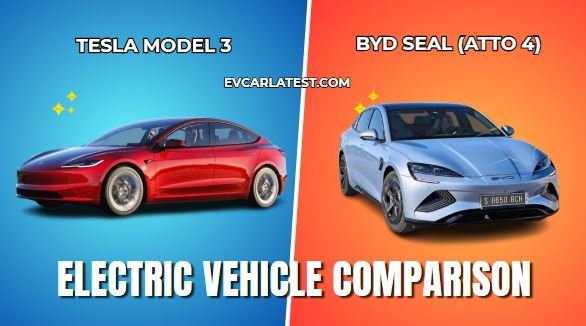
The Tesla Model 3 and BYD Seal are both mid-size electric sedans competing directly on price, range, and technology in an increasing number of markets. The Model 3 needs little introduction — it remains the global benchmark for the segment and the car most other electric sedans get measured against. The BYD Seal is newer, built on BYD’s e-Platform 3.0, and carries the same blade battery technology that has become one of BYD’s clearest selling points. Note that in some markets the Seal is badged as the Atto 4, though the two share the same fundamental platform and powertrain. Both target daily commuters and tech-aware buyers in the mid-size sedan segment who want strong range without crossing into premium pricing. Model 3 buyers are typically drawn to Tesla’s ecosystem and charging network. Seal buyers are often looking at what that money buys in terms of interior space and features at a comparable price.
The BYD Seal Long Range RWD is rated at around 570 km WLTP, with the AWD variant delivering approximately 520 km WLTP. Real-world figures in mixed driving typically land between 430–490 km. The Tesla Model 3 Long Range RWD is rated at around 629 km WLTP on the refreshed Highland build, with real-world performance tracking within 10–15% of that figure — one of the more honest relationships between rated and actual range in the segment. On charging, the BYD Seal supports 800V architecture with DC fast charging peaking at 150 kW, enabling a reasonably quick turnaround at compatible stations. The Model 3 peaks at 250 kW on Tesla’s V3 Superchargers — a higher ceiling — and benefits from a fast-charge network that is denser and more consistent than the public CCS infrastructure the Seal depends on in most Western markets. In China, BYD’s charging partnerships close that gap considerably.
The BYD Seal starts around $21,000–$27,000 USD in China depending on trim, making it one of the stronger value propositions in the segment on home turf. In Europe, pricing moves to approximately €37,000–€45,000 once import duties and local taxes apply, which puts it much closer to — and in some trims above — the Model 3‘s European pricing. The Tesla Model 3 starts at $38,990 USD in the United States, with European pricing broadly in the same band. Both have official presences in Europe, Australia, and parts of Southeast Asia. In markets like Thailand and New Zealand, BYD has been growing its dealer footprint quickly. In Nigeria and most of West Africa, both arrive as grey imports with no formal after-sales support — the Seal is newer to those channels, making the Model 3 the more familiar option by default for now. This page is for buyers in markets where both are officially available, weighing BYD’s blade battery technology and interior sizing against the Model 3’s range leadership and Supercharger network.
BYD’s lineup beyond the Seal includes the Han flagship sedan, the Atto 3 compact SUV, the Dolphin hatchback, and the Sealion 6 crossover — covering a wide range of body styles and budgets. Tesla’s lineup around the Model 3 includes the Model Y for buyers who need more cargo room, and the refreshed Highland Model 3 is worth checking specifically since it introduced meaningful interior and efficiency improvements over earlier builds. On the rival side, the Hyundai Ioniq 6 competes closely with both on efficiency and charging speed, and consistently scores well against the Model 3 in segment comparisons. The XPeng P7 is a direct Seal rival in the Chinese market, and the Volkswagen ID.7 enters the conversation in Europe for buyers looking at a German-branded alternative at a higher price point.
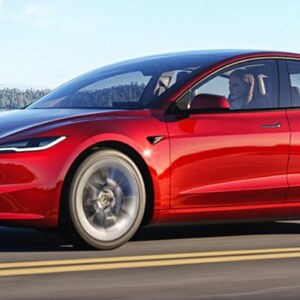
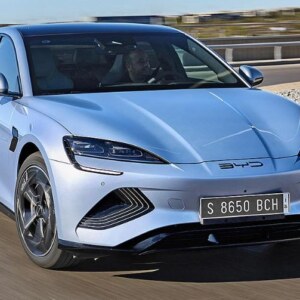
The BYD Seal has a more spacious rear cabin than the Model 3 — a genuine practical advantage for buyers who regularly carry adult passengers — BYD’s blade battery technology which has a strong safety record, and a feature-rich interior that tends to be better equipped at equivalent price points in markets where both compete closely. The Seal’s 150 kW fast-charging ceiling is a step behind faster-charging rivals, and BYD’s service network outside China and its established export markets is still developing in ways that affect ownership confidence. The Model 3 Highland delivers class-leading WLTP range on the Long Range RWD trim, Supercharger access that remains the most consistent public charging experience in North America and much of Europe, and strong resale value in Western markets where EV depreciation matters to the buying decision. The Model 3’s interior has improved with the Highland refresh but still draws comparisons to the Seal and Chinese rivals that offer more at similar prices, and Autopilot’s real-world limitations remain a recurring point of discussion among owners who bought partly on that expectation.
QUICK VERDICT
The BYD Seal is the stronger value argument in China and in markets where it’s priced below the Model 3 — more space, a competitive blade battery, and a feature set that doesn’t ask you to settle. The Model 3 holds its ground on range, charging infrastructure, and resale value in North America and Western Europe specifically. In markets where both land at similar prices after duties, the decision comes down to whether Supercharger access or rear passenger space matters more to how you actually use the car. Neither is a compromise product — they just prioritise different things.
Related EV Comparisons
- Tesla Cybertruck vs GMC Hummer EV SUV
- Volvo EX30 vs BYD Atto 3
- BYD Han vs Tesla Model 3
- NIO ET5 vs Tesla Model 3
- XPeng P7 vs Tesla Model 3
| |
| Price | $43,000.00 |
| Our Rating | |
| Brand | TESLA BYD |
| Category | Electric Cars Electric Cars |
MODEL
| Available Trims / Variants |
Tesla Model 3 Standard Range Tesla Model 3 Long Range RWD Tesla Model 3 Long Range Tesla Model 3 Performance BYD Seal (Atto 4) Standard Range BYD Seal (Atto 4) Long Range BYD Seal (Atto 4) Performance |
PRICE & AVAILABILITY
| Base Price (USD) |
€ 43,000 - Tesla Model 3 Standard Range $ 42,500 - Tesla Model 3 Long Range RWD $ 47,500 € 52,000 - Tesla Model 3 Long Range $ 53,000 € 58,500 £ 60,000 - Tesla Model 3 Performance |
| Availability Status |
Available to order. Released 2023, October - Tesla Model 3 Standard Range Available to order. Released 2024, July - Tesla Model 3 Long Range RWD Available to order. Released 2023, October - Tesla Model 3 Long Range Available to order. Released 2024, April - Tesla Model 3 Performance Available. Released 2023, September |
BATTERY & CHARGING
| Battery Capacity |
57.3 kWh usable, 60 kWh total -Tesla Model 3 Standard Range 78 kWh total - Tesla Model 3 Long Range RWD 78 kWh total - Tesla Model 3 Long Range 78 kWh total - Tesla Model 3 Performance 61.4 kWh total |
| Range (WLTP/CLTC/EPA) |
272 mi EPA (319 mi WLTP) - Tesla Model 3 Standard Range 436 mi WLTP (363 mi EPA) - Tesla Model 3 Long Range RWD 421 mi WLTP (342 mi EPA) - Tesla Model 3 Long Range 328 mi WLTP (296 mi EPA) - Tesla Model 3 Performance |
| DC Charging (Max kW) |
Supercharger V3 170 kW max -Tesla Model 3 Standard Range CCS 170 kW max Supercharger V3 250 kW max - Tesla Model 3 Long Range RWD CCS 250 kW max Supercharger V3 250 kW max - Tesla Model 3 Long Range CCS 250 kW max Supercharger V3 250 kW max - Tesla Model 3 Performance CCS 250 kW max CCS 110 kW, 30-80% in 26 min |
| AC Charging (Max kW) |
Type 2 11 kW, 0-100% in 7 hours 33 min - Tesla Model 3 Standard Range Type 2 11 kW, 0-100% in 8 hours 15 min - Tesla Model 3 Long Range RWD Type 2 11 kW, 0-100% in 8 hours 15 min - Tesla Model 3 Long Range Type 2 11 kW - Tesla Model 3 Performance Type 11 kW |
| Energy Consumption |
212 Wh/mi WLTP - Tesla Model 3 Standard Range 225 Wh/mi WLTP (260 Wh/mi EPA) - Tesla Model 3 Long Range 269 Wh/mi WLTP - Tesla Model 3 Performance |
PERFORMANCE
| Power Output (kW / hp) |
RWD 283 hp (208 kW) - Tesla Model 3 Standard Range RWD -Tesla Model 3 Long Range RWD AWD 498 hp (366 kW) - Tesla Model 3 Long Range AWD 625 hp (460 kW) - Tesla Model 3 Performance RWD 204 hp (150 kW) |
| 0–100 km/h / 0-60 mph (seconds) The acceleration numbers are an easy way to compare car performance. We list either time from 0 to 100 km/h or time from 0 to 60mph, depending on which number(s) the manufacturers provide. The lower the acceleration time, the higher performance the car is. |
5.8 sec 0-60 mph (6.1 sec 0-62 mph) - Tesla Model 3 Standard Range 4.9 sec 0-60 mph - Tesla Model 3 Long Range RWD 4.2 sec 0-60 mph (4.4 sec 0-62 mph) - Tesla Model 3 Long Range 2.9 sec 0-60 mph (3.1 sec 0-62 mph) - Tesla Model 3 Performance 7.5 sec 0-62 mph |
| Torque (Nm) |
450 Nm (332 lb-ft) - Tesla Model 3 Standard Range 493 Nm (364 lb-ft) - Tesla Model 3 Long Range 741 Nm (547 lb-ft) - Tesla Model 3 Performance 310 Nm (229 lb-ft) |
| Top Speed (km/h / mph) |
125 mph (201 km/h) - Tesla Model 3 Standard Range 125 mph (201 km/h) - Tesla Model 3 Long Range RWD 125 mph (201 km/h) - Tesla Model 3 Long Range 163 mph (262 km/h) - Tesla Model 3 Performance 112 mph (180 km/h) |
BODY & DIMENSIONS
| Dimensions (L×W×H mm) | 4720 x 1933 x 1441 mm (185.8 x 76.1 x 56.7 in) 4800 x 1875 x 1460 mm (189.0 x 73.8 x 57.5 in) |
| Trunk/Boot Capacity (L) |
EU: 682 l - Tesla Model 3 Standard Range EU: 594 l - Tesla Model 3 Long Range RWD EU: 594 l - Tesla Model 3 Long Range EU: 594 l - Tesla Model 3 Performance EU: 402 l |
| Body Style | 4 door sedan, 5 seats 4 door sedan, 5 seats |
| Kerb Weight (kg) |
EU: 1765 kg unladen -Tesla Model 3 Standard Range EU: 1822 kg unladen - Tesla Model 3 Long Range RWD EU: 1828 kg unladen, 2263 kg gross - Tesla Model 3 Long Range EU: 1929 kg unladen, 2271 kg gross - Tesla Model 3 Performance |
| Ground Clearance (mm) | 138 mm (5.4 in) |
| Frunk/Bonnet Capacity (L) | 88 l 53 l |
SAFETY & DRIVER ASSISTANCE
| Autonomous Driving Level | Autopilot with full Self-Driving capability |
COMFORT & SEATING
| Seating Capacity | Heated and ventilated/cooled front seats, heated rear seats Heated and ventilated front seats |
DISPLAYS & CONNECTIVITY
| Centre Screen (inches) | 15.4" touchscreen 15.6" rotating touchscreen |
| Driver's Display (inches) | No 10.25" |
| Head-Up Display (HUD) | No Yes |
TECHNOLOGY
ADDITIONAL SPECS
Note
| Additional Notes |
02 October 2024: Model 3 Standard Range is discontinued in USA 10 January 2024: Initial release price 38,990 USD 01 September 2023: Initial release price 42,990 EUR Digital Video Recorder 40500 Nm/degree torsional stiffness |

|
Disclaimer Note
Specifications sourced from manufacturer data and may reflect WLTP, CLTC, or EPA test conditions. Import prices in your local are estimates based on grey-market landing costs and exclude duties, clearing fees, and local taxes. Figures are subject to change without notice. Always verify with your local importer before purchase. We can not guarantee that the information on this page is 100% correct