- Home
- Electric Vehicles
- Compare
- Chevrolet Bolt EV vs Chevrolet Blazer EV
Chevrolet Bolt EV vs Chevrolet Blazer EV
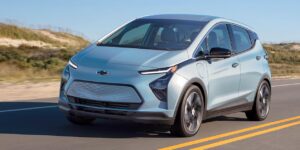
The Chevrolet Bolt EV and Chevrolet Blazer EV sit in different segments under the same brand. The Bolt EV is a compact hatchback built for urban drivers, budget-focused buyers, and daily commuters. The Blazer EV targets midsize SUV buyers who want more space, stronger performance options, and newer tech, including families and long-distance users.
Range and charging show a clear gap. The Bolt EV delivers about 259 miles (EPA) from a smaller battery, while the Blazer EV reaches up to 324 miles depending on trim. Charging speeds differ more. The Bolt EV peaks around 55 kW DC fast charging, which leads to longer stops. The Blazer EV supports up to about 190 kW DC fast charging, cutting charging time significantly and improving highway usability.

Price and positioning separate them further. The Bolt EV sits in the lower price bracket, historically around the $26K–$30K range before incentives, making it one of the most affordable EVs. The Blazer EV starts much higher, typically from the mid-$40K range and above depending on trims like LT, RS, or SS. The Bolt EV has had limited availability due to discontinuation and relaunch plans, while the Blazer EV is newer and expanding across North America. This comparison helps you decide between a low-cost city EV and a more versatile, modern electric SUV.
Within the brand, the Bolt EV relates to models like the Chevrolet Bolt EUV, while the Blazer EV aligns more with larger EV efforts and future GM platforms. Cross-brand rivals differ by segment. Bolt EV rivals include the Nissan Leaf and Mini Electric. Blazer EV competitors include the Ford Mustang Mach-E, Hyundai Ioniq 5, and Tesla Model Y.
The Bolt EV offers low entry cost, strong efficiency, and simple usability, but slower charging and smaller interior limit flexibility. The Blazer EV brings longer range, faster charging, and more space, but higher cost and heavier size reduce efficiency in city use.
QUICK VERDICT; Pick the Bolt EV if your focus stays on budget and daily city driving. Choose the Blazer EV if you need range, space, and faster charging for mixed or long-distance use.
Related EV Comparisons
- Chevrolet Equinox EV vs Chevrolet Silverado EV
- Chevrolet Equinox EV vs Hyundai Ioniq 5
- Chevrolet Equinox EV vs Tesla Model Y
- Chevrolet Equinox EV vs Nissan Ariya

MODEL
| Models |
Chevrolet Blazer EV LT Chevrolet Blazer EV RS RWD Chevrolet Blazer EV RS AWD Chevrolet Blazer EV SS pAWD |
LAUNCH
| Announced | 2021, August 16 2022, July 19 |
| Status |
Available to order. Released 2021, Q3
Available to order. Released 2023, Q3 - Chevrolet Blazer EV LT Available to order. Released 2023, Q3 - Chevrolet Blazer EV RS RWD Available to order. Released 2023, Q3 - Chevrolet Blazer EV RS AWD Available to order. Released 2024, Q2 - Chevrolet Blazer EV SS pAWD |
| Country of origin | United States |
| Base Price |
$ 32,500
$ 50,200 - Chevrolet Blazer EV LT $ 56,200 - Chevrolet Blazer EV RS RWD $ 54,500 - Chevrolet Blazer EV RS AWD $ 66,000 - Chevrolet Blazer EV SS pAWD |
PERFORMANCE
| Power |
FWD 200 hp (150 kW)
AWD 288 hp (212 kW) - Chevrolet Blazer EV LT RWD 340 hp (250 kW) - Chevrolet Blazer EV RS RWD AWD 288 hp (212 kW) - Chevrolet Blazer EV RS AWD AWD 557 hp (410 kW) - Chevrolet Blazer EV SS pAWD |
| Torque |
266 lb-ft (360 Nm)
333 lb-ft (451 Nm) - Chevrolet Blazer EV LT 441 Nm (325 lb-ft) - Chevrolet Blazer EV RS RWD 451 Nm (333 lb-ft) - Chevrolet Blazer EV RS AWD 879 Nm (648 lb-ft) - Chevrolet Blazer EV SS pAWD |
| Acceleration The acceleration numbers are an easy way to compare car performance. We list either time from 0 to 100 km/h or time from 0 to 60mph, depending on which number(s) the manufacturers provide. The lower the acceleration time, the higher performance the car is. |
6.5 sec 0-60 mph
6.5 sec 0-60 mph - Chevrolet Blazer EV RS RWD 6 sec 0-60 mph - Chevrolet Blazer EV RS AWD 4 sec 0-60 mph - Chevrolet Blazer EV SS pAWD |
| Max Speed |
90 mph (145 km/h)
118 mph (190 km/h) - Chevrolet Blazer EV LT 118 mph (190 km/h) - Chevrolet Blazer EV RS RWD 118 mph (190 km/h) - Chevrolet Blazer EV RS AWD 130 mph (209 km/h) - Chevrolet Blazer EV SS pAWD |
| transmission | Single-speed |
BATTERY
| Capacity |
65 kWh usable
85 kWh total - Chevrolet Blazer EV LT 102 kWh total - Chevrolet Blazer EV RS RWD 85 kWh total - Chevrolet Blazer EV RS AWD 102 kWh total - Chevrolet Blazer EV SS pAWD |
| Tech | Liquid-cooled Li-ion 350V Liquid-cooled Li-ion (400V type) |
| Range |
259 mi EPA
279 mi EPA - Chevrolet Blazer EV LT 324 mi EPA - Chevrolet Blazer EV RS RWD 279 mi EPA - Chevrolet Blazer EV RS AWD 279 mi EPA - Chevrolet Blazer EV SS pAWD |
| Consumption | 280 Wh/mi EPA 350 Wh/mi EPA |
| Recuperation | Yes Yes |
| Heat Pump | |
| AC Charging |
Up to 11 kW
Type 1 110V Type 2 11.5 kW |
| DC Charging |
Up to 55 kW
CCS 150 kW - Chevrolet Blazer EV LT CCS 190 kW - Chevrolet Blazer EV RS RWD CCS 190 kW - Chevrolet Blazer EV RS AWD CCS 190 kW - Chevrolet Blazer EV SS pAWD |
BODY
| Type | 5 door Hatchback, 5 seats 5 door SUV, 5 seats |
| Platform | BEV2 BEV3 |
| Dimensions | 163.2 x 69.5 x 63.4 in (4145 x 1765 x 1611 mm) 192.2 x 78.0 x 65.0 in (4882 x 1981 x 1651 mm) |
| Drag Co-Efficient | 0.32 Cd |
| Wheelbase | 102.4 in (2600 mm) 121.8 in (3094 mm) |
| Weight |
US: 3589 lb curb
US: 2536 kg curb - Chevrolet Blazer EV RS AWD US: 2421 kg curb - Chevrolet Blazer EV SS pAWD |
| Suspension | Front Independent MacPherson strut-type with direct-acting solid stabilizer bar, rear Compound crank (torsion beam) with coil springs Front short-long-arm double wishbone, rear multi-link |
| Wheels | R17 R19, R21, R22 |
| Trunk/Boot | US: 16.6 ft³, 57 ft³ max US: 25.5 ft³, 59.1 ft³ max |
| Frunk/Bonnet | No No |
| Towing |
No
No - Chevrolet Blazer EV LT No - Chevrolet Blazer EV RS AWD US: 680 kg unbraked - Chevrolet Blazer EV RS AWD US: 680 kg unbraked - Chevrolet Blazer EV SS pAWD |
DISPLAYS
| Centre | 10.2" touchscreen 17.7" touchscreen |
| Driver's Display | 8" 11" |
| Head-Up | No Yes, projector type |
COMFORT
| Seats | Heated and ventilated front seats Heated and ventilated front seats, heated rear seats |
| Roof | Panoramic glass roof, tilt & slide Panoramic glass sunroof |
| Parking Aids | Front and rear sensors, 360 camera, reversing camera Front and rear sensors, 360 camera, reversing camera, Advanced Park Assist |
| Connectivity | Wireless Apple CarPlay, Wireless Android Auto Android Automotive |
SAFETY
| Airbags | 10 airbags: front, side, rear, head airbag system, front seats knee airbags Front, side, rear, head airbag system, front seats knee airbags |
| Driving Aids | Front radar, front camera, 2 side cameras, rear camera. Forward Collision Alert, Rear Cross Traffic Alert, Lane Departure Warning, Lane Keep Assist, Side Blind Zone Alert, Lane Change Alert, Automatic Emergency Braking, Front Pedestrian Braking, Road Sign detection, High-Beam Assist, Driver Attention System, Vehicle Ahead Indicator Front radar, front camera, 2 side cameras, rear camera. Forward Collision Alert, Rear Cross Traffic Alert, Lane Departure Warning, Lane Keep Assist, Side Blind Zone Alert, Lane Change Alert, Automatic Emergency Braking, Front Pedestrian Braking, Road Sign detection, High-Beam Assist, Driver Attention System, Vehicle Ahead Indicator, Reverse Automatic Braking |
| Crash Tests | NHTSA 2020-2021: 5 stars |
Note

|
Disclaimer Note
We can not guarantee that the information on this page is 100% correct