- Home
- Electric Vehicles
- Compare
- Chevrolet Bolt EV vs Nissan Leaf
Chevrolet Bolt EV vs Nissan Leaf
Chevrolet Bolt EV and Nissan Leaf are compact electric hatchbacks built for buyers shifting from gas cars to affordable EVs. Both fit the entry EV segment where buyers want simple electric transport with usable range for daily driving and errands.
The Bolt EV’s EPA range sits near 259 miles. The Leaf’s range varies by battery: the standard Leaf is lower (around 150 miles) and the Leaf Plus trims reach about 215 miles. On charging, the Bolt EV accepts higher DC fast‑charge power, so it adds range quicker on compatible chargers. The Leaf’s fast‑charge power is lower on standard trims and higher on Plus trims, but overall it’s slower than the Bolt EV on the same charger.
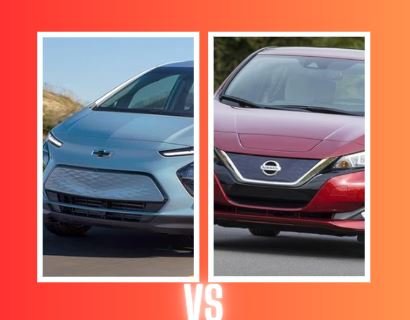
Price for the Bolt EV is positioned above the entry Leaf but below many larger EVs. The Leaf starts lower on price for base trims and climbs for the Plus. Both are widely sold in the U.S., though Nissan has reduced Leaf availability in some regions as newer EVs arrive. This comparison helps you choose between a longer‑range compact EV and a basic, lower‑cost EV with shorter range.
Chevrolet’s EV lineup also includes the Bolt EUV and upcoming Equinox EV. Nissan’s EV family includes the Ariya. Rival EVs for the Bolt EV include Hyundai Kona Electric and Kia Niro EV. For the Leaf, rivals include the Mini Electric and older model EVs in the affordable hatch segment.
Bolt EV pros: higher all‑electric range, faster DC charging, simple cabin. Cons: tighter rear seating, basic tech feel. Leaf pros: lower base price, easy daily range, comfortable ride. Cons: shorter range on base models, slower charging overall.
QUICK VERDICT; Pick the Bolt EV for longer range and faster charging. Pick the Leaf if you want a lower entry price and simple EV transport.
Related EV Comparisons
- Chevrolet Equinox EV vs Chevrolet Silverado EV
- Chevrolet Equinox EV vs Hyundai Ioniq 5
- Chevrolet Equinox EV vs Tesla Model Y
- Chevrolet Equinox EV vs Nissan Ariya
- Chevrolet Bolt EV vs Chevrolet Blazer EV
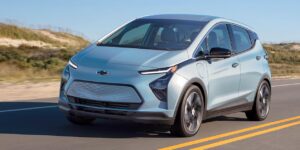
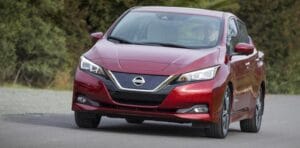
MODEL
| Models |
Nissan Leaf 40kWh Nissan Leaf 62kWh |
LAUNCH
| Announced |
2021, August 16
2017, October |
| Status |
Available to order. Released 2021, Q3
Available to order. Released 2018, February - Nissan Leaf 40kWh Available to order. Released 2019 - Nissan Leaf 62kWh |
| Country of origin | Japan |
| Base Price |
$ 32,500
$ 27,400 € 29,990 £ 25,990 - Nissan Leaf 40kWh $ 32,400 € 37,550 £ 30,440 - Nissan Leaf 62kWh |
PERFORMANCE
| Power |
FWD 200 hp (150 kW)
FWD 150 hp (110 kW) - Nissan Leaf 40kWh FWD 218 hp (160 kW) - Nissan Leaf 62kWh |
| Torque |
266 lb-ft (360 Nm)
320 Nm (236 lb-ft)- Nissan Leaf 40kWh 340 Nm (251 lb-ft) - Nissan Leaf 62kWh |
| Acceleration The acceleration numbers are an easy way to compare car performance. We list either time from 0 to 100 km/h or time from 0 to 60mph, depending on which number(s) the manufacturers provide. The lower the acceleration time, the higher performance the car is. |
6.5 sec 0-60 mph
7.9 sec 0-62 mph - Nissan Leaf 40kWh 6.9 sec 0-62 mph - Nissan Leaf 62kWh |
| Max Speed |
90 mph (145 km/h)
89 mph (144 km/h) - Nissan Leaf 40kWh 98 mph (157 km/h) - Nissan Leaf 62kWh |
| transmission | Single-speed |
BATTERY
| Capacity |
65 kWh usable
38 kWh usable, 40 kWh total - Nissan Leaf 40kWh 58 kWh usable, 62 kWh total - Nissan Leaf 62kWh |
| Tech | Liquid-cooled Li-ion 350V Li-ion 360V |
| Range |
259 mi EPA
168 mi WLTP (151 mi EPA, 124 mi NEDC) - Nissan Leaf 40kWh 239 mi WLTP (226 mi EPA, 155 mi NEDC) - Nissan Leaf 62kWh |
| Consumption |
280 Wh/mi EPA
300 Wh/mi EPA (332 Wh/mi WLTP) - Nissan Leaf 40kWh 290 Wh/mi WLTP (310 Wh/mi EPA) - Nissan Leaf 62kWh |
| Recuperation |
Yes
1 level, on/off button |
| Heat Pump | |
| AC Charging |
Up to 11 kW
Type 2 6.6 kW AC, 0-100% in 8 hours - Nissan Leaf 40kWh Type 2 6.6 kW AC, 0-100% in 11 hours 30 min - Nissan Leaf 62kWh |
| DC Charging |
Up to 55 kW
CHAdeMO 50 kW max, 0-80% in 40 min - Nissan Leaf 40kWh CHAdeMO 100 kW max, 0-80% in 45 min - Nissan Leaf 62kWh |
BODY
| Type |
5 door Hatchback, 5 seats
5 door hatchback, 5 seats |
| Platform | BEV2 e-Powertrain |
| Dimensions | 163.2 x 69.5 x 63.4 in (4145 x 1765 x 1611 mm) 4490 x 1788 x 1530 mm (176.8 x 70.4 x 60.2 in) |
| Drag Co-Efficient | 0.32 Cd 0.28 Cd |
| Wheelbase | 102.4 in (2600 mm) 2700 mm (106.3 in) |
| Clearance | 150 mm (5.9 in) |
| Weight |
US: 3589 lb curb
EU: 1580 kg unladen, 1995 kg gross - Nissan Leaf 40kWh EU: 1756 kg unladen, 2140 kg gross - Nissan Leaf 62kWh |
| Suspension | Front Independent MacPherson strut-type with direct-acting solid stabilizer bar, rear Compound crank (torsion beam) with coil springs Front MacPherson struts, rear torsion beam axle |
| Wheels | R17 R16, R17 |
| Trunk/Boot |
US: 16.6 ft³, 57 ft³ max
EU: 435 l, 1176 l max - Nissan Leaf 40kWh EU: 420 l, 1161 l max - Nissan Leaf 62kWh |
| Frunk/Bonnet |
No
No |
| Towing | No No |
DISPLAYS
| Centre | 10.2" touchscreen 5" or 7" or 8" touchscreen |
| Driver's Display | 8" 7" |
| Head-Up | No No |
COMFORT
| Seats | Heated and ventilated front seats Heated front seats, heated outer rear seats |
| Roof | Panoramic glass roof, tilt & slide No glass roof |
| Parking Aids |
Front and rear sensors, 360 camera, reversing camera
Front and rear sensors, 360 camera, reversing camera, ProPilot autonomous parking |
| Connectivity | Wireless Apple CarPlay, Wireless Android Auto Wired Android Auto and Apple CarPlay |
SAFETY
| Airbags | 10 airbags: front, side, rear, head airbag system, front seats knee airbags Side airbags, front and rear, including head airbag system |
| Driving Aids | Front radar, front camera, 2 side cameras, rear camera. Forward Collision Alert, Rear Cross Traffic Alert, Lane Departure Warning, Lane Keep Assist, Side Blind Zone Alert, Lane Change Alert, Automatic Emergency Braking, Front Pedestrian Braking, Road Sign detection, High-Beam Assist, Driver Attention System, Vehicle Ahead Indicator Front view camera and radar. Blind Spot Warning, Lane Departure Prevention, Lane Departure Warning, Rear Cross Traffic Alert, Driver Attention Alert, Automatic Emergency Braking with Pedestrian Detection, Intelligent Around View Monitor, High Beam Assist |
| Crash Tests | NHTSA 2020-2021: 5 stars NCAP 2018: 5 stars, NHTSA 2020-2022: 5 stars |
Note
| Others | Nissan Leaf 62kWh Also known as Nissan Leaf e+, Nissan Leaf Plus |
| disclaimer | We can not guarantee that the information on this page is 100% correct |
|
Disclaimer Note
We can not guarantee that the information on this page is 100% correct