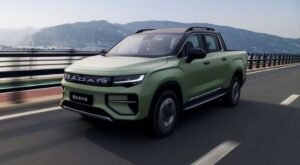
Radar King Kong EV and Riddara RD6 sit on the same Geely Radar platform and target different buyer expectations within the same pickup segment. Both serve as midsize electric pickups built for work use, fleet operators, and lifestyle buyers who want lower running cost alternatives to diesel trucks. The King Kong variant positions itself as a rugged, higher-utility version, while the standard RD6 focuses on balanced comfort and daily usability. This comparison matters now as Geely expands Radar pickups into export markets, including regions in Africa where pricing and durability shape purchase decisions.

Radar King Kong EV uses CLTC ratings around 400 to 600 km depending on battery choice, while Riddara RD6 sits in a similar CLTC band with up to about 550 to 600 km on long-range trims. Real-world driving in mixed city and highway use drops both into the 320 to 500 km range depending on load, terrain, and speed.
AC charging sits around 6.6 to 11 kW for both models, depending on onboard charger setup. DC fast charging peaks near 120 kW on King Kong variants and up to about 110 to 120 kW on RD6 trims. A 10 to 80 percent charge session takes around 35 to 50 minutes on standard DC stations. Home charging overnight suits both models for daily use, while highway charging favors planned stops.
Radar King Kong EV starts near $25,000 to $35,000, which aligns with roughly ₦30M to ₦45M in Nigeria based on import conditions. Riddara RD6 sits slightly higher in some markets, starting near $28,000 to $38,000, or about ₦35M to ₦50M depending on trim and duty.
King Kong trims focus on payload strength and utility setups, while RD6 trims focus on comfort, infotainment upgrades, and cabin refinement. Both models sell primarily in China, with gradual expansion into Southeast Asia and selected African import channels through third-party dealers.
This comparison helps you choose between a more rugged, utility-focused electric pickup and a more comfort-oriented version of the same platform.
Within the Radar lineup, both King Kong EV and RD6 sit under the same pickup family, with future variants expected around battery and drivetrain tuning rather than full redesigns.
Outside the brand, rivals include the Ford F-150 Lightning and the Tesla Cybertruck, both positioned in higher price tiers with stronger performance and software ecosystems. Other mid-tier competitors include emerging Chinese electric pickups targeting export markets.
This comparison still holds value because both Radar models deliver near-identical platform engineering, so your decision shifts to trim focus rather than brand or drivetrain difference.
Radar King Kong EV offers strong load capacity suited for work users who move goods or equipment daily. It delivers lower entry pricing, which supports budget-focused buyers in emerging markets. It also provides simple mechanical layout, which reduces complexity in long-term use. It shows weaker cabin refinement compared to passenger-focused trims. It also carries slower charging response compared to higher-end electric pickups.
Riddara RD6 offers a more refined interior setup, which suits family and mixed-use drivers. It delivers smoother ride tuning for city driving and longer commutes. It also offers better infotainment integration for connected driving needs. It shows higher purchase cost compared to utility-focused variants. It also places less emphasis on heavy-duty work configurations.
QUICK VERDICT
Choose Radar King Kong EV if lower cost ownership and work-focused usage matter most. Choose Riddara RD6 if comfort, cabin quality, and daily driving refinement matter more. Both sit on the same platform, so your decision depends on workload versus lifestyle balance. Price difference and trim focus define the final choice rather than performance gap.
Related EV Comparisons
| Models |
7 variants — 4 RWD, 3 AWD (Standard Bed & Long Bed) Export name - Riddara RD6 Riddara RD6 Pro |
| Announced | December 23, 2024 2022 |
| Status | On sale In Production |
| Country of origin | China China |
| Base Price | $13,700 (¥99,800 CNY) — up to ~$21,900 (¥159,800 CNY) 68,500 New Zealand Dollar |
| Power | RWD: 241 hp (180 kW) single motor · AWD: 375 hp (280 kW) dual motor 268 hp, Single Motor Rear-Wheel Drive (RWD) |
| Torque | RWD: 309 Nm · AWD: 485 Nm 384 Nm |
| Acceleration The acceleration numbers are an easy way to compare car performance. We list either time from 0 to 100 km/h or time from 0 to 60mph, depending on which number(s) the manufacturers provide. The lower the acceleration time, the higher performance the car is. | RWD: 8.1 sec · AWD: 5.7 sec (7.8 sec fully loaded) 0-100 km/h in 6.9 seconds |
| Max Speed | 185 km/h |
| transmission | Single-speed direct drive |
| Capacity | RWD: 42 / 55 / 73 / 86 kWh · AWD: 42 / 63 / 73 kWh 86.0 kWh |
| Tech | LFP (Lithium Iron Phosphate) Lithium Iron Phosphate (LFP) |
| Range | RWD: 310–605 km · AWD: 330–520 km 400 km (WLTP) |
| Consumption | 16.5 kWh/100 km (WLTP) |
| Recuperation | Yes |
| Heat Pump | |
| AC Charging | 7 kW, 12 hours (0-100%) |
| DC Charging | 120 kW, 30 minutes (20-80%) |
| Others | Five-star battery protection system; battery warranty: lifetime (3 electric systems) Bidirectional charging capability (V2L) |
| Type | 4-door, 5-seat pickup truck (dual-cab) 4-door, 5-seat pick-up truck |
| Platform | MAP Radar Hanhai (monocoque) Geely SEA platform |
| Dimensions |
(Standard Bed) 5,260 × 1,900 × 1,865 mm (RWD) / 1,880 mm height (AWD) (Long Bed)5,500 × 1,900 × 1,865 mm (RWD) / 1,880 mm height (AWD) 5260 x 1900 x 1830 mm |
| Drag Co-Efficient | 0.29 Cd |
| Wheelbase | Standard: 3,120 mm · Long: 3,310 mm 3120 mm |
| Clearance | 225 mm 220 mm |
| Weight | 2,130 kg |
| Suspension | Front: MacPherson struts · Rear: Multi-link Front double wishbone, Rear multi-link |
| Wheels | 18-inch |
| Trunk/Boot |
(Standard)1,525 × 1,450 × 540 mm (Long)1,765 mm depth 1,200 L bed |
| Frunk/Bonnet | 70 L |
| Towing | 2,500 kg |
| Cargo Capacity (kg) | 1,000 kg |
| Others | 70% high-strength steel body; torsional rigidity: 30,300 Nm; turning radius: 6.1 m |
| Centre | 14.6-inch touchscreen (Galaxy OS infotainment) 12.3-inch touchscreen |
| Driver's Display | 10.2-inch digital instrument cluster 10.25-inch digital cluster |
| Seats | 5 seats; artificial leather upholstery; electric seats (higher trims) Synthetic leather |
| Roof | Panoramic sunroof |
| Parking Aids | Surround-view cameras confirmed Rear parking sensors, 360-degree camera |
| Connectivity | Galaxy OS; Bluetooth/wireless Bluetooth, Apple CarPlay, Android Auto |
| Others | Active noise insulation; 4 terrain modes (Snow, Mud, Off-road, Sand); 3 drive modes (Eco, Comfort, Sport) on AWD |
| Airbags | Front, side, and curtain airbags |
| Driving Aids | Automatic emergency braking, lane-keeping assist confirmed; full ADAS Adaptive cruise control, lane-keeping assist, blind-spot monitoring |
| Self Driving | Level 2 |
|
We can not guarantee that the information on this page is 100% correct