- Home
- Electric Vehicles
- Compare Electric Cars
- Tesla Model Y vs Hyundai Ioniq 5
Tesla Model Y vs Hyundai Ioniq 5
The Tesla Model Y and the Hyundai Ioniq 5 are both electric crossover SUVs sold across multiple global markets. The Model Y is built by Tesla and sits as the brand’s best-selling vehicle worldwide. The Ioniq 5 is built by Hyundai and is part of the dedicated Ioniq EV sub-brand. Both vehicles target mainstream buyers looking for a practical, five-seat electric crossover with reasonable range for daily use and family trips — the segment that currently drives the largest share of global EV sales.
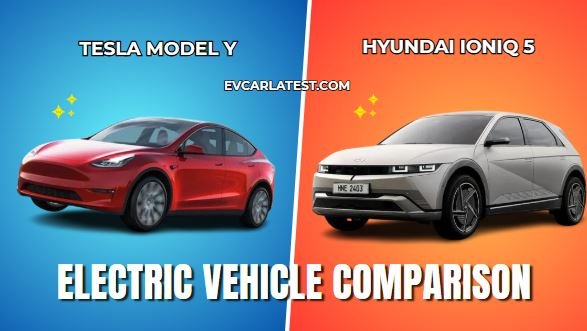
The Tesla Model Y Long Range AWD is rated at up to 330 miles of range, while the rear-wheel drive Standard Range version sits around 260 miles depending on the market. The Hyundai Ioniq 5 Long Range RWD reaches up to 303 miles, with the AWD version rated around 266 miles. On charging, the Ioniq 5 supports 800V architecture with up to 350 kW DC fast charging, allowing it to charge from 10 to 80 percent in around 18 minutes under ideal conditions. The Model Y charges at up to 250 kW on Tesla’s V3 Superchargers. The Ioniq 5 holds a clear advantage in peak charging speed, though Tesla’s Supercharger network remains the most extensive in North America and is expanding in other regions.
The Tesla Model Y starts at around $43,990 in the US for the rear-wheel drive version, with the Long Range AWD sitting closer to $48,990. The Hyundai Ioniq 5 starts at approximately $42,000 for the Standard Range trim and rises to around $55,000 for the Long Range AWD. Pricing varies by market, and both vehicles are available in Europe, Australia, and select Asian markets in addition to North America. The Model Y has broader global availability and higher production volume. The Ioniq 5 is widely stocked at Hyundai dealerships, which gives it a more conventional purchase and service experience compared to Tesla’s direct-sales model. This page helps buyers decide between two of the most purchased electric crossovers currently on the market, particularly if they are weighing charging network access against charging speed, or brand familiarity against software integration.
Tesla’s other current models include the Model 3, Model S, Model X, and Cybertruck. Hyundai’s other EVs under the Ioniq sub-brand include the Ioniq 6 sedan and the upcoming Ioniq 9 SUV, alongside the older Kona Electric. Outside these two brands, the main rivals in this segment are the Volkswagen ID.4, which competes closely on price and practicality, and the Kia EV6, which shares the same E-GMP platform as the Ioniq 5 and targets a near-identical buyer.
The Tesla Model Y’s three main strengths are its access to the largest fast-charging network in North America, its over-the-air software updates that regularly add features post-purchase, and its strong resale value relative to most competitors in the segment. Its two weaknesses are its interior, which is sparse by the standards of similarly priced conventional SUVs, and its service network, which remains thinner than traditional automaker dealership coverage in many regions. The Hyundai Ioniq 5’s three main strengths are its 800V charging architecture that cuts charge times significantly on compatible hardware, its vehicle-to-load bidirectional charging that allows it to power external devices and appliances, and its spacious interior with a flat floor and sliding center console. Its two weaknesses are its charging network dependency on third-party providers outside Korea, which varies in reliability by market, and its infotainment system, which is less integrated than Tesla’s in terms of over-the-air updates and app ecosystem.
Quick Verdict: These two crossovers are the most direct comparison in the mainstream EV segment. The Model Y wins on charging network reach and software consistency. The Ioniq 5 wins on peak charging speed and interior space. Buyers who drive long distances frequently and rely on public infrastructure will find the Model Y’s Supercharger access hard to ignore. Buyers who prioritize faster top-ups when chargers are available, and want more physical space inside the cabin, have a stronger case for the Ioniq 5.
Related EV Comparsions
| |
| Price | $45,000.00 $44,000.00 |
| Our Rating | |
| Brand | TESLA Hyundai |
| Category | Electric Cars Electric Cars |
MODEL
| Available Trims / Variants |
Tesla Model Y Standard Range+ RWD 60kWh Tesla Model Y Long Range AWD 82kWh Tesla Model Y Long Range RWD Tesla Model Y Long Range RWD USA Tesla Model Y Performance Hyundai Ioniq 5 63kWh RWD Hyundai Ioniq 5 84kWh RWD Hyundai Ioniq 5 84kWh AWD |
PRICE & AVAILABILITY
| Base Price (USD) |
€ 45,000 £ 45,000 - Tesla Model Y Standard Range+ RWD 60kWh $ 48,000 € 52,500 £ 53,000 - Tesla Model Y Long Range AWD 82kWh € 49,000 - Tesla Model Y Long Range RWD $ 45,000 - Tesla Model Y Long Range RWD USA $ 51,500 € 58,500 £ 60,000 - Tesla Model Y Performance € 44,000 £ 40,000 - Hyundai Ioniq 5 63kWh RWD € 51,700 £ 43,400 - Hyundai Ioniq 5 84kWh RWD € 59,400 £ 50,900 - Hyundai Ioniq 5 84kWh AWD |
| Availability Status |
Available. Released 2022, August - Tesla Model Y Standard Range+ RWD 60kWh Available to order. Released 2021 - Tesla Model Y Long Range AWD 82kWh Available to order. Released 2024, April - Tesla Model Y Long Range RWD Available to order. Released 2024, May - Tesla Model Y Long Range RWD USA Available to order. Released 2020 - Tesla Model Y Performance Available to order. Released 2024, July |
BATTERY & CHARGING
| Battery Capacity |
60 kWh total - Tesla Model Y Standard Range+ RWD 60kWh 75 kWh usable, 82 kWh total - Tesla Model Y Long Range AWD 82kWh 78.1 kWh total - Tesla Model Y Long Range RWD 76 kWh usable, 82 kWh total - Tesla Model Y Performance 63 kWh total - Hyundai Ioniq 5 63kWh RWD 84 kWh total - Hyundai Ioniq 5 84kWh RWD 84 kWh total - Hyundai Ioniq 5 84kWh AWD |
| Range (WLTP/CLTC/EPA) |
260 mi EPA (283 mi WLTP) - Tesla Model Y Standard Range+ RWD 60kWh 351 mi WLTP (310 mi EPA) - Tesla Model Y Long Range AWD 82kWh 373 mi WLTP - Tesla Model Y Long Range RWD 320 mi EPA - Tesla Model Y Long Range RWD USA 319 mi WLTP (279 mi EPA) - Tesla Model Y Performance 273 mi WLTP (240 mi EPA) - Hyundai Ioniq 5 63kWh RWD 320 mi WLTP (310 mi EPA) - Hyundai Ioniq 5 84kWh RWD 308 mi WLTP (280 mi EPA) - Hyundai Ioniq 5 84kWh AWD |
| DC Charging (Max kW) |
Supercharger V3 250 kW max, 10-80% in 30 min CCS 250 kW max, 10-80% in 30 min CCS 180 kW, 10-80% in 18 min - Hyundai Ioniq 5 63kWh RWD CCS 235 kW, 10-80% in 18 min - Hyundai Ioniq 5 84kWh RWD CCS 235 kW, 10-80% in 18 min - Hyundai Ioniq 5 84kWh AWD |
| AC Charging (Max kW) |
Type 2 7.7 kW - Tesla Model Y Standard Range+ RWD 60kWh Type 2 11 kW, 0-100% in 7 hours 31 min - Tesla Model Y Long Range AWD 82kWh Type 2 11 kW -Tesla Model Y Long Range RWD Type 2 11 kW - Tesla Model Y Long Range RWD USA Type 2 11 kW, 0-100% in 7 hours 31 min - Tesla Model Y Performance Type 2 11 kW |
| Energy Consumption |
253 Wh/mi WLTP - Tesla Model Y Standard Range+ RWD 60kWh 272 Wh/mi WLTP (280 Wh/mi EPA) - Tesla Model Y Long Range AWD 82kWh 249 Wh/mi WLTP - Tesla Model Y Long Range RWD 249 Wh/mi WLTP - Tesla Model Y Long Range RWD USA 275 Wh/mi WLTP (280 Wh/mi EPA) - Tesla Model Y Performance 251 Wh/mi WLTP - Hyundai Ioniq 5 63kWh RWD 277 Wh/mi WLTP - Hyundai Ioniq 5 84kWh RWD 293 Wh/mi WLTP - Hyundai Ioniq 5 84kWh AWD |
PERFORMANCE
| Power Output (kW / hp) |
RWD 347 hp (255 kW) - Tesla Model Y Standard Range+ RWD 60kWh AWD 514 hp (378 kW) - Tesla Model Y Long Range AWD 82kWh RWD 347 hp (255 kW) - Tesla Model Y Long Range RWD RWD - Tesla Model Y Long Range RWD USA AWD 534 hp (393 kW) - Tesla Model Y Performance RWD 170 hp (125 kW) - Hyundai Ioniq 5 63kWh RWD RWD 228 hp (168 kW) - Hyundai Ioniq 5 84kWh RWD AWD 325 hp (239 kW) - Hyundai Ioniq 5 84kWh AWD |
| 0–100 km/h / 0-60 mph (seconds) The acceleration numbers are an easy way to compare car performance. We list either time from 0 to 100 km/h or time from 0 to 60mph, depending on which number(s) the manufacturers provide. The lower the acceleration time, the higher performance the car is. |
6.6 sec 0-60 mph (6.9 sec 0-62 mph) - Tesla Model Y Standard Range+ RWD 60kWh 4.8 sec 0-60 mph (5 sec 0-62 mph) - Tesla Model Y Long Range AWD 82kWh 5.9 sec 0-62 mph - Tesla Model Y Long Range RWD 6.5 sec 0-60 mph - Tesla Model Y Long Range RWD USA 3.5 sec 0-60 mph (3.7 sec 0-62 mph) - Tesla Model Y Performance 8.5 sec 0-62 mph - Hyundai Ioniq 5 63kWh RWD 7.5 sec 0-62 mph - Hyundai Ioniq 5 84kWh RWD 5.3 sec 0-62 mph - Hyundai Ioniq 5 84kWh AWD |
| Torque (Nm) |
RWD 347 hp (255 kW) - Tesla Model Y Long Range RWD
350 Nm (258 lb-ft) - Hyundai Ioniq 5 63kWh RWD 350 Nm (258 lb-ft) - Hyundai Ioniq 5 84kWh RWD 605 Nm (446 lb-ft) - Hyundai Ioniq 5 84kWh AWD |
| Top Speed (km/h / mph) |
135 mph (217 km/h) - Tesla Model Y Standard Range+ RWD 60kWh 135 mph (217 km/h) - Tesla Model Y Long Range AWD 82kWh 135 mph (217 km/h) - Tesla Model Y Long Range RWD 135 mph (217 km/h) - Tesla Model Y Long Range RWD USA 155 mph (250 km/h) - Tesla Model Y Performance 115 mph (185 km/h) |
BODY & DIMENSIONS
| Dimensions (L×W×H mm) | 4750 x 1920 x 1624 mm (187.0 x 75.6 x 63.9 in) 4655 x 1890 x 1605 mm (183.3 x 74.4 x 63.2 in) |
| Trunk/Boot Capacity (L) | EU: 854 l, 2041 l max EU: 527 l, 1587 l max |
| Body Style | 5 door, SUV, 5/7 seats 5 door crossover, 5 seats |
| Kerb Weight (kg) |
EU: 1909 kg unladen - Tesla Model Y Standard Range+ RWD 60kWh EU: 2056 kg unladen - Tesla Model Y Long Range AWD 82kWh EU: 1959 kg unladen - Tesla Model Y Long Range RWD EU: 2072 kg unladen, 2591 kg gross - Tesla Model Y Performance EU: 1965 kg unladen, 2470 kg gross - Hyundai Ioniq 5 63kWh RWD EU: 2070 kg unladen, 2590 kg gross - Hyundai Ioniq 5 84kWh RWD EU: 2175 kg unladen, 2685 kg gross - Hyundai Ioniq 5 84kWh AWD |
| Ground Clearance (mm) | 167 mm (6.6 in) 160 mm (6.3 in) |
| Frunk/Bonnet Capacity (L) |
117 l
57 l 57 l 24 l |
SAFETY & DRIVER ASSISTANCE
| Autonomous Driving Level | Autopilot with full Self-Driving capability |
| Crash Test Ratings | NCAP 2022: 5 stars, NHTSA 2020-2022: 5 stars |
COMFORT & SEATING
| Seating Capacity | Heated front seats, heated rear seats, heated third row seats Heated and ventilated front seats, heated rear seats |
DISPLAYS & CONNECTIVITY
| Centre Screen (inches) | 15" touchscreeen 12.3" touchscreen |
| Driver's Display (inches) | No 12.3" |
| Head-Up Display (HUD) | No Yes, projector type |
TECHNOLOGY
ADDITIONAL SPECS
Note

|
Disclaimer Note
Specifications sourced from manufacturer data and may reflect WLTP, CLTC, or EPA test conditions. Import prices in your local are estimates based on grey-market landing costs and exclude duties, clearing fees, and local taxes. Figures are subject to change without notice. Always verify with your local importer before purchase. We can not guarantee that the information on this page is 100% correct