

- Electric Vehicles
- Compare Electric Cars
- AITO M9 2026 vs AITO M5
AITO M9 2026 vs AITO M5
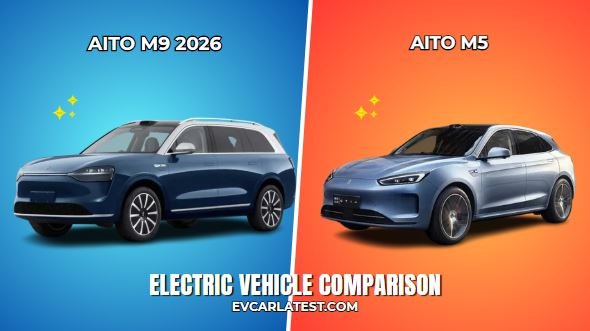
The AITO M9 2026 is a large, six-seat luxury SUV built by SERES with Huawei’s full technology stack — targeting buyers who want flagship-level comfort, advanced ADAS, and a genuinely premium cabin at a price well below European rivals. The AITO M5 is a compact five-seat SUV from the same ecosystem, aimed at urban professionals who want Huawei’s smart driving and HarmonyOS experience in a more accessible, everyday package. The M9’s 2026 refresh arrives fresh off 285,000 cumulative sales and over 70,000 pre-orders, making this a timely moment to weigh both models against each other.
Range & Charging
The 2026 M9 BEV covers 750 km on CLTC with a 120 kWh battery, while the EREV variant extends that to a combined CLTC range of 1,260 km using a petrol generator to top up the pack. Real-world BEV range will sit closer to 580–620 km depending on conditions — CLTC ratings run optimistic. The M5 covers 175–195 km CLTC on battery alone in EREV form, with a combined total of up to 1,440 km, and the BEV variant reaches 602 km CLTC. On charging, the M5 completes a 30–80% DC charge in approximately 30 minutes. DC charging data for the M9 2026 BEV has not been officially confirmed at publication — the M9 operates on an 800V platform, so fast charging is expected, but buyers should verify figures with the dealer before purchase.
Price, Availability & Market Fit
The M9 2026 starts at approximately $70,900 (¥479,800) for the five-seat extended-range Max+ trim, rising to around $97,500 for the Ultimate six-seater. The M5 starts at ¥229,800 (~$32,700) for the EREV rear-drive variant, with the AWD top trim at ¥249,800 (~$35,500). Both are currently sold in China, with grey-market import paths available for Nigeria, Kenya, and South Africa — factor in 15–30% on top of Chinese retail for landed cost. If your budget sits below $45,000 landed and you need a practical daily driver, the M5 is the clear answer. If you’re equipping a business or family with a premium flagship and can absorb the higher import cost, the M9 makes a stronger case.
Ecosystem & Rival Context
Within the AITO lineup, M9 buyers should also consider the upcoming AITO M8 (positioned between M5 and M9), while M5 buyers might cross-shop the AITO M7 for more cabin space at a similar price point. Outside AITO, the M9 competes with the Li Auto L9 and Voyah Dream for large EREV SUV buyers, while the M5 faces pressure from the BYD Tang EV and Xpeng G6. Both AITO models, however, offer Huawei’s ADS smart driving stack as standard — something neither BYD nor Xpeng matches at equivalent price points — which is the core reason buyers stay within the HIMA ecosystem.
Pros & Cons
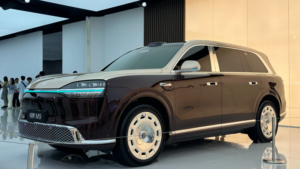
The M9 2026 earns its price through genuinely flagship-grade hardware: six-LiDAR ADS 5 smart driving, a 43-speaker audio system, and fully active suspension on top trims give it a technology edge no rival at this price can match. Its six-seat configuration makes it practical for large families or executive transport. The EREV system eliminates range anxiety completely, which matters in markets with limited charging infrastructure. On the downside, the M9’s 3,200 kg kerb weight creates real fuel costs on the EREV when running lean, and the price floor above $70,000 puts it out of reach for most buyers importing to African markets without significant upfront capital.
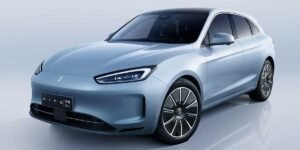
The M5 delivers the full Huawei smart ecosystem — HarmonyOS cockpit, LiDAR-equipped ADS, 192-channel sensing — at roughly a third of the M9’s price, making it the most accessible entry into this tech stack. Its 30-minute DC charge time is genuinely fast and usable. The compact footprint also works better in dense urban traffic. The trade-off is interior space: five seats and a shorter wheelbase mean rear passengers notice the size difference on longer journeys. The EREV’s 175–195 km pure-electric CLTC range is also modest for a daily EV commuter who wants to run electric most of the time.
Quick Verdict
Choose the M9 2026 if cabin space, flagship luxury, and the most advanced ADAS stack available from AITO are your priorities — and you have the budget to match. Choose the M5 if you want the same Huawei smart driving experience in a smaller, far more affordable package suited to city use and moderate long-distance travel. The M5 is better value per dollar; the M9 is a better car in almost every absolute measure. The gap between them, roughly $38,000 at minimum, is the only question that matters.
Related EV Comparisons
| |
| Price | $70,000.00 $33,300.00 |
| Our Rating | |
| Brand | Aito Aito |
| Category | Electric Cars Electric Cars |
MODEL
| Full Model Name | AITO M9 2026 |
| Generation | 2nd Generation |
| Segment / Class | Full-size luxury SUV |
| Available Trims / Variants |
Max+, Ultra, Ultimate Extended Edition
AITO M5 BEV RWD AITO M5 BEV AWD |
| Powertrain Options | BEV (pure electric); EREV (range-extended) |
| Special Editions | Ultimate Extended Edition — extended wheelbase, tri-motor, 2.0T range extender |
LAUNCH
| Reveal Date | 28 May 2026 September 2022 (BEV version unveiled) |
| Launch Year | 2026 |
| Availability Status | On sale in China from May 2026 In production / on sale |
| Brand / Manufacturer | Aito / HIMA (Huawei Intelligent Mobility Alliance + Seres) |
| Country of origin | China China |
| Assembly Country | China |
| Markets Available | China (official); grey market only elsewhere |
| Grey Market Import | Possible via parallel import |
| Base Price (USD) |
~$70,600 (¥479,800) — Max+; up to ~$97,000 (¥659,800) — Ultimate Extended
USD 33,370 - RWD USD 35,110 - AWD |
BATTERY
| Battery Capacity | 120 kWh (BEV) 80-83 kWh |
| Battery Chemistry | NMC lithium-ion (CATL) LFP (LiFePO₄) |
| Battery Architecture | 800V high-voltage platform (BEV) |
| Thermal Management | Liquid-cooled |
| Range (WLTP/CLTC/EPA) |
BEV: 750 km CLTC; EREV: 340–422 km pure electric CLTC; 1,405 km combined CLTC.
602 km (CLTC) for BEV RWD 552 km (CLTC) - AWD |
| Energy Consumption | 20-21 kWh/100 km |
| Heat Pump | |
| AC Charging (Max kW) | AC charge time 10.5 hours full (slow charging) for AWD BEV Ultra trim |
| DC Charging (Max kW) | DC charging (30-80%) ~ 0.5 hours - AWD BEV Ultra trim |
| Cell Brand | CATL |
| Additional Notes |
EREV uses 52 kWh pack (carry-over from 2025 refresh); BEV upgraded to 120 kWh from Gen 1's 100 kWh
battery under the floor Battery warranty: 8 years or ~160,000 km |
PERFORMANCE
| Motor Type | Permanent magnet synchronous |
| Motor Configuration | Dual motor (Max+, Ultra); Tri-motor (Ultimate Extended Edition) |
| Power Output (kW / hp) |
EREV standard: 497 kW / 667 hp; Ultimate Extended: 664 kW / 890 hp
272 PS ( 200 kW) RWD single motor - RWD 489 hp, dual motors (AWD) - AWD |
| Peak Power (kW / hp) | 664 kW / 890 hp (Ultimate Extended) |
| Torque (Nm) |
360 Nm - RWD 675 Nm - AWD |
| 0–100 km/h / 0-60 mph (seconds) The acceleration numbers are an easy way to compare car performance. We list either time from 0 to 100 km/h or time from 0 to 60mph, depending on which number(s) the manufacturers provide. The lower the acceleration time, the higher performance the car is. |
BEV: 4.5 sec; Ultimate Extended: 3.99 sec
7.1 seconds - RWD 4.3 seconds - AWD |
| Top Speed (km/h / mph) |
251 km/h (Ultimate Extended)
200 km/h - RWD 210 km/h - AWD |
| Transmission / Drive | Single-speed, AWD all trims Single-speed gearbox |
| Rear-Wheel Steering | Yes — ±8° |
| Additional Notes | Huawei Tuling active chassis platform; CDC dampers standard |
BODY
| Body Style | 5-door full-size luxury SUV 5-door, 5-seat SUV |
| Body Colour Options | Desert Gold Brown, Sayram Blue, Canghai Silver Blue (new); others not confirmed |
| Platform / Architecture | HIMA EV/EREV platform; Xuanwu Architecture 2.0 body structure Shares underpinnings with Seres SF5; collaboration with Huawei (Huawei’s DriveONE architectures) |
| Dimensions (L×W×H mm) | Standard: 5,285 × 2,026 × 1,845 mm; Ultimate Extended: 5,402 × 2,026 × 1,845 mm Length: 4,785 mm; Width: 1,930 mm; Height: ~1,620-1,625 mm |
| Wheelbase (mm) | Standard: 3,125 mm; Ultimate Extended: 3,236 mm 2,880 mm |
| Ground Clearance (mm) | 150 mm |
| Kerb Weight (kg) | 2,335 kg |
| Suspension (Front / Rear) | Dual-chamber air suspension standard; CDC dampers; front double wishbone Independent double wishbone front, multi-link independent rear |
| Wheel Size (inches) | 255/50 R19 |
| Trunk/Boot Capacity (L) | 369-776 L depending on configuration |
| Turning Circle (m) | 5.1 m (5.4 m vehicle) |
| Sunroof | Panoramic roof |
| Additional Notes | 91% high-strength steel and aluminium alloy body; A/B pillars use 2,200 MPa submarine-grade hot-formed steel Unibody body; doors 5; standard SUV structure |
SAFETY
| Airbags (count) | Multiple – front, side-curtain etc depending on variant; 6 airbags in some markets |
| Anti-lock Braking System (ABS) | Yes |
| Electronic Brakeforce Distribution (EBD) | Yes |
| Electronic Stability Control (ESC) | Yes |
| Traction Control System (TCS) | Yes |
| Structural Safety | Xuanwu Architecture 2.0; 91% high-strength materials; 2,200 MPa A/B pillars |
| Tyre Pressure Monitoring (TPMS) | Yes |
| Child Seat Anchors (ISOFIX / LATCH) | Yes |
| 360° Camera / Surround View | Yes |
| Reversing Camera | Yes |
| Driver Assistance (ADAS) | Huawei Qiankun ADS 5.0 — standard across all trims Lane departure warning, lane keeping, blind spot monitoring, traffic sign recognition, adaptive systems etc in higher trims |
| ADAS Features | Full-scenario navigation, car-to-car routing, advanced auto parking |
| Autonomous Driving Level | L2+ advanced driver assistance L2 level driver assist in the “Ultra” trim etc |
| Autonomous Driving System Name | Huawei Qiankun ADS 5.0 |
| Autonomous Driving Hardware | 6 LiDAR, 5 millimetre-wave radars, 12 ultrasonic radars, 12 HD cameras |
| Over-the-Air (OTA) Safety Updates | Yes |
| Additional Notes | ADS 5.0 is a major upgrade over Gen 1's ADS 3.0/3.3 |
COMFORT
| Seating Capacity | 4-seat, 5-seat, or 6-seat configurations available 5 seats; front seats typically with heating, ventilation etc in higher trims; rear seats with heating |
| Power Seats | Yes |
| Seat Heating | Yes |
| Roof Type | Panoramic / large roof – non-opening panoramic sunroof in many trims |
| Ambient Lighting | Yes |
| Bluetooth / Wi-Fi | Bluetooth, USB, voice recognition, OTA, facial recognition in some trims; HarmonyOS infotainment |
| Wireless Charging | Ye |
| 5G / LTE | Yes |
| Parking Aids | 360° cameras, front and rear radar, auto parking via ADS 5.0 Rear view camera; parking radar; sensors |
| Additional Notes | Retractable running boards available; gesture-controlled doors on some trims Keyless entry/start etc typical of modern EVs; multiple driving modes (economy, comfort, sport) |
DISPLAYS
| Centre Screen (inches) | Dual 17.2-inch 3.4K displays 15.6-inch touchscreen |
| Driver's Display (inches) | 12.3-inch instrument cluster 10.2-10.4-inch full LCD digital cluster |
| Head-Up Display (HUD) | AR-HUD — confirmed; projection size not confirmed for Gen 2 |
| Rear Passenger Screen | Optional 32-inch retractable projection screen |
| Display Resolution | 3.4K (main screens) |
| Operating System | HarmonyOS — Harmony Cockpit 5.2 |
| Voice Control | Yes — integrated with Pangu and DeepSeek large models |
| Additional Notes | Triple-screen cockpit (12.3" + dual 17.2"); 32" optional rear projection screen Wireless charging pads (some versions), good connectivity, voice control, OTA updates etc. |
LIGHTING
| Headlight Type (LED/Matrix/Laser) | Intelligent projection headlights |
| Daytime Running Lights (DRL) | Yes |
| Adaptive Headlights | Yes |
| Interior Ambient Lighting | Yes |
| Additional Notes | Headlights support interactive signalling function |
INFOTAINMENT & AUDIO
| Sound System Brand | Huawei Sound |
| Audio Output (watts) | 2,920W |
| Navigation System | Yes — Huawei maps |
| Rear Entertainment | Optional 32-inch retractable projection screen |
| Additional Notes | Harmony Cockpit 5.2 system |
TECHNOLOGY
| Smartphone App Control | Yes |
| Keyless Entry / Start | Yes |
| Bluetooth Key | Yes |
| Remote Parking | Yes — via ADS 5.0 |
| Automatic Parking | Yes |
| Digital Key | Yes |
| Smart Home Integration | Yes — HarmonyOS ecosystem |
| AI Assistant | Yes — Pangu + DeepSeek large model integration |
| Over-the-Air Map Updates | Yes |
OWNERSHIP
| Official Dealer Network | China only at launch |
| Service Interval | No official support outside China |
| Spare Parts Availability | Limited outside China |
| Import Duty Class | Varies by country |
Note
| Data Source | HIMA official launch (May 28, 2026); CarNewsChina report (May 28, 2026) |
| Last Updated | May 29, 2026 |
| Additional Notes |
ICE part: The 1.5-L turbo engine is used only as a generator / range extender, does not directly drive the wheels in the EREV version. Combined fuel consumption (with ICE) when in extended-mode is very low (~0.7 L/100 km mixed cycle) in WLTC for EREV RWD Ultra trimmed version. Warranty on battery pack: ~8 years or 160,000 km in many cases |
| Editor's Note | Full technical documentation expected within weeks of launch. Page will be updated as confirmed specs are released. WLTP and EPA range figures not available at time of writing. |

|
Disclaimer Note
Specifications sourced from manufacturer data and may reflect WLTP, CLTC, or EPA test conditions. Import prices in your local are estimates based on grey-market landing costs and exclude duties, clearing fees, and local taxes. Figures are subject to change without notice. Always verify with your local importer before purchase. We can not guarantee that the information on this page is 100% correct
Top EV Comparisons


