The Nio EP9 stands out as a flagship electric supercar from Chinese automaker Nio, serving as the brand’s ultimate halo vehicle beyond everyday models. This two-seater coupe relies on all-wheel drive powered by four inboard electric motors paired with individual gearboxes. What makes it notable? It set benchmark lap records for electric vehicles early on, like 6:45.90 at the Nürburgring Nordschleife and top times at Circuit Paul Ricard.
Nio equipped the EP9 with two lithium-ion battery packs—total weight around 635 kg, though exact usable capacity stays undisclosed—offering 427 km (265 miles) on the NEDC cycle typical for 2016-era EVs. Full charging via its swappable system takes about 45 minutes, with no split AC/DC rates published; battery swaps at stations cut that to roughly 8 minutes for quick track refills. Note these figures predate WLTP or EPA standards for EVs, so modern confirmation is absent.
Launch price hit $1.48 million USD in China for just 16 units (six investor cars, ten public), with resale values climbing to $3 million today. Realistically, it fits track-focused collectors or performance enthusiasts—not commuters—thanks to its race-bred design lacking full street certification.
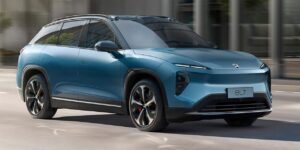
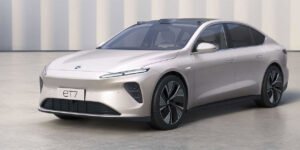
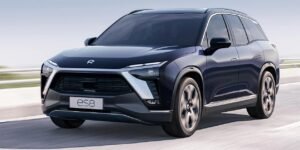
In Nio’s lineup, the EP9 towers over road cars like the ET7 sedan and ES8 SUV, acting as a tech showcase.
Rivals include the Rimac Nevera for raw power and Pininfarina Battista for acceleration supremacy in electric hypercars. Closest match? The Rimac Nevera—similar sub-2.7-second 0-60 mph, quad-motor AWD, and multimillion-dollar tag for track dominance.
Picture this: 1 MW (1,360 PS) surges the EP9 to 100 km/h in 2.7 seconds, 200 km/h in 7.1 seconds, topping out at 313 km/h. Active aero delivers 5,395 lbs of downforce at 150 mph—Formula 1 territory—via a three-stage wing and FIA Le Mans-approved carbon monocoque. Torque vectoring cranks out 1,480 Nm at shafts (6,334 Nm at wheels), all in a 1,735 kg package pulling 3.0 G corners.
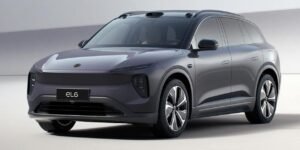
Production wrapped in 2017, cementing the EP9 as a collector’s artifact rather than a fresh buy—Nio nods to it for heritage but focuses on models like ET5 and EL6. While newer hypercars have eclipsed its lap times, the EP9’s early EV speed breakthroughs still echo in today’s electric performance scene.
| Available Trims / Variants | NIO EP9 (Electric Performance 9) |
| Reveal Date | 2016 |
| Availability Status | Limited production (16 units, track-only) |
| Base Price (USD) | Estimated over $1.2 million |
| Battery Capacity | 90 kWh (approx.) |
| Battery Chemistry | Liquid-cooled lithium-ion; swappable pack |
| Range (WLTP/CLTC/EPA) | 427 km (265 mi, NEDC) |
| Energy Consumption | High under performance driving (not publicly stated) |
| Regen Braking (Max kW) | Yes (regen braking) |
| Heat Pump | |
| AC Charging (Max kW) | 45 minutes |
| DC Charging (Max kW) | 45 minutes |
| Additional Notes | 45 minutes |
| Power Output (kW / hp) | 4 electric motors, all-wheel drive, 1 MW (≈1,360 hp) |
| Torque (Nm) | 6,334 Nm (combined at wheels, torque-vectoring) |
| 0–100 km/h / 0-60 mph (seconds) The acceleration numbers are an easy way to compare car performance. We list either time from 0 to 100 km/h or time from 0 to 60mph, depending on which number(s) the manufacturers provide. The lower the acceleration time, the higher performance the car is. | 0–100 km/h in ~2.7 s |
| Top Speed (km/h / mph) | 313 km/h (194 mph) |
| Body Style | 2-door electric hypercar (track-only) |
| Platform / Architecture | Custom carbon fiber monocoque |
| Dimensions (L×W×H mm) | L: 4,881 mm / W: 2,233 mm / H: 1,150 mm |
| Drag Coefficient (Cd) | Not published; optimized aero |
| Wheelbase (mm) | 3,100 mm |
| Ground Clearance (mm) | Very low (track setup) |
| Kerb Weight (kg) | 1,735 kg |
| Suspension (Front / Rear) | Push-rod suspension (race-style) |
| Wheel Size (inches) | 19" front / 21" rear racing alloys |
| Trunk/Boot Capacity (L) | None |
| Frunk/Bonnet Capacity (L) | No usable space |
| Towing Capacity (kg) | Not applicable |
| Additional Notes |
Active rear wing, carbon brakes |
| Airbags (count) | None |
| Driver Assistance (ADAS) | None |
| Autonomous Driving Level | Capable of autonomous laps (COTA demo) |
| Crash Test Ratings | Not applicable (track-only car) |
| Seating Capacity | 2 fixed racing seats with harnesses |
| Roof Type | Closed cockpit (carbon fiber shell) |
| Bluetooth / Wi-Fi | Minimal, telemetry system only |
| Parking Aids | None (track use only) |
| Additional Notes |
No climate or infotainment; pure performance |
| Centre Screen (inches) | Central touchscreen for car settings |
| Driver's Display (inches) | Digital race-style instrument cluster |
| Head-Up Display (HUD) | Not included |
| Additional Notes |
Passenger display with real-time telemetry |
| Additional Notes |
Lap records at Nürburgring (6:45.90), COTA (with and without driver), Paul Ricard, Shanghai Symbolic of NIO’s EV performance vision Not road legal |
Specifications sourced from manufacturer data and may reflect WLTP, CLTC, or EPA test conditions. Import prices in your local are estimates based on grey-market landing costs and exclude duties, clearing fees, and local taxes. Figures are subject to change without notice. Always verify with your local importer before purchase. We can not guarantee that the information on this page is 100% correct