Solar EV charging in Africa works. Right now. In Lagos, Nairobi, and Cape Town, EV owners are already charging cars overnight using rooftop solar panels and battery storage — without touching the grid at all. The challenge is not the physics. It’s the cost, the sizing, and the reality that most Africans don’t own a home with a roof they can bolt panels onto. This article breaks down exactly how solar charging works, what hardware you need, what it costs in Nigeria, Kenya, and South Africa, and where it genuinely makes sense for African drivers today.
Quick Summary
| What you need to know | Detail |
|---|---|
| Does solar EV charging work in Africa? | Yes — Africa’s sunlight hours (5–7 peak hours/day) make it technically ideal |
| Minimum solar system size for EV charging | 5 kW solar + 10 kWh battery storage for daily top-ups |
| Estimated cost in Nigeria | ₦2.5M–₦5.5M (≈ $1,600–$3,500) depending on EV range and usage |
| Biggest real-world barriers | Upfront cost, installation expertise, and flat-dwellers have no access |
| Best-fit scenario in 2025 | Homeowners with small EVs (BYD Seagull, Ampere Nexon-class) and existing solar setups |
How Solar Charging Actually Works for EVs
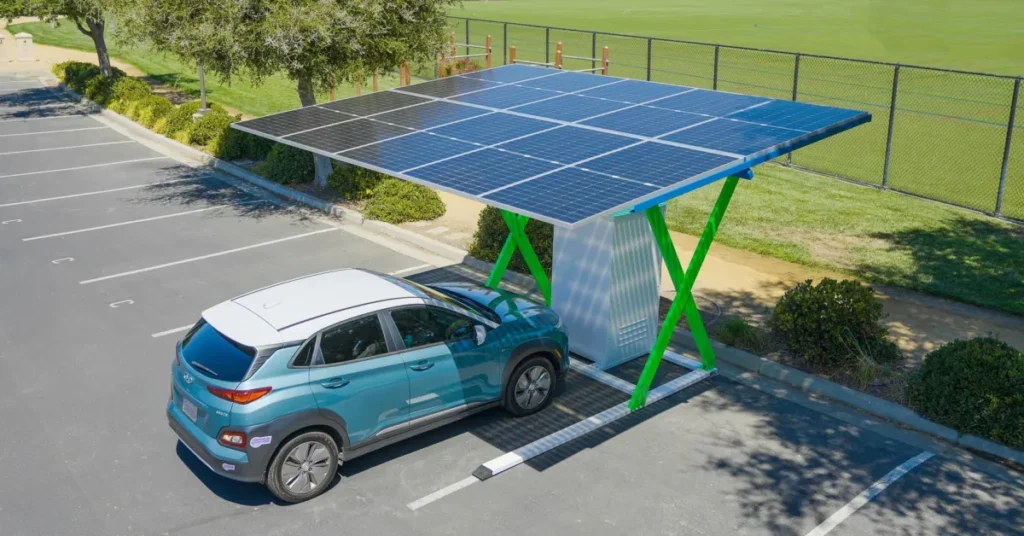
Your EV charges through an onboard charger connected to either an AC wall socket (Level 1 or Level 2) or a DC fast charger. Solar panels don’t plug straight into a car. The setup goes: panels → inverter → battery bank → EV charger. At home, this means a standard AC connection — the same Type 2 or Type 1 port your car already uses.
What changes with solar is the energy source. Instead of pulling from the grid (or NEPA, as most Nigerians still call it), you’re pulling from stored solar energy. A 7 kW home solar system generating 5–6 hours of peak output per day can produce roughly 35 kWh. That’s enough to charge a BYD Seagull from flat to full three times over, or add about 200 km of range to a mid-sized EV.
The critical piece most guides skip: you need battery storage. Panels only produce electricity when the sun is out. If you want to charge at night — which most people do — a battery bank is not optional. This is the line item that makes the budget jump.
What Solar System Do You Actually Need?
The answer depends on two numbers: how far you drive daily, and what EV you have.
For Short-Range Urban EVs (BYD Seagull, Ampere EV, Roewe Ei5)
These cars carry 30–38 kWh batteries and are already appearing in Lagos and Nairobi grey-market imports. A typical Nigerian urban driver covers 30–60 km per day. At roughly 15–18 kWh per 100 km, that’s 5–10 kWh daily.
Recommended setup:
- 4–6 x 400W solar panels (1.6 kW–2.4 kW)
- 5 kWh lithium battery storage
- 3 kW hybrid inverter
This is a system many Nigerian homeowners already have for household power. Adding EV charging just means routing your existing inverter output to a dedicated socket.
For Mid-Range EVs (BYD Atto 3, Hyundai Kona EV, MG4)
These carry 50–77 kWh batteries and are the most common EVs arriving in South Africa and Kenya via official and grey-market channels. A 60 km daily commute requires 9–14 kWh replenishment.
Recommended setup:
- 10–16 x 400W panels (4 kW–6.4 kW)
- 10–15 kWh lithium battery bank
- 5 kW hybrid inverter (DEYE or SUNSYNK brands are widely available in Nigeria and South Africa)
This size system runs ₦2.5M–₦4.5M installed in Lagos, roughly KES 280,000–520,000 in Nairobi, or ZAR 45,000–80,000 in Cape Town. Note: prices sourced from installer quotes circulating on Nigerian solar forums and South African retailer listings as of early 2025; verify with local suppliers before budgeting.
Solar EV Charging: Africa vs. Europe
This comparison matters because most of the solar EV charging content online is written for Germany or California. The picture in Africa is different in both directions — some things are easier, some are harder.
| Factor | Europe/USA | Nigeria | Kenya | South Africa |
|---|---|---|---|---|
| Peak sun hours/day | 3–4 hours | 5–6 hours | 5–7 hours | 5.5–6.5 hours |
| Grid reliability | High (backup only) | Low (solar is primary) | Medium | Medium-high |
| Upfront system cost | High, strong subsidies | High, no subsidies | High, limited subsidies | Medium, partial incentives |
| EV adoption stage | Mainstream | Early/grey-market | Early | Emerging mainstream |
| Flat/apartment dwellers | Managed via HOA rules | ~60% urban, no roof access | ~55% urban | ~45% urban |
| Typical charging speed (home solar) | 7–11 kW AC | 3–5 kW AC | 3–5 kW AC | 3–7 kW AC |
Africa’s solar resource is genuinely better than Europe’s. Nigeria’s 5–6 peak sun hours per day beats Germany’s 3–4 by a wide margin. The problem is not sunlight. It’s that the hardware costs are similar globally, but African incomes are not — and there are zero government EV charging subsidies in Nigeria or Kenya as of 2025.
This connects to why BYD’s expansion in sub-Saharan Africa matters for this conversation. Affordable EVs make the solar-charging math more accessible. A ₦20M luxury EV with a 100 kWh battery needs a much bigger solar system than a ₦8–10M entry EV with a 38 kWh pack.
Real-World Use Cases That Work Today
Case 1: The Nigerian Homeowner With Existing Solar
This is the strongest use case right now. A Lagos homeowner who already runs a 5 kW solar system for household needs can often add EV charging with minimal extra investment — upgrading battery capacity from 5 kWh to 10 kWh and adding a dedicated charging socket. Total additional outlay: ₦400,000–₦800,000.
Case 2: The Kenyan Workplace Charging Model
Several Nairobi tech companies — particularly in the Karen and Westlands areas — have installed solar carports for staff EVs. Employees charge during the day while panels are generating, eliminating the need for overnight battery storage entirely. This is arguably the most cost-efficient solar EV setup in Africa today.
Case 3: South African Loadshedding Arbitrage
South Africa’s loadshedding crisis pushed a large number of homeowners into solar investment earlier than the rest of the continent. Many now have 10–20 kW systems designed to ride out Stage 6 outages. For these households, adding EV charging is almost free in marginal terms — the infrastructure is already there. For a deeper look at how South African EV infrastructure is developing.
Where Solar EV Charging Doesn’t Work Well
Apartment and flat dwellers. An estimated 55–65% of urban Africans in Lagos, Nairobi, and Johannesburg rent flats or live in compounds without roof ownership. No roof access means no solar installation. Until landlords or building developers start installing shared solar carports — which is happening but slowly — this segment is locked out entirely.
Long-distance drivers. Solar home charging tops up daily urban use. It cannot replace fast charging infrastructure for 300+ km intercity trips. If your driving pattern includes regular Lagos–Ibadan or Nairobi–Mombasa runs, solar home charging is a supplement, not a complete solution.
Older Chinese import EVs without battery data. Some grey-market imports arriving in Nigeria lack accurate battery capacity documentation. Sizing a solar system for an EV you can’t fully spec is a real problem.
Solar EV Charging Hardware Available in Africa (2025)
| Product | Type | Output | Est. Price (NGN) | Available |
|---|---|---|---|---|
| DEYE 5 kW Hybrid Inverter | Inverter | 5 kW AC | ₦450,000–₦600,000 | Widely (Lagos, SA) |
| SUNSYNK 8 kW | Inverter | 8 kW AC | ₦700,000–₦950,000 | SA, Limited NG |
| LONGI Hi-MO 6 400W Panel | Panel | 400W | ₦120,000–₦160,000/panel | NG, KE, SA |
| Pylon Tech US3000C 3.5kWh | Battery | 3.5 kWh per unit | ₦380,000–₦450,000 | NG, SA |
| Generic 32A Type 2 EVSE | EV Charger | 7.4 kW | ₦80,000–₦150,000 | SA widely, NG limited |
Prices are installer/retail estimates as of early 2025. Verify locally. NGN figures based on ₦1,550/USD reference rate.
Bottom Line Verdict
Solar EV charging in Africa is not a future concept — it’s working today for homeowners who already have solar infrastructure and own short-to-mid-range EVs. The physics favour it, the sun hours are excellent, and the running costs beat grid electricity in every African market. The barrier is upfront capital, not technology. If you’re buying an EV and you own your home, budgeting for solar from day one is smarter than treating it as an upgrade later.
Related EV News
- EV Mobility Challenges in Accra: New Report Reveals Infrastructure Gaps Slowing Ghana’s Electric Vehicle Sector
- South Africa’s EV Market in 2026: Growth, Brands & Opportunity
- Kenya Electric Car Guide 2026: Models, Prices & What to Buy
- BYD Cars Nigeria: Prices, Specs, and Where to Buy (2026)
- Electric Motorcycle Nigeria: Best Options for Lagos & Abuja (2026)