- Electric Vehicles
- Compare Electric Cars
- Chevrolet Captiva EV vs Chevrolet Blazer EV
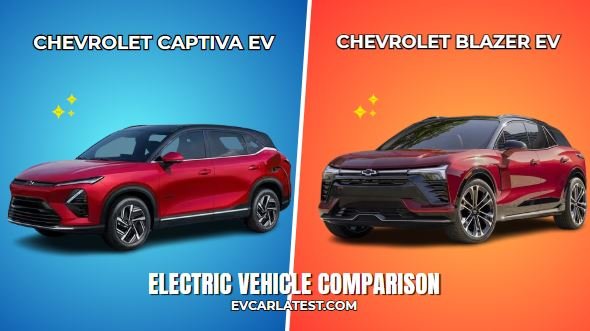
Chevrolet Captiva EV vs Chevrolet Blazer EV
The Chevrolet Captiva EV is a compact crossover SUV designed for urban buyers who want an affordable entry into electric mobility — it targets price-conscious, first-time EV owners in emerging markets like Latin America, the Middle East, and parts of Asia. The Chevrolet Blazer EV is a mid-size SUV built on GM’s Ultium platform, aimed at North American buyers who want performance, range, and a tech-forward cabin. With Chevrolet expanding its EV footprint globally, understanding where each model fits has become a practical question for buyers weighing brand loyalty against budget.
Range & Charging
The Captiva EV offers an estimated range of around 340–400 km under CLTC testing conditions — real-world figures typically land closer to 280–320 km depending on load and driving speed. It supports AC charging at up to 6.6 kW and DC fast charging at up to 60 kW, putting a 10–80% charge at roughly 60–70 minutes on a fast charger.
The Blazer EV delivers an EPA-rated range of up to 459 km (285 miles) on the RWD LT trim, with real-world estimates around 380–420 km. It supports up to 11.5 kW AC and 190 kW DC fast charging — achieving 10–80% in approximately 30 minutes on a compatible DC station. The Blazer EV has a significant charging speed advantage.
Price, Availability & Market Fit
The Captiva EV starts at roughly $25,000–$30,000 USD depending on market, with trim options typically limited to one or two variants. It is currently available in select Latin American, Middle Eastern, and Southeast Asian markets. In Nigeria or Kenya, grey-market import pricing would place it in the ₦20–₦25 million range.
The Blazer EV starts at approximately $42,995 USD in North America, with multiple trims — LT, RS, and SS — spanning up to $65,000+. It is primarily a US and Canada product. This page helps you decide: Captiva EV if your budget and market availability are the deciding factors; Blazer EV if range, charging speed, and performance headroom matter most.
Ecosystem & Rival Context
Within Chevrolet’s own EV lineup, the Captiva EV buyer should also consider the Equinox EV (where available), which offers more range for a competitive price. The Blazer EV buyer sits between the Equinox EV below it and the Silverado EV above. Outside Chevrolet, the BYD Atto 3 competes directly with the Captiva EV on price and availability in emerging markets, while the Hyundai Ioniq 6 and Ford Mustang Mach-E challenge the Blazer EV in North America. This Chevy-vs-Chevy framing still makes sense because both share brand service networks and software ecosystems, simplifying ownership for buyers already in the GM world.
Pros & Cons
Captiva EV: Its lower entry price makes EV ownership genuinely accessible without stretching a household budget. Its compact footprint handles dense city traffic better than larger crossovers. And its availability in non-US markets fills a gap that most premium EVs ignore. On the downside, its slower DC charging speed means longer stops on longer trips, which reduces its road-trip viability. Its range also falls short for buyers with long daily commutes or irregular charging access.
Blazer EV: Its fast DC charging makes it practical for road trips in a way few mid-size EVs match. The multi-trim lineup gives buyers genuine options across power and budget preferences. And its Ultium-platform build quality reflects a more mature EV architecture. However, its higher price excludes budget buyers, and its US-centric availability locks out most global markets entirely.
Quick Verdict
Choose the Captiva EV if price and local market availability drive your decision — it is the more accessible Chevrolet EV for buyers outside North America. Choose the Blazer EV if you are in the US or Canada and want stronger range, faster charging, and more powertrain options. The trade-off is simple: affordability and availability versus range and capability.
Related EV Comparisons

| |
| Price | $30,000.00 $50,000.00 |
| Our Rating | |
| Brand | Chevrolet Chevrolet |
| Category | Electric Cars Electric Cars |
MODEL
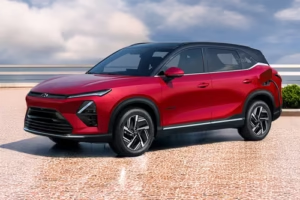
| Full Model Name | Chevrolet Captiva EV 2026 |
| Generation | 2nd Generation (EV platform) |
| Segment / Class | Compact Crossover SUV |
| Available Trims / Variants |
Premier (single trim at launch)
Chevrolet Blazer EV LT Chevrolet Blazer EV RS RWD Chevrolet Blazer EV RS AWD Chevrolet Blazer EV SS pAWD |
| Powertrain Options | BEV only (PHEV variant sold separately) |
| Special Editions | Darkened Edition (Brazil launch — gloss black accents, black bowtie) |
LAUNCH
| Reveal Date | Late 2025 2022, July 19 |
| Launch Year | 2025–2026 |
| Availability Status |
On Sale
Available to order. Released 2023, Q3 - Chevrolet Blazer EV LT Available to order. Released 2023, Q3 - Chevrolet Blazer EV RS RWD Available to order. Released 2023, Q3 - Chevrolet Blazer EV RS AWD Available to order. Released 2024, Q2 - Chevrolet Blazer EV SS pAWD |
| Brand / Manufacturer | Chevrolet / SAIC-GM-Wuling (SGMW) |
| Country of origin | China United States |
| Assembly Country | China |
| Markets Available | Brazil, Colombia, Uruguay, Ecuador, Middle East (Jordan, UAE, Qatar) |
| Grey Market Import | Possible via South American/Middle East channels |
| Base Price (USD) |
~$30,990 (Ecuador) / ~$37,550 (Brazil)
$ 50,200 - Chevrolet Blazer EV LT $ 56,200 - Chevrolet Blazer EV RS RWD $ 54,500 - Chevrolet Blazer EV RS AWD $ 66,000 - Chevrolet Blazer EV SS pAWD |
BATTERY
| Battery Capacity |
60 kWh
85 kWh total - Chevrolet Blazer EV LT 102 kWh total - Chevrolet Blazer EV RS RWD 85 kWh total - Chevrolet Blazer EV RS AWD 102 kWh total - Chevrolet Blazer EV SS pAWD |
| Battery Chemistry | Lithium Iron Phosphate (LFP) Liquid-cooled Li-ion (400V type) |
| Range (WLTP/CLTC/EPA) |
510 km CLTC / 415 km NEDC / 304 km INMETRO
279 mi EPA - Chevrolet Blazer EV LT 324 mi EPA - Chevrolet Blazer EV RS RWD 279 mi EPA - Chevrolet Blazer EV RS AWD 279 mi EPA - Chevrolet Blazer EV SS pAWD |
| Energy Consumption | ~36 km/l city equivalent (Chevrolet Brazil figure) 350 Wh/mi EPA |
| Regen Braking (Max kW) | Yes |
| Heat Pump | |
| AC Charging (Max kW) |
6.6 kW (Level 2 wallbox)
Type 1 110V Type 2 11.5 kW |
| DC Charging (Max kW) |
120 kW
CCS 150 kW - Chevrolet Blazer EV LT CCS 190 kW - Chevrolet Blazer EV RS RWD CCS 190 kW - Chevrolet Blazer EV RS AWD CCS 190 kW - Chevrolet Blazer EV SS pAWD |
| Charging Time (10–80%) | ~45 minutes (DC); ~8 hours (6.6 kW AC) |
| Battery Warranty | 8 years / 160,000 km |
PERFORMANCE
| Motor Type | Permanent Magnet Synchronous |
| Motor Configuration | Single front motor (FWD) |
| Front Motor Output (kW / HP) | 150 kW / 201 hp |
| Rear Motor Output (kW / HP) | None — FWD only |
| Power Output (kW / hp) |
150 kW / 201 hp
AWD 288 hp (212 kW) - Chevrolet Blazer EV LT RWD 340 hp (250 kW) - Chevrolet Blazer EV RS RWD AWD 288 hp (212 kW) - Chevrolet Blazer EV RS AWD AWD 557 hp (410 kW) - Chevrolet Blazer EV SS pAWD |
| Torque (Nm) |
310 Nm (229 lb-ft)
333 lb-ft (451 Nm) - Chevrolet Blazer EV LT 441 Nm (325 lb-ft) - Chevrolet Blazer EV RS RWD 451 Nm (333 lb-ft) - Chevrolet Blazer EV RS AWD 879 Nm (648 lb-ft) - Chevrolet Blazer EV SS pAWD |
| 0–100 km/h / 0-60 mph (seconds) The acceleration numbers are an easy way to compare car performance. We list either time from 0 to 100 km/h or time from 0 to 60mph, depending on which number(s) the manufacturers provide. The lower the acceleration time, the higher performance the car is. |
6.5 sec 0-60 mph - Chevrolet Blazer EV RS RWD 6 sec 0-60 mph - Chevrolet Blazer EV RS AWD 4 sec 0-60 mph - Chevrolet Blazer EV SS pAWD |
| Top Speed (km/h / mph) |
118 mph (190 km/h) - Chevrolet Blazer EV LT 118 mph (190 km/h) - Chevrolet Blazer EV RS RWD 118 mph (190 km/h) - Chevrolet Blazer EV RS AWD 130 mph (209 km/h) - Chevrolet Blazer EV SS pAWD |
| Transmission / Drive | Single-speed, FWD Single-speed |
| Torque Vectoring | No |
BODY
| Body Style | 5-door compact crossover SUV 5 door SUV, 5 seats |
| Body Colour Options | Multiple; two-tone black roof available |
| Platform / Architecture | SGMW EV platform BEV3 |
| Dimensions (L×W×H mm) | 192.2 x 78.0 x 65.0 in (4882 x 1981 x 1651 mm) |
| Wheelbase (mm) | 121.8 in (3094 mm) |
| Kerb Weight (kg) |
US: 2536 kg curb - Chevrolet Blazer EV RS AWD US: 2421 kg curb - Chevrolet Blazer EV SS pAWD |
| Suspension (Front / Rear) | Front short-long-arm double wishbone, rear multi-link |
| Wheel Size (inches) | R19, R21, R22 |
| Trunk/Boot Capacity (L) | US: 25.5 ft³, 59.1 ft³ max |
| Frunk/Bonnet Capacity (L) | No |
| Towing Capacity (kg) |
No - Chevrolet Blazer EV LT No - Chevrolet Blazer EV RS AWD US: 680 kg unbraked - Chevrolet Blazer EV RS AWD US: 680 kg unbraked - Chevrolet Blazer EV SS pAWD |
SAFETY
| Airbags (count) | Front, side, rear, head airbag system, front seats knee airbags |
| Anti-lock Braking System (ABS) | Yes |
| Electronic Brakeforce Distribution (EBD) | Yes |
| Electronic Stability Control (ESC) | Yes |
| Traction Control System (TCS) | Yes |
| Tyre Pressure Monitoring (TPMS) | Yes |
| Child Seat Anchors (ISOFIX / LATCH) | Yes |
| Reversing Camera | Yes |
| Hill Start Assist | Yes |
| Driver Assistance (ADAS) | Yes — Chevrolet Intelligent Driving suite Front radar, front camera, 2 side cameras, rear camera. Forward Collision Alert, Rear Cross Traffic Alert, Lane Departure Warning, Lane Keep Assist, Side Blind Zone Alert, Lane Change Alert, Automatic Emergency Braking, Front Pedestrian Braking, Road Sign detection, High-Beam Assist, Driver Attention System, Vehicle Ahead Indicator, Reverse Automatic Braking |
| ADAS Features | Adaptive Cruise Control, Lane Departure Warning, Lane Centering, Automatic Emergency Braking (confirmed in official materials) |
| Autonomous Driving Level | Level 2 |
COMFORT
| Seating Capacity | 5 Heated and ventilated front seats, heated rear seats |
| Seat Material | Leatherette (Black or Sandy) |
| Climate Control | Yes |
| Steering Wheel | Leather-wrapped |
| Roof Type | Fixed Panoramic glass sunroof |
| Interior Rear-View Mirror | Standard |
| Bluetooth / Wi-Fi | Android Automotive |
| Parking Aids | Reversing sensors/camera confirmed Front and rear sensors, 360 camera, reversing camera, Advanced Park Assist |
DISPLAYS
| Centre Screen (inches) | 15.6 inches 17.7" touchscreen |
| Driver's Display (inches) | 11" |
| Head-Up Display (HUD) | Yes, projector type |
| Operating System | Chevrolet Infotainment System |
| Mirror Link / Apple CarPlay / Android Auto | Yes — both |
LIGHTING
| Headlight Type (LED/Matrix/Laser) | LED |
| Daytime Running Lights (DRL) | Yes |
| Tail Light Design | LED |
INFOTAINMENT & AUDIO
| AM/FM/DAB Radio | Yes |
| Navigation System | Yes |
TECHNOLOGY
| Keyless Entry / Start | Yes |
OWNERSHIP
| Official Dealer Network | Yes — sold through Chevrolet dealerships (Brazil, Ecuador, Middle East) |
| Spare Parts Availability | Limited outside confirmed markets |
Note
| Data Source | GM Authority, Chevrolet UAE, Chevrolet Philippines, Chevrolet Jordan, Chevrolet Brazil official pages |
| Last Updated | June 2026 |
| Additional Notes | Several body, performance, and tech specs remain unpublished by Chevrolet across all markets |
| Editor's Note | CLTC (510 km) and NEDC (415 km) range figures should not be presented as real-world estimates. Use INMETRO (304 km) as the most conservative proxy until WLTP data is confirmed. Africa-market pricing and availability unconfirmed — flag if publishing for Nigerian, Kenyan, or South African audiences. |

|
Disclaimer Note
Specifications sourced from manufacturer data and may reflect WLTP, CLTC, or EPA test conditions. Import prices in your local are estimates based on grey-market landing costs and exclude duties, clearing fees, and local taxes. Figures are subject to change without notice. Always verify with your local importer before purchase. We can not guarantee that the information on this page is 100% correct
Top EV Comparisons