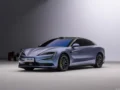
- Electric Vehicles
- Yangwang
- Yangwang U9
Yangwang U9


- Drive Type: AWD
- Body Type: 2-door, 2-seat electric hypercar
- Self Driving:
- Airbags: Yes
PROS
- Exceptional performance: up to 2,960 hp and 0–100 km/h in 2.36 s
- Groundbreaking suspension system (DiSus-X)
- Advanced 1200 V architecture with 500 kW charging
- Futuristic design and aerodynamic precision
- Competitive pricing for its performance class
CONS
- Limited global availability (China-focused launch)
- Heavy curb weight (~2.5 tons)
- Range limited to ~280 miles
- Lacks confirmed safety/crash test data
- Unknown comfort and practicality in daily use
If you’ve heard whispers about a Chinese electric supercar that can dance on three wheels or jump over potholes, you’re probably thinking of the Yangwang U9. But behind the stunts is a serious engineering effort from BYD’s luxury division. Let’s cut through the noise and look at what this car actually offers—from battery size and real-world charging to how it stacks up against a Lamborghini.
What Is the Yangwang U9?
The Yangwang U9 is a flagship battery-electric supercar produced by BYD Auto under its ultra-luxury Yangwang sub-brand. It’s a two-door coupe in the S‑segment (sports car class), with a four‑motor, all‑wheel‑drive layout—often called BYD’s e⁴ platform.
What makes it notable from a factual standpoint? The U9 is the first mass‑production Chinese car to combine a carbon‑fibre monocoque with BYD’s DiSus‑X intelligent body control system, allowing active suspension movements that no other production supercar offers today.
Powertrain, Battery & Charging (Specs & Caveats)
Battery size & range
Usable capacity: Not officially confirmed, but total battery size is 83 kWh (BYD Blade LFP).
WLTP range: Not officially validated. The factory quotes 450 km (280 miles) on the CLTC cycle (China’s optimistic test). Some sources estimate around 600 km (373 miles) WLTP, but take that as unconfirmed.
Note: Real-world range will likely be closer to 350–400 km (217–248 miles) in mixed driving.
Charging performance
AC onboard charger: 7 kW → 10–80% takes roughly 7 hours.
DC peak rate: Claimed 500 kW (using dual CCS ports).
10–80% time: Official claim is 10–12 minutes with ideal infrastructure. Independent testing suggests a more realistic 23 minutes under real‑world conditions. We flag this as unconfirmed until third‑party validation.
Why the discrepancy? Ultra‑fast 500 kW chargers are still rare, and battery temperature management affects real results.
How Much Does the Yangwang U9 Cost?
As of late 2025, the U9 starts at RMB 1.8 million in China (approx 252,630 USD). No official European or US pricing has been announced, but expect a six‑figure USD equivalent if it arrives.
Who Is This Supercar For?
Realistically, the Yangwang U9 suits affluent early‑adopter buyers, collectors, and tech‑focused enthusiasts who want a halo car—not a daily driver. It’s a weekend toy, a track‑capable conversation piece, and a showcase for BYD’s engineering. It is not aimed at commuters, families, or fleet buyers.
Where Does It Fit in BYD’s Lineup?
Within the Yangwang brand, the U9 sits above two other models:
Yangwang U8 – full‑size luxury SUV (approx. RMB 1.098 million / $152k)
Yangwang U7 – high‑performance executive sedan (approx. RMB 1 million / $139k)
The U9 is the flagship performance model—more extreme and less practical than both.
Main Competitors (External Rivals)
The U9 competes in the electric supercar space, though its price (around $250k) puts it in an unusual spot. Here are two direct rivals:
Tesla Roadster (2nd gen) – similar all‑electric halo supercar, but still not in production.
Rimac Nevera – far more expensive ($2M+), but the only other production EV with a four‑motor torque‑vectoring system.
Yangwang U9 Pictures


Full Electric Vehicle Specifications
MODEL
| Available Trims / Variants | Standard U9, Track / Xtreme Edition |
LAUNCH
| Reveal Date | April 2023 (Auto Shanghai) |
| Availability Status | Production started August 2024 |
| Country of origin | China |
| Base Price (USD) | Approx. $236,000 (1.68 million yuan) |
BATTERY
| Battery Capacity | 80 kWh |
| Battery Chemistry | LFP “Blade Battery” |
| Range (WLTP/CLTC/EPA) | 450 km (280 mi, CLTC estimate) |
| Heat Pump | |
| AC Charging (Max kW) | 7 kW onboard |
| DC Charging (Max kW) | Up to 500 kW, dual-port fast charging |
| Additional Notes | Dual charging system, high-voltage architecture |
PERFORMANCE
| Power Output (kW / hp) |
1,287 hp, Quad-motor AWD Xtreme Edition - 2,960 hp (2,220 kW). |
| 0–100 km/h / 0-60 mph (seconds) The acceleration numbers are an easy way to compare car performance. We list either time from 0 to 100 km/h or time from 0 to 60mph, depending on which number(s) the manufacturers provide. The lower the acceleration time, the higher performance the car is. | 0–100 km/h in 2.36 s |
| Top Speed (km/h / mph) | 391 km/h (Standard) / 496 km/h (Xtreme) |
BODY
| Body Style | 2-door, 2-seat electric hypercar |
| Platform / Architecture | BYD e⁴ Architecture |
| Dimensions (L×W×H mm) | 4,966 mm (L) × 2,029 mm (W) × 1,295 mm (H) |
| Wheelbase (mm) | 2,900 mm |
| Kerb Weight (kg) | 2,475 kg |
| Suspension (Front / Rear) | Fully active DiSus-X system with adjustable height and vertical “jump” capability |
| Wheel Size (inches) | 21-inch performance tires (Front: 275/35 R21; Rear: 325/30 R21) |
SAFETY
| Driver Assistance (ADAS) | Stability control, torque vectoring, traction management |
COMFORT
| Seating Capacity | 2 sculpted sport seats |
| Roof Type | Fixed hardtop |
| Bluetooth / Wi-Fi | 5G + DiLink smart system |
| Parking Aids | Likely includes sensors and camera assist |
| Additional Notes | Optional Dynaudio sound system, advanced driving modes |
DISPLAYS
| Centre Screen (inches) | Vertical touchscreen infotainment |
| Driver's Display (inches) | Full digital cluster |
| Additional Notes | BYD DiLink system with 5G and voice assistant |
LIGHTING
INFOTAINMENT & AUDIO
TECHNOLOGY
OWNERSHIP
Note
User Reviews
Disclaimer Note
Specifications sourced from manufacturer data and may reflect WLTP, CLTC, or EPA test conditions. Import prices in your local are estimates based on grey-market landing costs and exclude duties, clearing fees, and local taxes. Figures are subject to change without notice. Always verify with your local importer before purchase. We can not guarantee that the information on this page is 100% correct