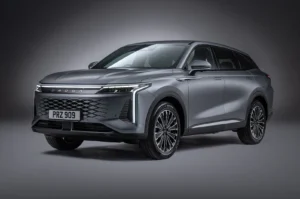
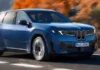
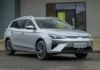
The Avatr 07L is a five-seat electric SUV from Avatr Technology, the joint venture backed by Changan Automobile, CATL, and Huawei. It sits above the standard Avatr 07 as a stretched, long-wheelbase family SUV, positioned below the brand’s 11 and 12 flagships. The 07L is built on a mid-size premium SUV platform and is offered in single-motor rear-wheel-drive and triple-motor all-wheel-drive configurations. What makes it notable isn’t styling — it’s that the 07L is the first Avatr model to offer a triple-motor setup, and it launches with Huawei’s newer Qiankun ADS 5 driver-assistance suite standard across every trim, a step up from the ADS 4 hardware fitted to earlier Avatr models.
The 07L runs an 89.33 kWh CATL Shenxing LFP battery on an 800-volt silicon carbide platform. Top trims are rated at 725 km CLTC, with the entry configuration rated at 650 km CLTC. No WLTP or EPA figures exist yet, and CLTC readings typically come in higher than either cycle would for the same hardware, so treat the range figure as a China-market benchmark rather than a global one. The battery supports 5C DC fast charging, with Avatr claiming a 0–80% charge in 20 minutes. AC onboard charging capacity has not been officially published for the 07L specifically. Any range or charging figure not explicitly tied to a confirmed trim above should be treated as preliminary until independent testing or a global-market spec sheet is released.
In its home market, the 07L launched at 219,900 to 279,900 yuan (roughly $32,380 to $40,000), with limited-time launch pricing running slightly below that range. Pricing and availability outside China have not been confirmed, and there is no announced export timeline at this stage. The 07L realistically suits family buyers who want interior space from a longer wheelbase along with a full driver-assistance package, rather than buyers prioritizing top speed or a compact footprint.
Within Avatr’s own lineup, the 07L sits between the standard Avatr 07 and the flagship Avatr 12, offering more interior room than the former without stepping into the latter’s premium sedan positioning. Outside the brand, it competes most directly with the Xiaomi YU7 and the Zeekr 7X, both of which target the same mid-size premium SUV buyer with comparable range and driver-assistance claims. For a direct spec-for-spec and price-for-price comparison, the Xiaomi YU7 is the closest match and the most relevant benchmark for shoppers cross-shopping this segment.
| Full Model Name | Avatr 07L (阿维塔 07L) |
| Generation | 1st generation (stretched derivative of Avatr 07) |
| Segment / Class | Mid-to-large premium electric SUV |
| Available Trims / Variants | Elite (RWD), Max+ (RWD), Ultra (Tri-motor AWD) |
| Powertrain Options | Single-motor RWD, Tri-motor AWD |
| Additional Notes | First Avatr model offered with a tri-motor drivetrain |
| Reveal Date | Pre-sales opened July 17, 2026; officially launched August 8, 2026 |
| Launch Year | 2026 |
| Availability Status | On sale in China |
| Brand / Manufacturer | Avatr Technology (Changan / CATL / Huawei joint venture) |
| Country of origin | China |
| Assembly Country | China (Chongqing) |
| Markets Available | China only at launch |
| Grey Market Import | Possible via third-party exporters |
| Base Price (USD) | 219,900 yuan (~$32,380 USD, limited-time launch price); standing price from 229,900 yuan |
| Additional Notes | Three trims priced at 229,900 / 249,900 / 279,900 yuan before launch discounts |
| Battery Capacity | 89.33 kWh |
| Battery Chemistry | LFP (Lithium Iron Phosphate) |
| Battery Architecture | 800V silicon carbide platform |
| Range (WLTP/CLTC/EPA) | (CLTC): 725 km (Elite/Max+ RWD), 650 km (Ultra AWD) — CLTC only; no WLTP or EPA figure published |
| Heat Pump | |
| DC Charging (Max kW) | 5C-rate CATL Shenxing pack; 30–80% in under 10 minutes |
| Charging Time (10–80%) | 0–80% in approximately 20 minutes (manufacturer claim) |
| Cell Brand | CATL Shenxing |
| Additional Notes | Battery is shared across all three trims |
| Motor Type | Permanent magnet synchronous |
| Motor Configuration | Single rear motor (Elite/Max+); tri-motor, one front + two rear (Ultra) |
| Front Motor Output (kW / HP) | 210 kW (282 hp) — Ultra only |
| Rear Motor Output (kW / HP) | 305 kW (409 hp) single-motor version; 2 × 251 kW (337 hp each) on Ultra |
| Power Output (kW / hp) | 305 kW (409 hp) RWD; 712 kW (955 hp) Ultra combined |
| Peak Power (kW / hp) | 712 kW (955 hp) — Ultra tri-motor |
| Torque (Nm) | 996 Nm (Ultra combined) |
| 0–100 km/h / 0-60 mph (seconds) The acceleration numbers are an easy way to compare car performance. We list either time from 0 to 100 km/h or time from 0 to 60mph, depending on which number(s) the manufacturers provide. The lower the acceleration time, the higher performance the car is. | 5.9 sec (RWD); 3.7 sec (Ultra tri-motor) |
| Top Speed (km/h / mph) | 200 km/h (all trims) |
| Transmission / Drive | Single-speed reduction gear, RWD or tri-motor AWD |
| Torque Vectoring | Implied on tri-motor Ultar via independent rear motors |
| Body Style | 5-door SUV, 5-seat |
| Body Colour Options | Desert White, Jet Black, Rock Gray, Star Purple, Crescent Moon Silver |
| Platform / Architecture | CHN platform (Avatr/Changan EV architecture) |
| Dimensions (L×W×H mm) | 4,910 × 1,980 × 1,650 mm (1,670 mm with Ultra roof rack) |
| Wheelbase (mm) | 2,990 mm |
| Suspension (Front / Rear) | Double-wishbone front / multi-link rear, CDC adaptive dampers |
| Trunk/Boot Capacity (L) | 735 L (1,645 L with rear seats folded) |
| Frunk/Bonnet Capacity (L) | 100 L |
| Additional Notes | The 07L is 85 mm longer and 50 mm longer in wheelbase than the standard Avatr 07 (4,825 mm / 2,940 mm); rear doors are longer, C-pillar side windows are larger, and the tailgate is less rakish per official images |
| Driver Assistance (ADAS) | Huawei Qiankun ADS 5, standard on all trims |
| ADAS Features | City NCA available via paid ADS software package |
| Autonomous Driving System Name | Huawei Qiankun ADS 5 |
| Autonomous Driving Hardware | Roof-mounted lidar, 896 channels, resolves a 14 cm object at 120 m |
| Additional Notes | Huawei Qiankun branding is visible on the B-pillar in official exterior images; full ADAS hardware list pending official reveal |
| Seating Capacity | 5 |
| Seat Material | Water-based microfibre leather (standard); Nappa leather (Maple Red/Cloud White interior) |
| Power Seats | Front passenger "zero-gravity" seat with dual 120° recline; rear seats power-reclining up to 130° |
| Noise Insulation | 6 mm double-layer acoustic glass on all four doors; 151 acoustic treatment measures |
| Centre Screen (inches) | 15.6-inch, HarmonyOS |
| Driver's Display (inches) | 35.4-inch panoramic strip display (instrument cluster) |
| Operating System | HarmonyOS (Huawei) |
| Headlight Type (LED/Matrix/Laser) | LED, split-headlight design |
| Daytime Running Lights (DRL) | LED |
| Tail Light Design | Full-width, continuous LED unit |
| Additional Notes | Semi-hidden door handles; optional camera-based side mirrors in place of glass mirrors |
| Navigation System | HarmonyOS-integrated navigation |
| Vehicle-to-Load (V2L) | 3.3 kW |
| Additional Notes | Huawei Qiankun badge featured on B-pillar, denoting "2.0" partnership tier with Avatr |
| Official Dealer Network | China only at launch |
| Import Duty Class | Varies by country |
| Grey Market Support | No official support; third-party exporter routes exist |
| Data Source | Avatr official launch specifications (China-market), CnEVPost, CarNewsChina |
| Last Updated | August 11, 2026 |
Specifications sourced from manufacturer data and may reflect WLTP, CLTC, or EPA test conditions. Import prices in your local are estimates based on grey-market landing costs and exclude duties, clearing fees, and local taxes. Figures are subject to change without notice. Always verify with your local importer before purchase. We can not guarantee that the information on this page is 100% correct