- Home
- Electric Vehicles
- Compare Electric Cars
- BMW iX3 2026 vs Mercedes-Benz GLC
BMW iX3 2026 vs Mercedes-Benz GLC
The BMW iX3 2026 is a mid-size pure-electric SUV from BMW’s X lineup, aimed at buyers who want full BEV ownership without stepping away from premium German engineering. The Mercedes-Benz GLC 300e is a plug-in hybrid in the same class — not a pure EV — which matters when comparing real electric capability. This pairing is relevant right now because both compete directly in Africa’s grey-market premium import space, where buyers spending $60,000–$75,000 are deciding between full electric and PHEV flexibility.
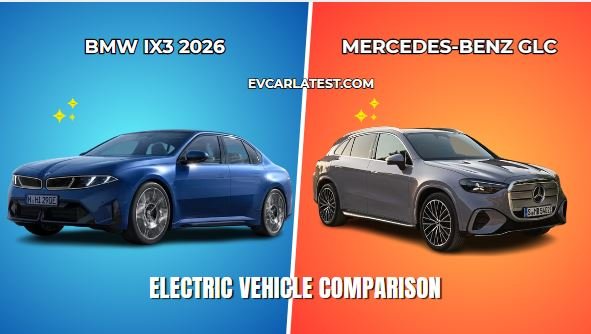
The BMW iX3 2026 delivers 460km WLTP range, with real-world estimates closer to 370–390km. It supports up to 150kW DC fast charging and 11kW AC, hitting 10–80% in roughly 34 minutes. The Mercedes GLC 300e offers only ~120km WLTP on electric alone (real-world N/C), with 7.4kW AC charging and no DC fast charge support. A full battery charge takes around 3.5 hours on AC. For drivers outside city centres, these are very different vehicles.
The iX3 2026 starts around $65,000 USD — approximately ₦100M+ on grey market in Nigeria, ZAR 1.2M in South Africa, and KES 8.5M in Kenya. The GLC 300e starts from ~$62,000 USD (approx. ₦96M grey import; ZAR 1.15M). Both are available through grey import channels in Nigeria, with more formal availability in South Africa and Kenya. If reliable home charging is available, the iX3 is the more cost-efficient long-term choice. If you need petrol as a backup given Nigeria’s sparse charging network, the GLC answers that need.
BMW’s relevant alternatives include the smaller, more affordable iX1 and the larger iX. Mercedes counters with the EQC (full BEV) and EQB (a 7-seat BEV option). Outside both brands, the Volvo EX60 and Audi Q4 e-tron compete at similar pricing. The iX3 vs GLC 300e comparison remains the sharpest one because it directly captures the full-BEV-versus-PHEV question that most African premium buyers are actually sitting with.
The iX3’s 460km range means fewer charging stops on intercity runs like Lagos–Ibadan or Nairobi–Mombasa, which matters where chargers are spaced far apart. Its 150kW DC capability makes stops quick when infrastructure exists. As a full BEV, there is no combustion drivetrain to maintain, which lowers long-term servicing costs. On the downside, zero petrol fallback is a real risk in markets with unreliable charging, and grey-market pricing pushes the iX3 above ₦100M in Nigeria. The GLC 300e’s petrol backup eliminates range anxiety on long or rural routes entirely, and its interior quality remains a strong point for corporate buyers. PHEV flexibility suits city commuters who can charge overnight. The limitations are real though: 120km electric range barely covers heavy urban daily use, and AC-only charging means no fast top-ups on the road.
Quick Verdict:
Choose the BMW iX3 2026 if full electric ownership is your goal and you have reliable home or workplace charging. Choose the Mercedes-Benz GLC 300e if you want EV-style daily driving without abandoning petrol as a fallback — especially relevant for Nigerian buyers where public charging is still limited. The GLC costs less upfront but covers far less electric ground per charge. The iX3 is the stronger long-term choice if your infrastructure can support it.
FAQ
Is the BMW iX3 2026 better than the Mercedes GLC for long trips?
The iX3’s 460km WLTP range is far ahead of the GLC 300e’s 120km electric range for long-distance EV driving. That said, the GLC can refuel at any petrol station, making it more practical on routes in Nigeria or rural Kenya where EV chargers are scarce.
Which is cheaper to maintain?
The iX3, as a full BEV, carries no combustion engine, exhaust system, or gearbox oil. The GLC 300e runs two drivetrains in parallel, meaning two systems to service. Over five years, the iX3 typically costs less to maintain.
Is the Mercedes-Benz GLC 300e available in Nigeria?
Yes, through grey market importers sourcing from the UK, UAE, or Europe. Official Mercedes-Benz dealers in Nigeria stock selected models, but the GLC 300e is not always a standard showroom item. Import pricing and specs vary by batch.
Related EV Comparisons
- BMW iX3 2026 vs Polestar 3
- BMW iX3 2026 vs Porsche Macan
- Zeekr 007 GT (7 GT) 2026 vs BMW i5 Touring
- Audi Q4 e-tron 2026 vs Mercedes-Benz EQB
- Audi Q4 e-tron 2026 vs BMW iX1 2026

| |
| Price | $60,000.00 $71,000.00 |
| Our Rating | |
| Brand | BMW MERCEDES |
| Category | Electric Cars Electric Cars |
MODEL
| Available Trims / Variants |
iX3 40 (RWD, coming late 2026), iX3 50 xDrive (AWD, at launch) Mercedes GLC 300+ Mercedes GLC 400 4MATIC |
PRICE & AVAILABILITY
| Base Price (USD) |
$60,000
€ 71,200 - Mercedes GLC 400 4MATIC |
| Availability Status | On sale — UK/Europe from Sept 2025; US/Canada from summer 2026 Coming soon. Expected release 2026, Q1 |
BATTERY & CHARGING
| Battery Capacity | 108.4 kWh usable / 113.4 kWh total 94 kWh usable |
| Range (WLTP/CLTC/EPA) |
(WLTP): 456–500 miles (EPA): ~400 miles 444 mi WLTP - Mercedes GLC 400 4MATIC |
| DC Charging (Max kW) |
Up to 400 kW — 10–80% in 21 minutes; 231 miles added in 10 minutes
CCS - Mercedes GLC 300+ CCS 330 kW 10-80% in 22 min - Mercedes GLC 400 4MATIC |
| AC Charging (Max kW) |
11 kW onboard charger — 0–100% approx. 11 hours
Type 2 11 kW - Mercedes GLC 300+ Type 2 22 kW Type 2 11 kW 0-100% in 10 hours - Mercedes GLC 400 4MATIC |
| Energy Consumption |
3.7–4.1 miles/kWh (WLTP)
240 Wh/mi WLTP - Mercedes GLC 400 4MATIC |
PERFORMANCE
| Power Output (kW / hp) |
463 hp (345 kW) — dual-motor AWD — Front motor: 123 kW / 255 Nm; Rear motor: 240 kW / 435 Nm RWD 369 hp (271 kW) - Mercedes GLC 300+ AWD 489 hp (360 kW) - Mercedes GLC 400 4MATIC |
| 0–100 km/h / 0-60 mph (seconds) The acceleration numbers are an easy way to compare car performance. We list either time from 0 to 100 km/h or time from 0 to 60mph, depending on which number(s) the manufacturers provide. The lower the acceleration time, the higher performance the car is. |
0–62 mph in 4.9 seconds
5.9 sec 0-62 mph - Mercedes GLC 300+ 4.3 sec 0-62 mph - Mercedes GLC 400 4MATIC |
| Torque (Nm) |
645 Nm (475 lb-ft)
504 Nm (372 lb-ft) - Mercedes GLC 300+ 800 Nm (590 lb-ft) - Mercedes GLC 400 4MATIC |
| Top Speed (km/h / mph) |
130.5 mph (210 km/h)
130 mph (210 km/h) - Mercedes GLC 400 4MATIC |
BODY & DIMENSIONS
| Dimensions (L×W×H mm) | 4,782 mm L × 1,895 mm W × 1,635 mm H |
| Trunk/Boot Capacity (L) | 520 L standard; 1,750 L with rear seats folded EU: 570 l, 1740 l max |
| Body Style | 5-door, 5-seat electric SUV 5 door SUV, 5/7 seats |
| Kerb Weight (kg) |
2,285 kg curb weight; 2,825 kg max allowable
EU: 2535 kg unladen, 3040 kg gross - Mercedes GLC 400 4MATIC |
| Ground Clearance (mm) | 176 mm |
| Frunk/Bonnet Capacity (L) | 58 L 128 l |
SAFETY & DRIVER ASSISTANCE
| Autonomous Driving Level | AI-based automated driving superbrain co-developed with Qualcomm, processes data 20× faster than previous systems; Highway Assist (hands-free) optional |
COMFORT & SEATING
| Seating Capacity | Heated front seats standard with electric adjustment; M Sport seats add 10-way adjustment and 7-stage massage Heated and cooled front seats, heated outer rear seats, hot-stone massaging seats |
DISPLAYS & CONNECTIVITY
| Centre Screen (inches) | 17.9-inch touchscreen, 3,340 × 1,440 px, angled 17.5° toward driver; BMW Operating System X (iDrive X) Part of 39" screen |
| Driver's Display (inches) | BMW Panoramic Vision — projects across the full windshield base (110 cm / 43.3 in), A-pillar to A-pillar; three fixed driver tiles plus six configurable widgets Part of 39" screen |
| Head-Up Display (HUD) | 3D HUD Yes, with augmented reality |
TECHNOLOGY
ADDITIONAL SPECS
Note
| Additional Notes | The iX3 also won the 2026 World Electric Vehicle Award. The iX3 40 (single motor, RWD) is arriving later in 2026 at a lower price. A long-wheelbase China-market variant with 900 km CLTC range is also in production. Some specs and pricing vary by market and trim. |

|
Disclaimer Note
Specifications sourced from manufacturer data and may reflect WLTP, CLTC, or EPA test conditions. Import prices in your local are estimates based on grey-market landing costs and exclude duties, clearing fees, and local taxes. Figures are subject to change without notice. Always verify with your local importer before purchase. We can not guarantee that the information on this page is 100% correct