- Home
- Electric Vehicles
- Compare Electric Cars
- Volkswagen ID.3 Neo vs Hyundai Ioniq 6
Volkswagen ID.3 Neo vs Hyundai Ioniq 6
The Volkswagen ID.3 Neo is a compact five-door hatchback from Germany’s MEB platform, designed for urban professionals who want practical daily range in a familiar form factor. The Hyundai Ioniq 6 is a sleek aerodynamic fastback from South Korea, targeting tech-forward buyers who want maximum efficiency and longer range. With Hyundai expanding its footprint in South Africa and grey-market ID.3 imports growing across Nigeria and Kenya, this pairing is worth a close look in 2025.
The ID.3 Neo (77 kWh) delivers 430 km WLTP range — real-world estimates land around 340–370 km. The Ioniq 6 Long Range RWD achieves 614 km WLTP, with real-world figures closer to 480–520 km. DC fast charging favours the Ioniq 6 significantly — 233 kW peak versus the ID.3 Neo’s 170 kW. The Ioniq 6 charges 10–80% in roughly 18 minutes on a 350 kW charger; the ID.3 Neo takes around 28 minutes. For buyers on long inter-city routes, that gap is meaningful.
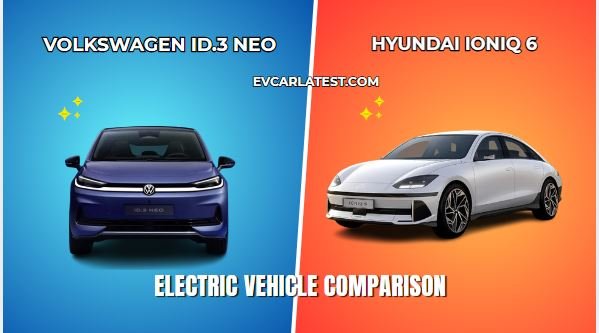
The ID.3 Neo starts near €35,000 (~₦63M / ~$38,000) via grey-market import. The Ioniq 6 Standard Range opens around €38,000 (~₦68M / ~$41,000), with Long Range RWD closer to €45,000 (~₦81M / ~$49,000). In South Africa, the Ioniq 6 is officially sold — pricing starts around ZAR 850,000. Neither has official Nigerian distribution; both arrive through grey-market channels from Europe or the UK. If range and charging speed matter most across sparse charging corridors, this page answers which one holds up better.
VW’s wider lineup includes the ID.4 and ID.7 for buyers needing more cabin space or crossover utility. Hyundai’s EV stable covers the Ioniq 5 (crossover format, same E-GMP platform) and the more affordable Kona Electric. The Tesla Model 3 and BYD Seal are the key rivals at this price band — both offer strong range — but the ID.3 Neo and Ioniq 6 hold an advantage in parts accessibility through established European and Korean import networks already active in West and East Africa.
ID.3 Neo — Its compact footprint handles congested Lagos or Nairobi traffic more comfortably than a larger fastback, which matters for daily urban use. VW’s MEB platform has broad grey-import service familiarity across African markets. The 77 kWh pack provides enough buffer for most Nigerian inter-city runs without range anxiety. The downside: its 430 km WLTP ceiling trails the Ioniq 6 noticeably, and interior quality feels underwhelming relative to its price point.
Ioniq 6 — Its 800V architecture and 233 kW peak charging make it one of the fastest-charging EVs at this price, genuinely reducing stop time on long routes. The Long Range variant’s 614 km WLTP rating is the strongest in this comparison, offering real comfort for buyers in markets with limited public charging. Hyundai also has official presence in South Africa, easing access to service and warranty support. The trade-offs: it’s longer and less city-manoeuvrable than the ID.3, and the higher Long Range pricing stretches the budget considerably.
Quick Verdict
Choose the ID.3 Neo if urban practicality and a smaller upfront cost are your priorities — its compact size and adequate range suit city-heavy use well. Choose the Ioniq 6 if long-distance capability and ultra-fast charging matter more, especially if you’re in South Africa where official support is available. The range and charging gap between them is real, but so is the price difference.
FAQ
Is the Hyundai Ioniq 6 better than the VW ID.3 Neo for long trips?
Yes, by a clear margin. The Ioniq 6 Long Range offers nearly 200 km more WLTP range and charges significantly faster, making it the stronger choice for inter-city travel where charging stops need to be short.
Which is cheaper to maintain, the ID.3 Neo or Ioniq 6?
Both have low running costs typical of EVs. The ID.3 Neo may be slightly easier to service through grey-import mechanics familiar with VW platforms; the Ioniq 6 benefits from Hyundai’s official dealer network in South Africa.
Is the Hyundai Ioniq 6 available in Nigeria?
There is no official Hyundai EV distribution in Nigeria as of 2025. The Ioniq 6 can be sourced via grey-market importers, but buyers should factor in the absence of warranty coverage and limited spare parts availability locally.
Does the VW ID.3 Neo or Ioniq 6 handle Nigerian roads better?
The ID.3 Neo’s shorter wheelbase and hatchback profile give it a handling edge in tight urban traffic. Ground clearance on both is modest, so rough road surfaces remain a concern regardless of which model you choose.
Related EV Comparisons
- Volkswagen ID.3 Neo vs Peugeot e-308
- Volkswagen ID.3 Neo vs BYD Seal (Atto 4)
- Volkswagen ID.3 Neo vs Tesla Model 3 2025
- Volkswagen ID.3 Neo vs Cupra Born
- Hongqi Tiangong 05 (EH5) vs Hyundai Ioniq 6

| |
| Price | $39,000.00 $41,000.00 |
| Our Rating | |
| Brand | VOLKSWAGEN Hyundai |
| Category | Electric Cars Electric Cars |
MODEL
| Available Trims / Variants |
Volkswagen ID.3 Neo 50 kWh Volkswagen ID.3 Neo 58 kWh Volkswagen ID.3 Neo 79 kWh Hyundai Ioniq 6 53kWh RWD Hyundai Ioniq 6 77.4kWh RWD Hyundai Ioniq 6 77.4kWh AWD |
PRICE & AVAILABILITY
| Base Price (USD) |
€ 43,900 $ 41,600 - Hyundai Ioniq 6 53kWh RWD $ 45,500 € 54,000 £ 46,750 - Hyundai Ioniq 6 77.4kWh RWD $ 49,000 € 61,100 £ 55,000 - Hyundai Ioniq 6 77.4kWh AWD |
| Availability Status | Coming soon. Expected release 2026, Q3 Available to order. Released 2022, November 15 |
BATTERY & CHARGING
| Battery Capacity |
50 kWh usable - Volkswagen ID.3 Neo 50 kWh 58 kWh usable, 62 kWh total - Volkswagen ID.3 Neo 58 kWh 79 kWh usable, 82 kWh total - Volkswagen ID.3 Neo 79 kWh 53 kWh total - Hyundai Ioniq 6 53kWh RWD 77.4 kWh total - Hyundai Ioniq 6 77.4kWh RWD 77.4 kWh total - Hyundai Ioniq 6 77.4kWh AWD |
| Range (WLTP/CLTC/EPA) |
259 mi WLTP - Volkswagen ID.3 Neo 50 kWh 307 mi WLTP - Volkswagen ID.3 Neo 58 kWh 391 mi WLTP - Volkswagen ID.3 Neo 79 kWh 267 mi WLTP (240 mi EPA) - Hyundai Ioniq 6 53kWh RWD 382 mi WLTP (361 mi EPA) - Hyundai Ioniq 6 77.4kWh RWD 362 mi WLTP (316 mi EPA) - Hyundai Ioniq 6 77.4kWh AWD |
| DC Charging (Max kW) |
CCS 105 kW, 10-80% in 29 min - Volkswagen ID.3 Neo 50 kWh CCS 105 kW, 10-80% in 29 min - Volkswagen ID.3 Neo 58 kWh CCS 183 kW, 10-80% in 26 min - Volkswagen ID.3 Neo 79 kWh CCS 235 kW, 10-80% in 18 min |
| AC Charging (Max kW) |
Type 2 7.2 kW Type 2 11 kW Type 2 11 kW, 10-100% in 5 hours 40 min - Hyundai Ioniq 6 53kWh RWD Type 2 11 kW, 10-100% in 7 hours 16 min - Hyundai Ioniq 6 77.4kWh RWD Type 2 11 kW, 10-100% in 7 hours 16 min - Hyundai Ioniq 6 77.4kWh AWD |
| Energy Consumption |
240 Wh/mi WLTP
224 Wh/mi WLTP - Hyundai Ioniq 6 53kWh RWD 230 Wh/mi WLTP - Hyundai Ioniq 6 77.4kWh RWD 243 Wh/mi WLTP - Hyundai Ioniq 6 77.4kWh AWD |
PERFORMANCE
| Power Output (kW / hp) |
RWD 170 hp (125 kW) - Volkswagen ID.3 Neo 50 kWh RWD 190 hp (140 kW) - Volkswagen ID.3 Neo 58 kWh RWD 231 hp (170 kW) - Volkswagen ID.3 Neo 79 kWh RWD 151 hp (111 kW) - Hyundai Ioniq 6 53kWh RWD RWD 229 hp (168 kW) - Hyundai Ioniq 6 77.4kWh RWD AWD 325 hp (239 kW) - Hyundai Ioniq 6 77.4kWh AWD |
| 0–100 km/h / 0-60 mph (seconds) The acceleration numbers are an easy way to compare car performance. We list either time from 0 to 100 km/h or time from 0 to 60mph, depending on which number(s) the manufacturers provide. The lower the acceleration time, the higher performance the car is. |
7.3 sec 0-62 mph
8.8 sec 0-62 mph - Hyundai Ioniq 6 53kWh RWD 7.4 sec 0-62 mph - Hyundai Ioniq 6 77.4kWh RWD 5.1 sec 0-62 mph - Hyundai Ioniq 6 77.4kWh AWD |
| Torque (Nm) |
350 Nm (258 lb-ft) - Hyundai Ioniq 6 53kWh RWD 350 Nm (258 lb-ft) - Hyundai Ioniq 6 77.4kWh RWD 605 Nm (446 lb-ft) - Hyundai Ioniq 6 77.4kWh AWD |
| Top Speed (km/h / mph) | 99 mph (160 km/h) 115 mph (185 km/h) |
BODY & DIMENSIONS
| Dimensions (L×W×H mm) | 4265 x 1809 x 1554 mm (167.9 x 71.2 x 61.2 in) 4855 x 1880 x 1495 mm (191.1 x 74.0 x 58.9 in) |
| Trunk/Boot Capacity (L) | EU: 385 l, 1267 l max EU: 401 l |
| Body Style | 5 door hatchback, 4/5 seats 4 door sedan, 5 seats |
| Kerb Weight (kg) |
EU: 1833 kg unladen - Hyundai Ioniq 6 53kWh RWD EU: 1986 kg unladen - Hyundai Ioniq 6 77.4kWh RWD EU: 2096 kg unladen - Hyundai Ioniq 6 77.4kWh AWD |
| Ground Clearance (mm) | 141 mm (5.6 in) |
| Frunk/Bonnet Capacity (L) |
No
45 l 45 l 14 l |
SAFETY & DRIVER ASSISTANCE
| Crash Test Ratings | NCAP 2022: 5 stars |
COMFORT & SEATING
| Seating Capacity | Heated front seats, massage Heated and ventilated front seats, heated rear seats |
DISPLAYS & CONNECTIVITY
| Centre Screen (inches) | 12.9" touchscreen 12.3" touchscreen |
| Driver's Display (inches) | 10.25" 12.3" |
| Head-Up Display (HUD) | Yes, with augmented reality Yes, projector type |
TECHNOLOGY
ADDITIONAL SPECS
Note

|
Disclaimer Note
Specifications sourced from manufacturer data and may reflect WLTP, CLTC, or EPA test conditions. Import prices in your local are estimates based on grey-market landing costs and exclude duties, clearing fees, and local taxes. Figures are subject to change without notice. Always verify with your local importer before purchase. We can not guarantee that the information on this page is 100% correct