- Home
- Electric Vehicles
- Compare Electric Cars
- Volkswagen ID.3 Neo vs Peugeot e-308
Volkswagen ID.3 Neo vs Peugeot e-308
The Volkswagen ID.3 Neo is a purpose-built electric hatchback on VW’s MEB platform, aimed at urban professionals wanting proven German EV engineering in a practical package. The Peugeot e-308 is a stylish compact hatchback from Stellantis, targeting design-conscious buyers who want a full-EV drivetrain without abandoning conventional hatchback proportions. With both models increasingly appearing through grey-market imports into Nigeria, Kenya, and South Africa, the choice between them deserves a direct answer.
The ID.3 Neo (77 kWh) claims 430 km WLTP range, with real-world figures around 340–370 km. The e-308 (54 kWh usable) delivers 418 km WLTP, though real-world range settles closer to 320–350 km. On DC fast charging, the ID.3 Neo holds a clear lead at 170 kW versus the e-308’s 100 kW limit. The ID.3 Neo completes 10–80% in roughly 28 minutes; the e-308 needs around 35–38 minutes on a compatible fast charger. For buyers managing long inter-city runs, that charging gap matters.
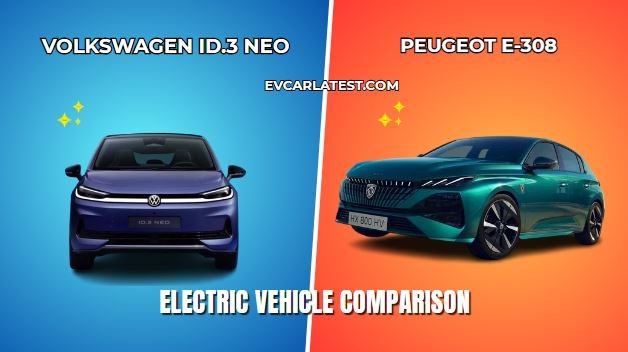
The ID.3 Neo starts around €35,000 (~₦63M / ~$38,000) via grey-market import. The e-308 opens near €36,500 (~₦65.5M / ~$39,500), making the price gap narrow on paper. Neither carries official distribution in Nigeria or most of West Africa — both arrive through European or UK grey-market channels. South Africa has limited Stellantis presence, giving e-308 buyers slightly better service access there. This page helps buyers decide which compact European EV justifies the import cost given local charging realities.
VW’s lineup extends to the ID.4 and ID.7 for buyers needing more space or range. Peugeot’s EV stable includes the e-208 (smaller, more affordable) and e-2008 (compact crossover). Outside both brands, the Opel Astra Electric and Renault Mégane E-Tech occupy this same segment — but the ID.3 Neo and e-308 lead on parts familiarity and grey-import track record across African markets, which reduces long-term service uncertainty.
ID.3 Neo — Its 170 kW DC fast charging meaningfully cuts downtime on longer routes where charging stops are infrequent, a real advantage in Nigeria and Kenya. The larger 77 kWh battery provides a genuine range buffer that reduces anxiety outside major urban centres. VW’s MEB platform is widely serviced by grey-import mechanics across West Africa. On the downside, cabin plastics feel budget-grade for the price, and the entry 58 kWh trim’s range is tight for buyers outside Lagos or Nairobi.
Peugeot e-308 — Interior design and material quality are noticeably more premium, which matters for buyers stepping up from a petrol mid-range car. Its lighter kerb weight from the 54 kWh pack translates into confident, precise handling that suits urban driving. Stellantis platform sharing with Opel and Citroën broadens potential service touchpoints. However, the 100 kW DC charging ceiling is a genuine constraint for fast-charge-dependent users, and its real-world range trails the ID.3 Neo on longer runs.
Quick Verdict
Choose the ID.3 Neo if charging speed and range buffer are your main concerns — the larger battery and faster DC charging make a practical difference where infrastructure is thin. Choose the e-308 if interior quality and driving refinement matter more and your daily range stays within 200 km. The price difference is small, but the performance gap at the charger is not.
FAQ
Is the VW ID.3 Neo better than the Peugeot e-308 for long trips?
The ID.3 Neo holds an advantage on longer routes thanks to its bigger battery and faster DC charging, allowing shorter stops and greater confidence between chargers.
Which is cheaper to maintain, the ID.3 Neo or Peugeot e-308?
Running costs are comparable for both — no oil changes, similar brake wear patterns. The ID.3 Neo may edge ahead on parts sourcing due to VW’s wider grey-import service network in West Africa.
Is the Peugeot e-308 available in Nigeria?
Peugeot has a historical presence in Nigeria, but the e-308 electric is not officially distributed locally. Grey-market imports from Europe remain the only route, with limited warranty and parts support.
Related EV Comparisons
- Volkswagen ID.3 Neo vs BYD Seal (Atto 4)
- Volkswagen ID.3 Neo vs Tesla Model 3 2025
- Volkswagen ID.3 Neo vs Cupra Born
- Roewe D6 vs Volkswagen ID.3 2026
- Hyundai Ioniq 3 vs Volkswagen ID.3 2026

| |
| Price | $39,000.00 $48,500.00 |
| Our Rating | |
| Brand | VOLKSWAGEN PEUGEOT |
| Category | Electric Cars Electric Cars |
MODEL
| Available Trims / Variants |
Volkswagen ID.3 Neo 50 kWh Volkswagen ID.3 Neo 58 kWh Volkswagen ID.3 Neo 79 kWh e-308 (electric version) |
PRICE & AVAILABILITY
| Base Price (USD) | US $48,500 (for base trim) |
| Availability Status | Coming soon. Expected release 2026, Q3 Available for order in late 2025 / early 2026. |
BATTERY & CHARGING
| Battery Capacity |
50 kWh usable - Volkswagen ID.3 Neo 50 kWh 58 kWh usable, 62 kWh total - Volkswagen ID.3 Neo 58 kWh 79 kWh usable, 82 kWh total - Volkswagen ID.3 Neo 79 kWh 58.4 kWh gross, ~55.4 kWh usable |
| Range (WLTP/CLTC/EPA) |
259 mi WLTP - Volkswagen ID.3 Neo 50 kWh 307 mi WLTP - Volkswagen ID.3 Neo 58 kWh 391 mi WLTP - Volkswagen ID.3 Neo 79 kWh (mi WLTP): ~281 mi (~450 km) WLTP |
| DC Charging (Max kW) |
CCS 105 kW, 10-80% in 29 min - Volkswagen ID.3 Neo 50 kWh CCS 105 kW, 10-80% in 29 min - Volkswagen ID.3 Neo 58 kWh CCS 183 kW, 10-80% in 26 min - Volkswagen ID.3 Neo 79 kWh Up to 100 kW DC fast charging; ~20%-80% in ~30-32 minutes |
| AC Charging (Max kW) |
Type 2 7.2 kW Type 2 11 kW On-board charger ~11 kW (3-phase) in many markets |
| Energy Consumption | 240 Wh/mi WLTP Approx ~12.4 kWh/100km |
PERFORMANCE
| Power Output (kW / hp) |
RWD 170 hp (125 kW) - Volkswagen ID.3 Neo 50 kWh RWD 190 hp (140 kW) - Volkswagen ID.3 Neo 58 kWh RWD 231 hp (170 kW) - Volkswagen ID.3 Neo 79 kWh 115 kW (~156 hp), front-wheel drive (FWD) |
| 0–100 km/h / 0-60 mph (seconds) The acceleration numbers are an easy way to compare car performance. We list either time from 0 to 100 km/h or time from 0 to 60mph, depending on which number(s) the manufacturers provide. The lower the acceleration time, the higher performance the car is. | 7.3 sec 0-62 mph 0-100 km/h around ~9.8 s |
| Torque (Nm) | 270 Nm (~199 lb-ft) |
| Top Speed (km/h / mph) | 99 mph (160 km/h) 170 km/h (~106 mph) |
BODY & DIMENSIONS
| Dimensions (L×W×H mm) | 4265 x 1809 x 1554 mm (167.9 x 71.2 x 61.2 in) Length ~4,365 mm; Width ~1,850 mm; Height ~1,465 mm; Wheelbase ~2,680 mm. |
| Trunk/Boot Capacity (L) | EU: 385 l, 1267 l max 361 L with rear seats up (hatch) for electric version |
| Body Style | 5 door hatchback, 4/5 seats 5-door compact hatchback (e-308) |
| Ground Clearance (mm) | 132 mm |
| Frunk/Bonnet Capacity (L) | No |
SAFETY & DRIVER ASSISTANCE
| Autonomous Driving Level | No full Level-3 autonomous driving capability cited. |
COMFORT & SEATING
| Seating Capacity | Heated front seats, massage Standard premium materials vary by trim; higher trims include sportier finishes. |
DISPLAYS & CONNECTIVITY
| Centre Screen (inches) | 12.9" touchscreen 10″ central touchscreen infotainment |
| Driver's Display (inches) | 10.25" Digital instrument cluster (10″+); optional 3D head-up for upper trims |
| Head-Up Display (HUD) | Yes, with augmented reality Available as optional/upgraded feature |
TECHNOLOGY
ADDITIONAL SPECS
Note
| Additional Notes |
These specs refer to European/UK market version; markets such as Nigeria may have different configuration (charger, trim, price, RHD/LHD). Some values are approximate or based on early announcements (e.g., WLTP range “target” ~450 km). Trim-specific equipment (e.g., GT Premium) may include additional features beyond this general spec sheet. |

|
Disclaimer Note
Specifications sourced from manufacturer data and may reflect WLTP, CLTC, or EPA test conditions. Import prices in your local are estimates based on grey-market landing costs and exclude duties, clearing fees, and local taxes. Figures are subject to change without notice. Always verify with your local importer before purchase. We can not guarantee that the information on this page is 100% correct