- Home
- Electric Vehicles
- Compare Electric Cars
- Zeekr 007 GT 2026 vs Tesla Model 3 2025
Zeekr 007 GT 2026 vs Tesla Model 3 2025
Zeekr 007 GT 2026 vs Tesla Model 3 2025, both target the same mid-size EV space with different body styles. The Zeekr is a shooting brake from Zeekr under Geely, built for buyers who want more cargo space and premium features. The Model 3 from Tesla targets tech-focused drivers who value efficiency and software. This comparison matters now as newer Chinese EVs expand into global markets and compete on price and features.
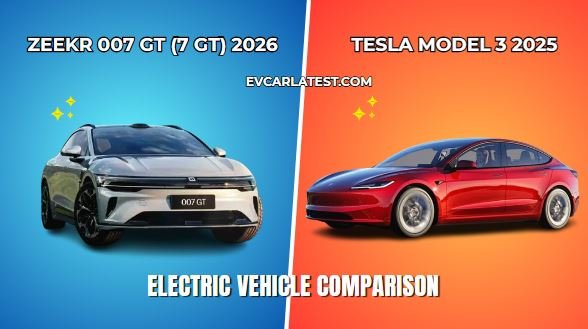
Zeekr 007 GT 2026 vs Tesla Model 3 2025 Range
The Zeekr 007 GT offers up to about 700 km CLTC range, which translates to roughly 550–600 km WLTP estimate. Real-world use often lands near 480–550 km. The Model 3 2025 delivers about 513 km WLTP for the RWD version, with real-world figures around 420–460 km. The Zeekr supports 11 kW AC and up to 360 kW DC fast charging on its 800V system. The Model 3 supports 11 kW AC and about 170–250 kW DC depending on variant. A 10–80% charge takes around 15–20 minutes in the Zeekr and about 25–30 minutes in the Model 3 on fast chargers.
The Zeekr 007 GT starts around $42,000, which converts to roughly ₦65–75 million for imported units. The Model 3 2025 starts near $39,000, landing around ₦60–70 million depending on import costs. Zeekr offers RWD and AWD variants with larger battery options and higher output. The Model 3 lineup includes RWD, Long Range, and Performance. The Zeekr is mainly available in China and select export markets, while the Model 3 has wider global availability including Europe, North America, and imports into Africa. This page helps you decide between a newer high-tech EV with faster charging and a proven sedan with broader support.
Within Zeekr’s lineup, buyers can look at the Zeekr 001 for a larger option. Tesla buyers can consider the Tesla Model Y for more space. Outside both brands, the Hyundai Ioniq 6 and BYD Seal compete in this price range. This comparison stands out because it highlights charging speed versus ecosystem strength in one segment.
The Zeekr 007 GT offers longer range and faster charging, which reduces downtime on long trips. Its shooting brake design adds cargo space, which helps if you carry more gear. It also includes newer interior tech and premium materials, which improve comfort. On the downside, limited availability makes servicing harder in Africa. Its software ecosystem is less proven outside China, which affects long-term support.
The Model 3 2025 delivers a stable software system with regular updates, which keeps features current. Its global presence makes parts and support easier to find in many regions. It also maintains strong efficiency, which reduces running costs. On the downside, charging speed is slower than newer 800V rivals, which increases wait time. Its sedan design limits cargo flexibility compared to a shooting brake.
QUICK VERDICT
before you Choose from Zeekr 007 GT 2026 vs Tesla Model 3 2025, the Zeekr 007 GT 2026 if you prioritize faster charging and more cargo space. Choose the Tesla Model 3 2025 if software support and global availability matter more to you. The trade-off comes down to newer hardware versus established ecosystem.

| |
| Price | $28,000.00 $37,000.00 |
| Our Rating | |
| Brand | Zeekr TESLA |
| Category | Electric Cars Electric Cars |
MODEL
| Available Trims / Variants |
RWD Standard Range RWD Long Range AWD Long Range Tesla Model 3 Standard |
PRICE & AVAILABILITY
| Base Price (USD) | ~$28,400 (limited-time); MSRP ~$29,800 $ 37,000 |
| Availability Status | On sale — China Q2 2026; Europe (as Zeekr 7 GT) TBD Available to order. Released 2025, October |
BATTERY & CHARGING
| Battery Capacity |
75 kWh (LFP) 103 kWh (NMC) 69 kWh total |
| Range (WLTP/CLTC/EPA) |
(CLTC) 75 kWh: up to 905 km 103 kWh: up to 905 km (WLTP est.)Not officially confirmed for 2026 update; ~620–680 km estimated 321 mi EPA |
| DC Charging (Max kW) | Up to 6C peak; 10–80% in ~10 minutes (900V ultra-fast) Supercharger 225 kW max |
| AC Charging (Max kW) | 11 kW Type 2 11 kW |
PERFORMANCE
| Power Output (kW / hp) |
RWD: 496 hp (370 kW) AWD: 784 hp (585 kW) RWD |
| 0–100 km/h / 0-60 mph (seconds) The acceleration numbers are an easy way to compare car performance. We list either time from 0 to 100 km/h or time from 0 to 60mph, depending on which number(s) the manufacturers provide. The lower the acceleration time, the higher performance the car is. |
RWD: ~5.3 s AWD: 2.95 s 5.8 sec 0-60 mph |
| Torque (Nm) |
RWD: ~440 Nm AWD: 710 Nm |
| Top Speed (km/h / mph) | 210 km/h (130 mph) 125 mph (201 km/h) |
BODY & DIMENSIONS
| Dimensions (L×W×H mm) | 4,858–4,880 mm (L) × 1,900 mm (W) × 1,445–1,460 mm (H) 4720 x 1933 x 1441 mm (185.8 x 76.1 x 56.7 in) |
| Trunk/Boot Capacity (L) | 456 L / up to 1,390 L (seats folded) US: 680 l |
| Body Style | 5-door shooting brake, 5 seats 4 door sedan, 5 seats |
| Kerb Weight (kg) | US: 1705 kg curb |
| Ground Clearance (mm) | 162–169 mm (air suspension adjustable, 55 mm travel range) 165 mm (6.5 in) |
| Frunk/Bonnet Capacity (L) | 65 L (RWD) · 32 L (AWD) 88 l |
SAFETY & DRIVER ASSISTANCE
| Autonomous Driving Level | L2 ADAS; NZP highway pilot; G-ASD system (Geely); ejection / drift / track modes on AWD Autopilot with full Self-Driving capability |
COMFORT & SEATING
| Seating Capacity | Faux suede / Nappa leather; 14-way electric adjustment; heating, ventilation, 8-point massage Heated and ventilated/cooled front seats, heated rear seats |
DISPLAYS & CONNECTIVITY
| Centre Screen (inches) | 15" OLED / 2.5K touchscreen 15.4" touchscreen |
| Driver's Display (inches) | 13" LCD instrument cluster No |
| Head-Up Display (HUD) | 35.5" AR-HUD No |
TECHNOLOGY
ADDITIONAL SPECS
Note
| Additional Notes |
CLTC figures are from China's optimistic test cycle — real-world range will be lower. 900V upgrade arrived with the April 2026 refresh; earlier 007 GT (2025) used 800V. Sold overseas as Zeekr 7 GT. European pricing expected around €47,000.
01 September 2023: Initial release price 42,990 EUR 10 January 2024: Initial release price 38,990 USD - Tesla Model 3 Standard Range 01 September 2023: Initial release price 51,990 EUR 10 January 2024: Initial release price 45,990 USD - Tesla Model 3 Long Range 11 July 2024: Initial release price 42,490 USD |

|
Disclaimer Note
Specifications sourced from manufacturer data and may reflect WLTP, CLTC, or EPA test conditions. Import prices in your local are estimates based on grey-market landing costs and exclude duties, clearing fees, and local taxes. Figures are subject to change without notice. Always verify with your local importer before purchase. We can not guarantee that the information on this page is 100% correct