

- Electric Vehicles
- Compare Electric Cars
- Hongqi Tiangong 06 vs XPeng G6 2026
Hongqi Tiangong 06 vs XPeng G6 2026
The Hongqi Tiangong 06 is a mid-size electric SUV from FAW Hongqi, China’s state-backed prestige brand. It targets buyers who want a premium-feeling cabin, long range, and strong technology at a sub-$30,000 price point. The XPeng G6 2026 is a fastback coupe-crossover from XPeng, a tech-first automaker positioning itself as a smarter Tesla Model Y alternative for buyers who value fast charging and advanced driver assistance. This comparison matters now because both models have received significant 2025–2026 updates, bringing 800V charging and fresh specs to a segment increasingly relevant for grey-market imports into Nigeria, Kenya, and South Africa.
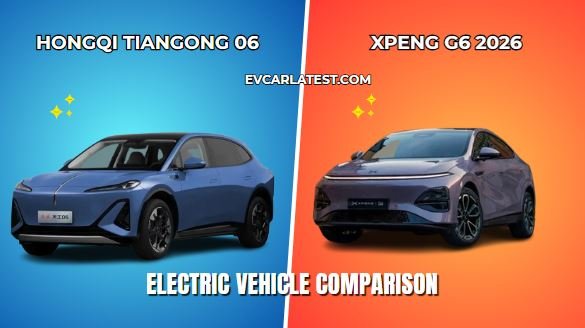
The Tiangong 06 offers a CLTC-rated range of up to 610km on its 800V variant, and both it and its sibling can recharge from 10% to 80% in just 12 minutes using the 800V high-voltage architecture. Real-world WLTP equivalent is estimated at around 480–500km for the top trim. The XPeng G6 Long Range achieves up to 326 miles (525km) WLTP, while the Standard Range manages 292 miles (470km) WLTP. On a compatible ultra-rapid charger, both variants reach 10–80% in as little as 12 minutes, with the Long Range and Performance models supporting up to 451kW DC. For African road conditions where long inter-city gaps exist — Lagos to Ibadan, Nairobi to Mombasa — the Tiangong 06 has a practical edge in raw range, but the G6’s WLTP figures are independently verified and more conservative. AC charging for both sits at around 11kW on-board, making overnight home charging the realistic daily routine.
The Tiangong 06 800V starts at 191,800 yuan, approximately $26,700 USD — around ₦42.7M, KES 3.4M, or ZAR 495,000 at current grey-market import estimates, excluding duty. The XPeng G6 starts at $34,900 USD, translating to roughly ₦55.8M, KES 4.5M, or ZAR 648,000 before Nigerian or Kenyan import duties. Neither is officially sold in Africa yet, meaning both arrive through grey-market channels. The Tiangong 06 wins on entry price and is the better choice for buyers prioritising space, range, and prestige badge appeal on a tighter budget. The G6 suits buyers who want a verified WLTP range figure, a slicker exterior design, and a more internationally recognisable tech ecosystem.
Within Hongqi’s lineup, the Tiangong 05 sedan and the larger Tiangong 08 SUV flank this model — useful if the buyer wants to compare family sizes. The Tiangong 08 is the flagship crossover in the series, while the Tiangong 05 is a more affordable sedan starting around $22,050. For XPeng, the P7 sedan and the X9 large SUV round out the range for buyers wanting more space or performance. Outside both brands, the BYD Atto 3 and MG4 Electric remain the most accessible alternatives in African grey markets at lower price points, but neither matches the range or charging speed of these two. This Tiangong 06 vs G6 comparison wins because both occupy the same premium-practical mid-size SUV sweet spot where the real buying decision actually happens.
The Tiangong 06’s longer CLTC-rated range makes it more capable for African highway driving where charging infrastructure is still limited. Its lower starting price gives buyers more car for the money compared to similarly equipped rivals. The 800V fast charging means that where DC chargers exist, top-ups are quick enough to be genuinely practical. On the downside, CLTC range figures are measured under Chinese test conditions and tend to be optimistic, which could disappoint buyers expecting real-world numbers closer to those claims. Hongqi’s after-sales and spare parts network in Africa is essentially non-existent at this stage, adding risk to grey-market ownership.
The XPeng G6’s WLTP range rating is the more honest number for African buyers to plan around, reducing the gap between claimed and real-world performance. Its 451kW DC charging capability is class-leading and future-proofs the car as fast-charging infrastructure grows across Africa. The coupe-SUV design and tech-rich cabin make it one of the more distinctive vehicles in this price range. However, the G6 carries a noticeably higher purchase price once import costs are added, which narrows the value proposition for budget-conscious buyers. The touchscreen-heavy interior, while impressive, lacks physical controls that suit users in markets where software localisation and updates may be inconsistent.
Quick Verdict
Choose the Hongqi Tiangong 06 if maximum range per dollar and a more premium badge name matter most to you — it delivers more car at a lower cost, especially for buyers already familiar with grey-market Chinese imports. Choose the XPeng G6 if independently verified range figures and class-leading charging speeds are your priorities, and you are prepared to pay the higher landed cost for a more globally recognised EV brand. Both are grey-market imports in Africa, so factor in parts availability and local support before committing to either.
FAQ
Is the Hongqi Tiangong 06 better than the XPeng G6 for long trips?
The Tiangong 06 claims more range on paper at up to 610km CLTC, but that figure is measured under Chinese test conditions. The G6’s 525km WLTP Long Range rating is a more conservative and reliable estimate. For long African highway drives, the Tiangong 06 may go further between stops, but the G6 charges faster at high-power DC stations when they’re available.
Which is cheaper to maintain, the Tiangong 06 or XPeng G6?
Both use LFP battery chemistry, which is durable and degrades less than NMC over time, keeping long-term battery costs lower. Neither brand has an official service network in Nigeria or Kenya, so grey-market maintenance costs will depend on your local EV technician’s familiarity with Chinese platforms. The Tiangong 06’s lower purchase price gives it a head start on overall cost of ownership.
Is the XPeng G6 available in Nigeria or Africa?
The XPeng G6 is not officially sold in Nigeria or anywhere in sub-Saharan Africa as of mid-2026. It can be imported through grey-market channels from China, the UK, or European markets, though import duties, certification, and after-sales support remain the buyer’s responsibility. Pricing will vary significantly depending on the source market and the importer.
Related EV Comparisons
- Hongqi Tiangong 06 vs NIO ES6
- Hongqi E-HS9 vs Volvo EX90
- XPeng P7 vs Tesla Model 3
- NIO ET5 vs XPeng P7
- XPeng MONA M03 vs BYD Dolphin

| |
| Price | $26,000.00 $34,000.00 |
| Our Rating | |
| Brand | Hongqi XPeng |
| Category | Electric Cars Electric Cars |
MODEL
| Available Trims / Variants |
400V (RWD & AWD) and 800V (RWD & AWD); 2026 update applies to 800V series
Standard Range RWD Long Range RWD Performance AWD |
LAUNCH
| Reveal Date |
Pre-sale opened March 2025 800V trims launched April 2026 2025 |
| Availability Status | On sale — China market only In production (2026 model year) |
| Country of origin | China China |
| Base Price (USD) |
~$26,700 (191,800 yuan) — 800V entry trim
$34000 - Standard Range RWD $39000 - Long Range RWD $42000 - Performance AWD |
BATTERY
| Battery Capacity |
62 kWh or 85 kWh (400V trims) 98 kWh (800V trims) 66 kWh - Standard Range RWD 87.5 kWh - Long Range RWD 87.5 kWh - Performance AWD |
| Battery Chemistry |
LFP — 400V trims Ternary lithium (NMC) — 800V trims LFP, 800V architecture - Standard Range RWD NMC, 800V architecture - Long Range RWD NMC, 800V architecture - Performance AWD |
| Range (WLTP/CLTC/EPA) |
520–610 km depending on trim (800V: up to 610 km CLTC) 370–380 mi / ~595–610 km — WLTP (mi WLTP): ~270 mi - Standard Range RWD (mi WLTP): ~354 mi - Long Range RWD (mi WLTP): ~342 mi - Performance AWD |
| Energy Consumption | 17.5–18 kWh/100 km |
| Regen Braking (Max kW) | Yes (regen braking, adjustable levels) |
| Heat Pump | |
| AC Charging (Max kW) | 11 kW, 7 hours |
| DC Charging (Max kW) | 800V: 10%–80% in 12 minutes 215–280 kW, 10–80% in ~20 min (newest trims up to 451 kW, ~12 min) |
| Additional Notes | V2L (vehicle-to-load) external discharge at 6 kW Vehicle-to-Load (V2L), advanced thermal management |
PERFORMANCE
| Power Output (kW / hp) |
400V RWD: 282 hp (210 kW) 400V AWD: 553 hp (412 kW) 800V RWD: 402 hp (300 kW) 800V AWD: ~643 hp (480 kW) 258 HP, RWD - Standard Range RWD 292 HP, RWD - Long Range RWD 476 HP, AWD - Performance AWD |
| Torque (Nm) |
400V RWD: 317 Nm 400V AWD: 623 Nm 800V RWD: 450 Nm 800V AWD: 770 Nm 440 Nm (RWD) - Standard Range RWD 440 Nm (RWD) - Long Range RWD 660 Nm - Performance AWD |
| 0–100 km/h / 0-60 mph (seconds) The acceleration numbers are an easy way to compare car performance. We list either time from 0 to 100 km/h or time from 0 to 60mph, depending on which number(s) the manufacturers provide. The lower the acceleration time, the higher performance the car is. |
5 sec (AWD)
(0–100 km/h): 6.6 s - Standard Range RWD (0–100 km/h): 6.2 s - Long Range RWD (0–100 km/h): 4.0 s - Performance AWD |
| Top Speed (km/h / mph) | 230 km/h / 143 mph 200 km/h |
| Transmission / Drive | Single-speed direct drive |
BODY
| Body Style | 5-door midsize SUV, 5 seats 5-door coupe SUV, 5 seats |
| Platform / Architecture | Hongqi Tiangong Architecture (400V or 800V variant) SEPA 2.0 EV architecture |
| Dimensions (L×W×H mm) | 4,750 mm (L) × 1,900 mm (W) × 1,640 mm (H) 4753 × 1920 × 1650 mm |
| Drag Coefficient (Cd) | 0.259 Cd 0.248 Cd |
| Wheelbase (mm) | 2,900 mm 2890 mm |
| Kerb Weight (kg) |
2025 kg - Standard Range RWD 2025 kg - Long Range RWD 2195 kg - Performance AWD |
| Suspension (Front / Rear) | Front double-wishbone, rear multi-link independent |
| Wheel Size (inches) | 19-inch or 20-inch alloy; 235/55 R19 or 235/50 R20 19–20 inch alloy (trim dependent) |
| Trunk/Boot Capacity (L) | 472 L standard / 1,611 L seats folded 571 L (rear seats up), 1374 L (folded) |
| Towing Capacity (kg) | Optional tow bar in some markets |
| Additional Notes | Hidden door handles; double-layer acoustic laminated glass (front) High torsional rigidity (41,600 N·m/deg), integrated battery-body structure |
SAFETY
| Airbags (count) | Full suite (front, side, curtain) |
| Driver Assistance (ADAS) | Hongqi Sinan system (camera-only); highway NOA; urban NOA; L2.9 ADAS rating Adaptive cruise, lane centering, blind-spot, traffic jam assist |
| Autonomous Driving Level | L2.9 (advanced driver assistance, not autonomous) XPILOT / XNGP (L2+/L3 in supported markets) |
| Crash Test Ratings | Meets C-NCAP 2024 / Euro NCAP 2023 standards, strong battery safety structure |
COMFORT
| Seating Capacity | Zero-gravity passenger seat; heated, ventilated, and massage seats (higher trims) Heated, ventilated front; rear heated; massage (high trims) |
| Roof Type | Panoramic glass roof (with optional starry effect) |
| Bluetooth / Wi-Fi | Bluetooth, Wi-Fi (assumed); Lingxi cockpit with AI voice OTA updates, WiFi/4G, smartphone app integration, voice AI |
| Parking Aids | Auto parking; multi-level memory parking; trace reverse parking 360° cameras, auto-parking, remote parking (selected trims) |
| Additional Notes |
14-speaker Dynaudio system (higher trims) Warm ambient lighting; large bed/flat mode; 5 interior colour options 18-speaker premium sound (960 W), wireless charging pad |
DISPLAYS
| Centre Screen (inches) | 15.6-inch 2.5K floating touchscreen 14.96–15.6 inch touchscreen (Xmart OS) |
| Driver's Display (inches) | 10.2 inch digital cluster |
| Head-Up Display (HUD) | AR-HUD (standard) |
| Additional Notes | Lingxi smart cockpit OS with AI voice assistant; multi-zone voice recognition Digital rear-view mirror in higher trims, ambient interior lighting |
LIGHTING
INFOTAINMENT & AUDIO
TECHNOLOGY
OWNERSHIP
Note
| Additional Notes |
Solid-state battery prototype has been installed in a Tiangong 06 test vehicle; production version targeting 2027, not confirmed for this model. CLTC figures are China-specific and typically read 15–20% higher than real-world range. The 800V/900V trims are the same architecture referenced under different names across sources — the 2026 launch specifically used the 800V designation. No confirmed export markets as of April 2026. 10–80% charge as fast as 12 minutes with latest 800V system 8-year / 160,000 km battery warranty (market-dependent) Competitive base pricing undercuts rivals like Tesla Model Y and BYD Seal U |

|
Disclaimer Note
Specifications sourced from manufacturer data and may reflect WLTP, CLTC, or EPA test conditions. Import prices in your local are estimates based on grey-market landing costs and exclude duties, clearing fees, and local taxes. Figures are subject to change without notice. Always verify with your local importer before purchase. We can not guarantee that the information on this page is 100% correct