

- Home
- Electric Vehicles
- Compare Electric Cars
- Toyota bZ4X Touring vs Subaru Solterra
Toyota bZ4X Touring vs Subaru Solterra
The Toyota bZ4X and Subaru Solterra are mid-size electric SUVs co-developed on the same e-TNGA platform — twin vehicles from two Japanese brands with notably different personalities. The bZ4X is built for urban commuters and family buyers who want a polished, efficient EV with flexible drivetrain options at a lower entry price. The Solterra is aimed squarely at outdoors-oriented drivers who want standard AWD, higher ground clearance, and genuine off-road confidence. With falling prices on both models — Subaru cut the Solterra’s MSRP by $6,500 for 2025 — this matchup has become one of the most competitive in the affordable EV SUV space, and worth a serious look for South African and East African buyers exploring Japanese-brand EV imports.
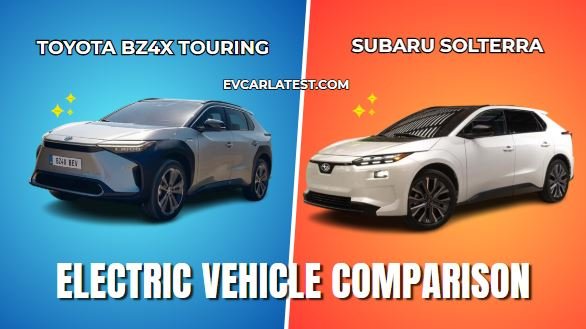
The Toyota bZ4X delivers up to 252 miles of EPA-estimated range on its front-wheel-drive configuration, while the Subaru Solterra tops out at around 225 miles EPA on its AWD setup. In real-world driving, expect 10–15% less on both, particularly in heat or at highway speeds. The single-motor FWD bZ4X can charge from 20% to 80% in roughly 30 minutes on a DC fast charger, while the dual-motor AWD versions of both the bZ4X and Solterra take approximately 35 minutes for the same window. DC fast charging tops out at around 150 kW on paper for both models, and both support Level 2 AC home charging at approximately 20 miles of range added per hour. For buyers in markets where public fast chargers are scarce, overnight Level 2 charging from a home outlet or solar setup remains the most practical daily solution for either vehicle.
The 2025 Toyota bZ4X starts at $37,070 for the base XLE FWD, while the Subaru Solterra opens at $38,495 for the Premium AWD trim. The Solterra’s range-topping Touring model reaches $51,995, and all variants include standard AWD. Toyota offers broader trim flexibility, including FWD and AWD configurations across XLE, Nightshade, and Limited grades. In Nigeria, both arrive via parallel import at approximately ₦55M–₦80M depending on year and trim; in South Africa, Toyota has an official dealer network that supports the bZ4X, giving it a servicing advantage. This page answers one question directly: if you’re choosing between these two Japanese co-twins, the bZ4X wins on price and range, while the Solterra wins on standard AWD and off-road readiness.
Toyota’s EV lineup surrounding the bZ4X includes the smaller bZ3 sedan and the upcoming bZ5X, giving buyers a path to stay within the brand as the range expands. Subaru currently offers only the Solterra as its sole EV in most markets, though the brand has committed to additional electric models through its partnership with Toyota. Outside both brands, the Volkswagen ID.4 and Hyundai Ioniq 5 compete at similar price points and offer notably better range — but neither brings the off-road software and AWD-standard lineup that makes this bZ4X vs Solterra comparison relevant for buyers who need genuine rough-terrain capability at an accessible price.
Toyota bZ4X The bZ4X’s higher EPA range of up to 252 miles on the FWD trim gives buyers a practical buffer on long inter-city runs where charging stops are limited. Toyota’s wider dealer and service network in markets like South Africa and Kenya means that maintenance and warranty support are far more accessible than with a grey-market alternative. Toyota has historically run aggressive lease incentives on the bZ4X, making it one of the more accessible ways into a new Japanese EV in markets where financing is available. However, the base model’s front-wheel-drive setup limits its usefulness on unpaved or wet roads, a real disadvantage for African buyers outside city centres. Its infotainment setup, while functional, lags behind similarly priced Korean rivals in screen quality and software responsiveness.
Subaru Solterra The Solterra comes standard with dual-motor AWD, X-MODE dual traction control, and class-leading ground clearance of 8.3 inches — a genuine advantage for buyers navigating rough roads or seasonal terrain. Later Solterra models gained improved thermal battery management, cutting fast-charge times roughly in half compared to launch-year cars, making newer used units meaningfully better to own. Standard heated seats and steering wheel on all trims add real everyday comfort for buyers in highland or cool climates. The tradeoff is a shorter EPA range of around 222–227 miles, which limits the Solterra’s appeal for buyers who frequently cover long distances without charging infrastructure. Its price premium over the bZ4X is noticeable, and because Subaru’s African dealer footprint is thin, servicing a Solterra outside South Africa typically means relying on independent mechanics.
Quick Verdict
Choose the bZ4X if range, price flexibility, and access to an authorised service network matter most — it is the more practical, cost-efficient choice for city and highway buyers. Choose the Solterra if you regularly drive on unpaved roads, in wet conditions, or need confident AWD traction as standard rather than as an upgrade. Both share identical charging infrastructure and battery origins, so the decision comes down to whether you prioritise efficiency or capability. For African buyers specifically, the bZ4X’s wider dealer network gives it a meaningful edge in long-term ownership peace of mind.
FAQ
Is the Toyota bZ4X better than the Subaru Solterra for long trips?
On range alone, the bZ4X holds an advantage, offering up to 252 miles EPA on the FWD trim versus around 225 miles for the AWD-only Solterra. Both share similar DC fast-charging speeds, so neither has a major edge at the charger. For long-distance driving, the bZ4X’s extra range buffer makes it the more comfortable choice between the two.
Which is cheaper to maintain, the bZ4X or the Solterra?
Running costs are very similar since both share platform components, battery chemistry, and motor architecture with no combustion engine to service. Toyota’s broader dealer network in Africa and Asia generally means easier access to trained technicians and genuine parts. Outside South Africa, Solterra owners may face higher servicing costs due to limited authorised Subaru outlets.
Is the Subaru Solterra available in Nigeria or Africa?
The Solterra is not officially sold through Subaru dealers in Nigeria and arrives only through parallel import channels, typically from the US or UK as a used model. In South Africa, Subaru has a more established presence, though availability can vary by region. Always verify warranty coverage and charging adapter compatibility before purchasing a grey-market unit anywhere in Africa.
Which has better AWD — the bZ4X or the Solterra?
The Solterra’s dual-motor AWD is standard across all trims and includes X-MODE with two terrain settings — snow/dirt and deep snow/mud — plus Hill Descent Control. The bZ4X offers AWD only on higher trims and lacks the dedicated off-road traction software. For buyers who genuinely need all-surface capability, the Solterra’s AWD system is more purpose-built.
Related EV Comparisons

| |
| Price | $38,000.00 |
| Our Rating | |
| Brand | Toyota SUBARU |
| Category | Electric Cars Electric Cars |
MODEL
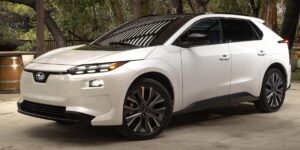
| Full Model Name | Subaru Solterra |
| Segment / Class | Compact Electric SUV |
| Available Trims / Variants |
Toyota bZ4X Touring FWD Toyota bZ4X Touring AWD Premium, Limited, Touring, Touring Onyx Edition |
| Powertrain Options | Dual-motor AWD (only option) |
PRICE & AVAILABILITY
| Base Price (USD) | $38,495 MSRP |
| Availability Status | Coming soon. Expected release 2026, Q1-Q2 On sale now |
| Markets Available | US, Europe, Japan, and other global markets |
| Brand / Manufacturer | Subaru Corporation |
BATTERY & CHARGING
| Battery Capacity | 74.7 kWh total 72.8 kWh (2025); 74.7 kWh (2026) |
| Range (WLTP/CLTC/EPA) |
348 mi WLTP - Toyota bZ4X Touring FWD 314 mi WLTP - Toyota bZ4X Touring AWD Up to 227 mi EPA (2025); up to 288 mi (2026) |
| DC Charging (Max kW) | CCS 150 kW max 100 kW (2025); 150 kW (2026) |
| Charging Time (10–80%) | ~35 min (2025); ~28 min (2026) |
| AC Charging (Max kW) |
Type 2 11 kW Type 2 22 kW ~9.5 hrs on Level 2 |
| Battery Warranty | Not specified |
| Energy Consumption | ~16.0 kWh/100km |
PERFORMANCE
| Power Output (kW / hp) |
FWD 224 hp (165 kW) - Toyota bZ4X Touring FWD AWD 380 hp (280 kW) - Toyota bZ4X Touring AWD 215 hp combined |
| 0–100 km/h / 0-60 mph (seconds) The acceleration numbers are an easy way to compare car performance. We list either time from 0 to 100 km/h or time from 0 to 60mph, depending on which number(s) the manufacturers provide. The lower the acceleration time, the higher performance the car is. | 6.90 s / 6.70 s |
| Motor Configuration | Dual motor, front + rear, AWD |
| Torque (Nm) | 265 Nm (195 lb-ft) 249 lb-ft (~338 Nm) |
| Top Speed (km/h / mph) | 99 mph (160 km/h) 160 km/h (99 mph) |
BODY & DIMENSIONS
| Dimensions (L×W×H mm) | 4830 x 1860 x 1670 mm (190.2 x 73.2 x 65.7 in) 4,690 × 1,860 × 1,650 mm |
| Trunk/Boot Capacity (L) | EU: 600 l 421 L |
| Body Style | 5 door SUV, 5 seats 5 door SUV, 5 seats |
| Kerb Weight (kg) | 2,010 kg |
| Ground Clearance (mm) | 240 mm (9.4 in) 8.3 in (211 mm) |
| Frunk/Bonnet Capacity (L) | No Not available |
| Sunroof | Not offered on most trims |
SAFETY & DRIVER ASSISTANCE
| ADAS Features | EyeSight suite (full driver-assist package) |
| Autonomous Driving Level | Level 2 |
| Crash Test Ratings | 5 stars |
| Over-the-Air (OTA) Safety Updates | Not confirmed |
COMFORT & SEATING
| Seating Capacity | Heated front seats 5 |
| Seat Material | Cloth (base), leatherette (higher trims) |
| Wireless Charging | Limited trim and above |
DISPLAYS & CONNECTIVITY
| Centre Screen (inches) | 14" touchscreen 12.3" touchscreen |
| Mirror Link / Apple CarPlay / Android Auto | Wireless, both supported |
| Driver's Display (inches) | 7" 7.0" LCD |
| Head-Up Display (HUD) | No Not offered |
TECHNOLOGY
| Vehicle-to-Load (V2L) | Not confirmed |
| Vehicle-to-Grid (V2G) | Not available |
| Over-the-Air Map Updates | Not confirmed |
ADDITIONAL SPECS
| Headlight Type (LED/Matrix/Laser) | LED |
| Adaptive Headlights | Not standard |
| Sound System Brand | Harman Kardon (higher trims) |
| Speaker Count | N/A |
| Navigation System | Higher trims |
| Face Recognition | Not offered |
| Fingerprint Sensor | Not offered |
| Remote Parking | Not offered |
| Official Dealer Network | Subaru dealers nationwide/globally |
| Service Interval | Not specified |
| Roadside Assistance | Included via Subaru ownership programs |
Note
| Data Source | Subaru press materials, Autoblog, Cars.com, KBB, cars-data.com |
| Last Updated | September 2026 |
| Additional Notes | 2025 MY pricing dropped $6,500 vs. 2024; 2026 MY brings a new battery/platform with major range and charging gains |
| Editor's Note | The 2026 redesign closes much of the range/charging gap with rivals |

|
Disclaimer Note
Specifications sourced from manufacturer data and may reflect WLTP, CLTC, or EPA test conditions. Import prices in your local are estimates based on grey-market landing costs and exclude duties, clearing fees, and local taxes. Figures are subject to change without notice. Always verify with your local importer before purchase. We can not guarantee that the information on this page is 100% correct