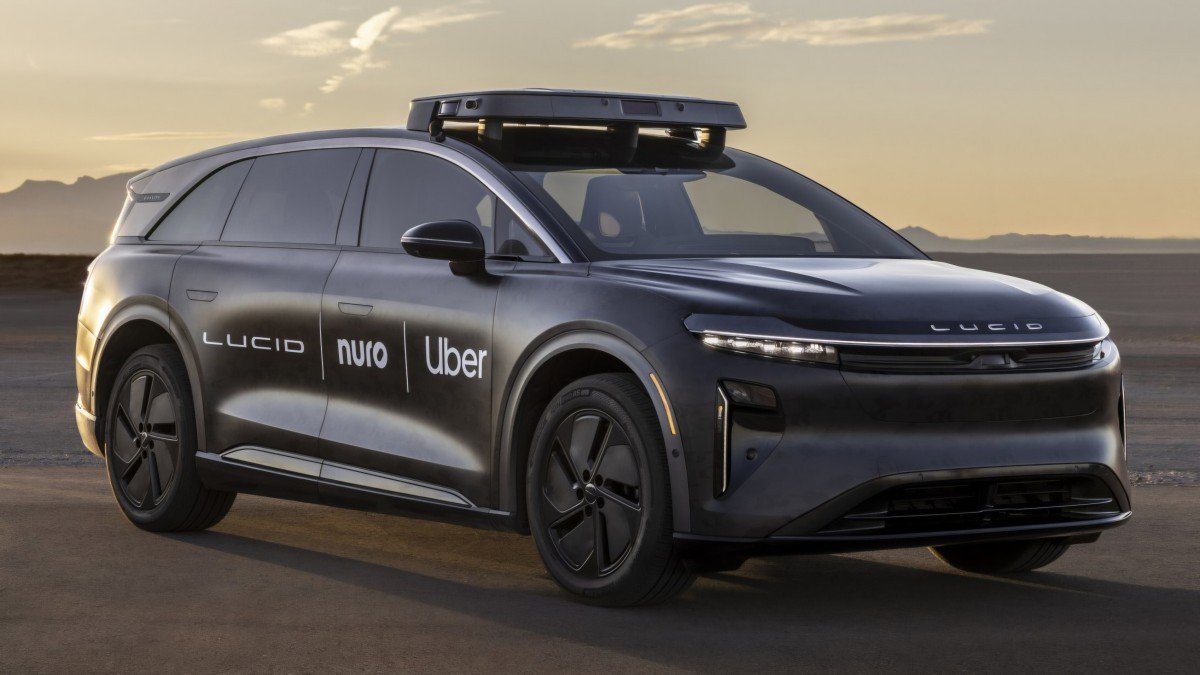
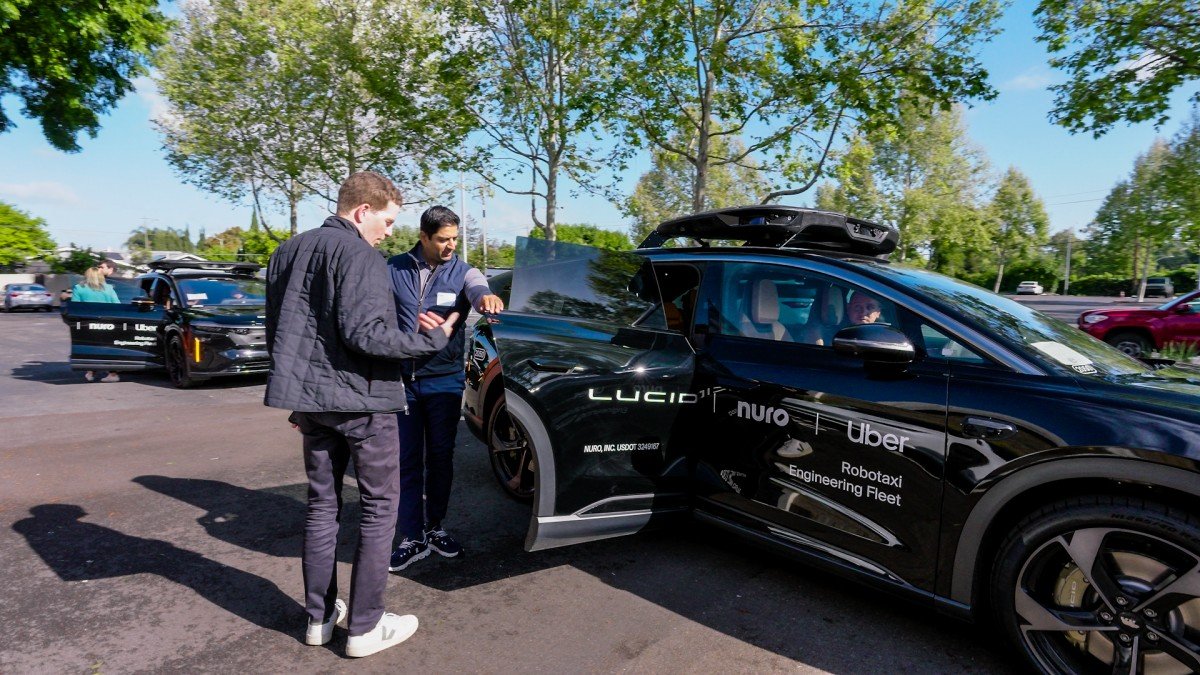
Uber’s self-driving robotaxi program just crossed a significant milestone. As of April 2026, the ride-sharing giant and its partners — Lucid Motors and autonomous tech company Nuro — are carrying actual passengers in a driverless Lucid Gravity SUV on the streets of San Francisco. No app waitlist, no staged demo. Real rides, real roads.
For now, only Uber employees can book one. But the direction of travel is clear.
How the Uber-Lucid-Nuro Robotaxi Partnership Works
The three-way partnership was announced in July 2025. Each company has a defined role: Lucid Motors supplies the vehicle — its flagship Gravity SUV — while Nuro provides the autonomous brain, a Level 4 system it calls “Driver.” Uber handles the platform and, eventually, the paying customers.
By October 2025 the team had selected the San Francisco Bay Area as its launch market. January 2026 brought the first reveal of a production-intent model — meaning this was no concept car; it looked exactly like the units destined for commercial deployment. Three months later, the program moved into supervised passenger testing.
The Lucid Gravity SUV: Built for the Long Shift
Choosing the Lucid Gravity for a robotaxi program isn’t an obvious call — it’s a luxury SUV that retails for over $94,000. But the specs make sense for a vehicle that needs to run all day.
The Gravity stretches 5.03 meters and can seat up to seven in its consumer configuration, though the robotaxi variant is optimized for rear-passenger comfort and sensor equipment. Its range tops 435 miles per charge — more than enough for a full operational day. When the battery does run low, a 900V architecture enables 199 miles of added range in roughly 15 minutes.
The autonomy hardware is equally capable. Nuro’s “Driver” system combines cameras, LiDAR, and radar into a 360-degree sensor array that can detect a pedestrian stepping off a curb or a cyclist in a blind spot faster than any human driver. Nuro currently runs a fleet of nearly 100 development vehicles across U.S. cities, continuously feeding road data back into the system.
Safety Drivers, For Now
The test rides are not fully driverless yet. A safety driver occupies the front seat on every trip, ready to intervene if the software encounters something it can’t handle. That’s standard practice at this stage — Waymo operated the same way for years before going fully driverless in Phoenix.
The employee-only phase gives Uber and its partners controlled data on how the autonomous system handles San Francisco’s notoriously unpredictable traffic, while also gathering passenger experience feedback before a public rollout.
Uber Has Committed to 20,000 Units
The scale of Uber’s commitment puts this in a different category from most robotaxi pilots. The company has agreed to deploy up to 20,000 Lucid Gravity robotaxis. That’s not a test program — that’s a fleet buildout.
Public access in San Francisco is expected later in 2026. After that, the partnership plans to expand to dozens of markets over the next six years.
Whether riders will warm up to a steering-wheel-less Lucid SUV arriving at their door is the open question. The luxury positioning cuts both ways: it signals safety and quality, but it also means the service will likely be priced above standard Uber. For a robotaxi program that needs volume to prove its unit economics, that tension is worth watching.
Related EV News
- Renault Rebrands Charging Network as Plug Inn — 320 kW Stations, 99% Uptime
- Honda Super-N: The $27,000 Electric Hatchback Coming to the UK This July — With Fake Gear Changes
- Ethiopia Installs National EV Charging Network as Electric Vehicle Fleet Tops 140,000 Units
- Dongfeng Nissan NX8 Launches in China: BEV and EREV from $23,300, Up to 901 Miles Total Range
- 2026 Mercedes-Benz GLB Electric Review: 392-Mile Range, 320 kW Charging & 7 Seats — Everything You Need to Know