Volvo EX30 vs BYD Atto 3
The Volvo EX30 and BYD Atto 3 are both compact electric SUVs aimed at buyers who want something manageable in size without giving up everyday practicality. The EX30 is Volvo’s smallest EV — a city-friendly crossover built on Geely’s SEA platform, positioned as an entry point into the Volvo lineup rather than a compromise product. The Atto 3 is BYD’s global compact SUV, one of the first models BYD pushed seriously into export markets across Europe, Australia, and Southeast Asia. Both target first-time EV buyers and urban commuters who want a known brand, reasonable range, and a car that fits in tight parking. The EX30 buyer tends to lean toward Scandinavian design and brand heritage. The Atto 3 buyer is usually more focused on value per feature and BYD’s battery reputation.
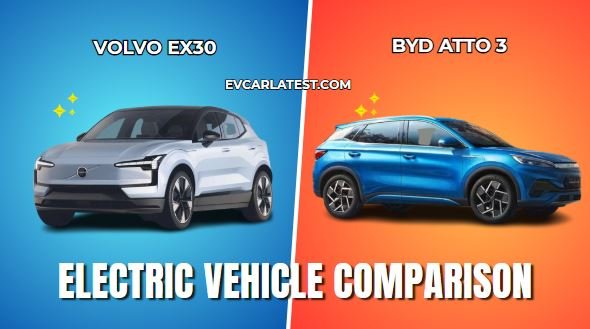
The Volvo EX30 Single Motor Extended Range is rated at 480 km WLTP — one of the stronger figures in the compact EV segment. The standard Single Motor version delivers around 344 km WLTP. Real-world range in mixed driving typically sits 10–15% below those numbers. The BYD Atto 3 Extended Range is rated at 420 km WLTP, with the standard range version coming in at around 320 km WLTP. Real-world figures track similarly. On charging, the EX30 supports DC fast charging at up to 153 kW, which is competitive for a car this size. The Atto 3 peaks at 88 kW DC fast charging — noticeably slower, and a real gap when you’re comparing time spent at a public charger. The EX30 pulls ahead clearly on charging speed, which matters more the further you drive between stops.
The Volvo EX30 starts around $34,950 USD in the United States and from approximately €36,000 in Europe. The BYD Atto 3 starts around €38,000–€42,000 in European markets depending on trim and country, though it carries a lower starting price in markets like Australia and China. The pricing relationship between the two shifts depending on which market you’re in and what import duties apply — in some European markets they land close together, in others the Atto 3 is noticeably pricier once taxes are factored in. Both have official dealer presences in Europe, Australia, and parts of the Middle East. In Nigeria and most of West Africa, both arrive as imports with no formal after-sales network. This page helps buyers in markets where both are accessible decide whether the EX30’s charging speed and brand positioning are worth the price difference, or whether the Atto 3’s feature set and BYD’s blade battery technology make more practical sense.
Volvo’s broader EV lineup includes the EX40, EC40, and the larger EX90 — stepping up in size and price from the EX30 if the compact footprint is the main trade-off. BYD’s lineup around the Atto 3 includes the Atto 2, the larger Atto 4, the Seal sedan, and the Sealion 6 crossover, giving buyers a wider range of size and price options within the brand. On the rival side, the Mini Cooper Electric and the Stellantis-based Jeep Avenger Electric compete with the EX30 in the small premium EV space. The MG4 and the Volkswagen ID.3 are direct rivals to the Atto 3 on price and segment, and both come up regularly in the same buying conversations.
The EX30 has one of the better WLTP range figures in its class for the Extended Range trim, a fast-charging ceiling that holds up against cars from larger segments, and Volvo’s safety engineering which remains a genuine differentiator even in a smaller package. Boot space is tight even by compact SUV standards, and the minimalist interior concentrates almost every control into a single central screen — which some buyers find clean and others find frustrating after daily use. The Atto 3 offers a more generous interior for the footprint, BYD’s blade battery technology which has a strong safety record, and a feature list that tends to be well-specced relative to its price in most markets. The 88 kW fast-charging limit is a practical disadvantage on longer trips, and BYD’s service network outside its established markets is still thinner than what Volvo’s dealer infrastructure offers.
QUICK VERDICT
The EX30 is the stronger pick if charging speed matters to how you actually use the car, and if the Volvo brand carries weight in your buying decision. The Atto 3 makes more sense if interior room and BYD’s battery technology are the priority, particularly in markets where its pricing comes in below the EX30. In markets where both have dealer support, the EX30’s charging advantage and longer WLTP range give it a practical edge for drivers who leave the city regularly. In grey import markets, the decision shifts almost entirely to which car has better local parts availability.
Related EV Comparisons
- BYD Han vs Tesla Model 3
- BYD Seagull vs Wuling Hongguang Mini EV
- BYD Sealion 06 vs Tesla Model Y
- Volvo EX30 vs Smart #1
- Volvo EX90 vs Cadillac Escalade IQ
| |
| Price | $35,000.00 $38,000.00 |
| Our Rating | |
| Brand | Volvo BYD |
| Category | Electric Cars Electric Cars |
MODEL
| Available Trims / Variants |
Volvo EX30 Single Motor Volvo EX30 Single Motor Extended Range Volvo EX30 Twin Motor Performance BYD Atto 3 Long Range |
PRICE & AVAILABILITY
| Base Price (USD) |
€ 36,800 £ 34,000 - Volvo EX30 Single Motor $ 35,000 € 42,000 £ 38,550 - Volvo EX30 Single Motor Extended Range $ 46,200 € 45,300 £ 41,000 - Volvo EX30 Twin Motor Performance € 38,000 £ 37,200 |
| Availability Status | Available to order. Released 2023, June Available to order. Released 2022, Q4 |
BATTERY & CHARGING
| Battery Capacity |
51 kWh total - Volvo EX30 Single Motor 69 kWh total - Volvo EX30 Single Motor Extended Range 69 kWh total - Volvo EX30 Twin Motor Performance 60.4 kWh usable |
| Range (WLTP/CLTC/EPA) |
214 mi WLTP - Volvo EX30 Single Motor 298 mi WLTP - Volvo EX30 Single Motor Extended Range 286 mi WLTP (275 mi EPA) - Volvo EX30 Twin Motor Performance 261 mi WLTP, 298 mi NEDC |
| DC Charging (Max kW) |
CCS 134 kW max, 10-80% in 25 min - Volvo EX30 Single CCS 153 kW max, 10-80% in 25 min - Volvo EX30 Single Motor Extended Range CCS 153 kW max, 10-80% in 25 min - Volvo EX30 Twin Motor Performance CCS 88 kW, 30-80% in 29 min, 10-80% in 44 min, 0-100% in 1 hour 20 min |
| AC Charging (Max kW) |
Type 2 11 kW, 100% in 8 h
Type 2 7 kW, 0-100% in 9 hours 42 min Type 2 11 kW, 0-100% in 6 hours 30 min |
| Energy Consumption |
269 Wh/mi WLTP - Volvo EX30 Single Motor 253 Wh/mi WLTP - Volvo EX30 Single Motor Extended Range 262 Wh/mi WLTP (265 Wh/mi EPA) - Volvo EX30 Twin Motor Performance 251 Wh/mi WLTP |
PERFORMANCE
| Power Output (kW / hp) |
RWD 272 hp (200 kW) - Volvo EX30 Single Motor RWD 272 hp (200 kW) - Volvo EX30 Single Motor Extended Range AWD 428 hp (315 kW) - Volvo EX30 Twin Motor Performance FWD 204 hp (150 kW) |
| 0–100 km/h / 0-60 mph (seconds) The acceleration numbers are an easy way to compare car performance. We list either time from 0 to 100 km/h or time from 0 to 60mph, depending on which number(s) the manufacturers provide. The lower the acceleration time, the higher performance the car is. |
5.7 sec 0-62 mph - Volvo EX30 Single Motor 5.3 sec 0-62 mph - Volvo EX30 Single Motor Extended Range 3.4 sec 0-60 mph (3.6 sec 0-62 mph) - Volvo EX30 Twin Motor Performance 7.3 sec 0-62 mph |
| Torque (Nm) |
253 lb-ft (343 Nm) - Volvo EX30 Single Motor 253 lb-ft (343 Nm) - Volvo EX30 Single Motor Extended Range 543 Nm (400 lb-ft) - Volvo EX30 Twin Motor Performance 229 lb-ft (310 Nm) |
| Top Speed (km/h / mph) | 112 mph (180 km/h) 99 mph (160 km/h) |
BODY & DIMENSIONS
| Dimensions (L×W×H mm) | 166.7 x 72.3 x 61.0 in (4233 x 1836 x 1549 mm) 175.4 x 73.8 x 63.6 in (4455 x 1875 x 1615 mm) |
| Trunk/Boot Capacity (L) | EU: 11.2 ft³ EU: 15.5 ft³, 47.3 ft³ max |
| Body Style | 5 door SUV, 5 seats 5 door SUV, 5 seats |
| Kerb Weight (kg) |
EU: 1833 kg unladen, 2216 kg gross - Volvo EX30 Single Motor EU: 1830 kg unladen, 2235 kg gross - Volvo EX30 Single Motor Extended Range EU: 1943 kg unladen, 2338 kg gross - Volvo EX30 Twin Motor Performance EU: 3704 lb unladen, 4608 lb gross |
| Ground Clearance (mm) | 6.9 in (175 mm) |
| Frunk/Bonnet Capacity (L) | Yes No |
SAFETY & DRIVER ASSISTANCE
| Crash Test Ratings | NCAP 2023: 5 stars |
COMFORT & SEATING
| Seating Capacity | Heated front seats Heated front seats |
DISPLAYS & CONNECTIVITY
| Centre Screen (inches) | 12.3" touchscreen 12.8" or 15.6" rotating touchscreen |
| Driver's Display (inches) | No 5" |
| Head-Up Display (HUD) | No No |
TECHNOLOGY
ADDITIONAL SPECS
Note
| Additional Notes | Digital Video Recorder |


|
Disclaimer Note
Specifications sourced from manufacturer data and may reflect WLTP, CLTC, or EPA test conditions. Import prices in your local are estimates based on grey-market landing costs and exclude duties, clearing fees, and local taxes. Figures are subject to change without notice. Always verify with your local importer before purchase. We can not guarantee that the information on this page is 100% correct