If you’ve filled up a tank recently, you already know the answer feels different than it did three years ago. Petrol in Nigeria now sits at ₦1,200 per liter in most cities — and that number has a way of making the idea of an electric car feel less like a luxury and more like arithmetic.
So here’s the actual math. Not the optimistic version. Not the press release version. Just what it costs to run a petrol car versus an EV on Nigerian roads right now, in 2025.
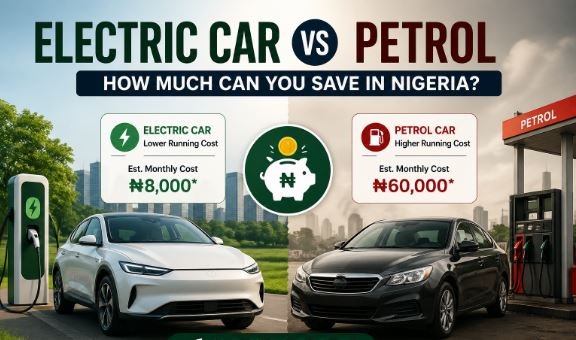
What running a petrol car actually costs per month
The average Nigerian daily driver — a Toyota Corolla, a Honda Civic, a Hyundai Elantra — gets roughly 10–12km per liter in city traffic. Lagos and Abuja traffic being what it is, let’s be generous and say 12km/liter.
At 1,500km per month (about 50km of driving daily, a realistic commuter figure), you’re burning through 125 liters. At ₦1,200 per liter, that’s ₦150,000 in fuel alone every single month.
Add engine oil changes every 5,000km, spark plugs, air filters, transmission fluid — petrol engine maintenance runs another ₦30,000–₦60,000 a month when amortized. The full cost of keeping a petrol car on Nigerian roads is closer to ₦180,000–₦210,000 monthly. That’s over ₦2 million a year, just to keep moving.
What charging an electric car costs in Nigeria
An average electric car uses about 18 kWh per 100km. For the same 1,500km monthly, you need roughly 270 kWh.
On Band A electricity (the most stable supply tier, at roughly ₦225/kWh in 2025), that comes to ₦60,750 per month. More than half the cost of petrol, saved before you even factor in maintenance.
Now here’s where Nigeria gets interesting: if you’re charging off solar — and many EV owners are — the per-kWh cost drops dramatically. A properly sized solar system can bring your effective charging cost to ₦40–₦60/kWh after amortization. At that rate, 270 kWh costs you roughly ₦13,500. Per month.
Side-by-side: the real monthly numbers
| Cost item | Petrol car | Electric car (Band A) | Electric car (Solar) |
|---|---|---|---|
| Fuel / charging (1,500km) | ₦150,000 | ₦60,750 | ~₦13,500 |
| Monthly maintenance | ₦40,000 | ₦8,000 | ₦8,000 |
| Total monthly cost | ₦190,000 | ₦68,750 | ~₦21,500 |
| Monthly saving vs petrol | — | ₦121,250 | ~₦168,500 |
| Annual saving | — | ~₦1.45M | ~₦2.02M |
That ₦1.45 million per year on Band A power is not a rounding error. Over five years, you’re looking at over ₦7 million in savings — on fuel and maintenance alone — before counting depreciation differences or resale value.
The costs people tend to forget
Running an EV in Nigeria is genuinely cheaper, but it’s not free of complications. A few things worth knowing before you decide:
- Battery replacement: EV batteries typically last 8–15 years or 200,000–300,000km. If you buy a used import, verify the battery health before anything else. A degraded battery is the one cost that can make the savings math fall apart.
- Home charging setup: A basic Level 2 home charger and installation in Nigeria runs ₦200,000–₦500,000. Budget for this as part of your total switch cost.
- Public charging: Still sparse outside Lagos and Abuja. If you drive long distances regularly, this is a real constraint — for now.
- EV mechanics: They exist, but you’ll need to find one who actually knows EV systems, not just someone who watched a YouTube video about it.
What this looks like on Nigerian roads specifically
Fuel queues alone cost Nigerians real money — in time, in fuel burned idling, sometimes in jerry-can surcharges. That invisible cost disappears with an EV. You charge overnight, or during the day off solar, and you leave the queue politics entirely behind.
The pothole concern is real too. Nigerian roads aren’t kind to anything, EVs included. But modern EVs have higher ground clearance than many assume, and the absence of a combustion engine actually means fewer vibration-sensitive parts. What matters most is suspension — and that’s as replaceable on an EV as on any petrol car.
For the Nigerian driver who already has solar at home, or who is about to invest in one, the equation is unusually favorable compared to almost anywhere else in the world. The combination of high petrol prices, stable solar irradiance, and the EV’s low running cost creates a savings window that is arguably better here than in Europe.
Frequently asked questions
Is it cheaper to run an electric car in Nigeria?
Yes, significantly. On grid power (Band A), running costs drop by roughly ₦121,000 per month compared to a petrol car at the same mileage. On solar, the saving grows to over ₦168,000 monthly.
How long does it take to recover the extra cost of buying an EV in Nigeria?
EVs still carry a price premium over petrol equivalents in the Nigerian market. At savings of ₦1.45M–₦2M per year, a ₦3–5M premium on the purchase price typically pays back in 2–3 years, assuming current fuel prices hold.
Can you charge an electric car using solar power in Nigeria?
Yes. A 5–10kW solar system with battery storage is sufficient to charge most EVs overnight. Many Nigerian EV owners are already doing this, and it makes the economics even more compelling given the country’s irradiance levels and the cost of grid power.
What electric cars are available in Nigeria right now?
Most EVs in Nigeria arrive as used imports — primarily from the UK, USA, and increasingly China. Popular models include the Nissan Leaf, Tesla Model 3, BYD Atto 3, and the Hyundai Ioniq 5. A handful of dealers in Lagos now stock new units. Prices vary widely based on battery age and spec.
Related EV News
- How Long Does It Really Take to Charge an Electric Car?
- Electric Vehicles in Africa: The Full 2026 State of the Market
- Chery Plans to Enter Nigeria’s Commercial Vehicle Market After Passenger Car Growth
- Roam Electric Orders Double as Kenya Fuel Prices Breach 200 Shillings Per Litre
- BYD vs Geely: Which Chinese EV Brand Is Actually Better in 2026?