The honest answer is: it depends on four things — your charger type, your battery size, how depleted the pack is, and the car’s onboard charging limit. Anyone giving you a single number without those four variables is selling something.
This guide breaks down each charging level with real-world numbers, explains why manufacturer estimates rarely match what you actually experience, and flags what matters most if you’re in a market where fast charging infrastructure is still thin on the ground.
The Three Charging Levels
Level 1 — Standard Wall Outlet (1.4 kW–2.4 kW)
This is a regular household socket. In most of Africa, that means a 220V/16A outlet delivering roughly 3.5 kW at best, though real-world output is usually lower once you account for losses.
At this rate, you’re adding somewhere between 15 and 30 km of range per hour. A 60 kWh battery starting from near-empty will take 20–40 hours to reach full. Nobody does that. In practice, you plug in overnight and recover 100–150 km, which covers most daily driving.
Level 1 is slow. It is also the most available charging option in markets without dedicated EV infrastructure, which makes it practically important even if it looks bad on a spec sheet.
Level 2 — AC Wallbox or Public AC Charger (3.7 kW–22 kW)
This is where most home charging actually happens for EV owners who invest in a proper setup. A 7.4 kW wallbox — the most common home install — adds roughly 40–50 km of range per hour. A 60 kWh battery goes from 20% to 80% in around 5–6 hours. Overnight is more than enough.
The ceiling matters here: a car can only accept as much AC power as its onboard charger allows, regardless of what the wallbox can supply. The Nissan Leaf (older models) tops out at 6.6 kW AC. The MG4 takes up to 11 kW. The BYD Atto 3 accepts up to 11 kW. If you install a 22 kW wallbox, most cars will still only draw what their onboard charger permits.
Public AC chargers at shopping centres or office parks typically run at 11–22 kW. Useful for top-ups during a 2–3 hour visit. Not suited for full charges during quick stops.
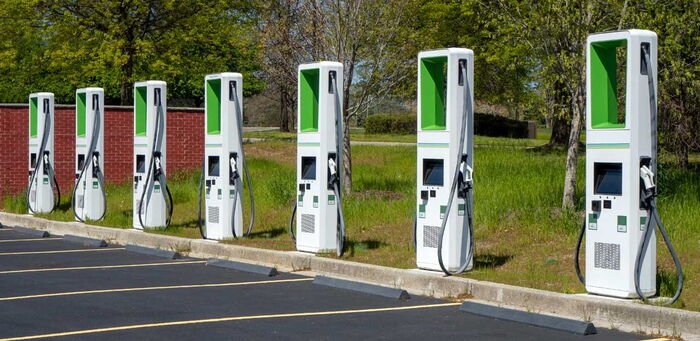
Level 3 — DC Fast Charging (50 kW–350 kW)
DC fast chargers bypass the car’s onboard AC charger and push power directly into the battery. This is where you get the numbers that make headlines: 20 minutes to 80%, 150 kW sessions, 400 km of range in half an hour.
Real-world conditions cut into those figures significantly:
- Charging curve: Charge rates drop sharply above 80% state of charge. Nearly every manufacturer’s 0–100% time includes a long, slow top-up from 80–100%. The 20-minute figure almost always means 10–80%, not a full charge.
- Battery temperature: Cold batteries charge slower. Hot batteries (from a long highway drive) may also throttle to protect cell health.
- Charger load: A 150 kW charger shared between two vehicles may only deliver 75 kW to each.
- Actual max rate: A car rated for 100 kW DC only pulls 100 kW even if plugged into a 350 kW charger.
For reference, some common models and their DC fast charge rates:
| Model | Max DC Charge Rate | 10–80% (approx.) |
|---|---|---|
| MG4 Standard Range | 88 kW | ~35 min |
| BYD Atto 3 | 80 kW | ~45 min |
| Tesla Model 3 LR (V3 Supercharger) | 250 kW | ~25 min |
| Hyundai Ioniq 6 | 230 kW | ~18 min |
| Nissan Leaf 40 kWh | 50 kW | ~40 min |
What Actually Affects Your Charge Time
Battery Size
Larger packs take longer to fill, all else being equal. A 100 kWh pack at 11 kW AC takes over 8 hours. A 40 kWh pack at the same rate takes under 4.
State of Charge
Starting from 10% and ending at 80% is faster per kWh than starting from 80% and going to 100%. The last 20% is always slow.
Weather
Cold weather can extend charging times by 20–40% in extreme cases. Heat is less of a problem for charging speed but can affect how long the battery stays at peak performance.
Cable and Connector Type
In markets where CHAdeMO, CCS, and GB/T coexist, the connector type also determines what charger you can use. Most new EVs in African markets support CCS2 for DC and Type 2 for AC — but verify before buying.
What This Means for African Markets
The charging infrastructure picture in most sub-Saharan African markets is still early-stage. South Africa has the most developed network, with operators like GridCars and Rubicon running a mix of 22 kW AC and 50–100 kW DC sites. Nigeria, Kenya, and Ghana have chargers in capital cities and major commercial corridors, but coverage outside urban centres is limited.
In that context, Level 1 home charging is not a compromise — it is the primary charging method for most EV owners in the region. A car with a larger battery and reasonable overnight range recovery matters more than a high DC peak charge rate when there are few fast chargers to use it on.
When evaluating an EV for African road conditions, the more useful questions are:
- How many kilometres does it add per hour on a standard 220V outlet?
- What is the real-world range on a full charge at moderate highway speeds?
- Does the car support 11 kW AC, which is increasingly available at commercial sites?
The DC peak charge rate is worth knowing, but it is not the first number to optimise for.
Common Misconceptions
“Charging ruins the battery.” Regularly charging to 100% on DC fast chargers does accelerate degradation over time. Most manufacturers and EV owners recommend keeping daily charging between 20–80% and using fast charging occasionally rather than as a routine. This has nothing to do with plugging in frequently — it is about the charge level and method.
“You need to charge every night.” Only if you need the range. Most EV owners charge two or three times a week depending on their daily mileage.
“A bigger battery means a slower charge.” Not necessarily. Charging speed also depends on the max power the car accepts. A large-battery car with a high charge rate can fill faster in real minutes than a small-battery car with a low charge rate.
Quick Reference
| Charger Type | Power Output | Range Added per Hour | Typical Full Charge (60 kWh) |
|---|---|---|---|
| Level 1 (household socket) | 1.4–3.5 kW | 10–25 km | 18–40 hours |
| Level 2 (7.4 kW wallbox) | 7.4 kW | ~40 km | ~9 hours |
| Level 2 (11 kW AC) | 11 kW | ~60 km | ~6 hours |
| DC Fast (50 kW) | 50 kW | N/A (10–80% in ~55 min) | ~1.5 hours (to 80%) |
| DC Fast (150 kW) | 150 kW | N/A (10–80% in ~25 min) | ~30 min (to 80%) |
All figures are approximate. Real-world results vary by vehicle, battery temperature, and charger load.
Related EV News
- Electric Vehicles in Africa: The Full 2026 State of the Market
- Chery Plans to Enter Nigeria’s Commercial Vehicle Market After Passenger Car Growth
- Roam Electric Orders Double as Kenya Fuel Prices Breach 200 Shillings Per Litre
- BYD vs Geely: Which Chinese EV Brand Is Actually Better in 2026?
- Cheapest Electric Cars You Can Buy in 2026 (Under $15,000)