Africa’s EV market is valued at $0.69 billion in 2026 for passenger vehicles alone, but the broader Middle East and Africa EV market — which most institutional reports now track together — is already past $5 billion and projected to cross $20 billion by 2031. That’s a 32% annual growth rate, which sounds exciting until you look at what’s driving it: not consumer demand in the way you see in Europe or China, but fleet operators, government procurement, and structural fuel economics that are forcing the hand of both policymakers and logistics companies.
This is Africa’s EV story in 2026. Not a revolution — an acceleration. And it’s messy, uneven, and worth understanding properly.
The Market at a Glance: What the Numbers Actually Mean
The Africa Electric Vehicle Market is expected to reach USD 0.45 billion in 2025 and grow at a CAGR of 56.30% to reach USD 4.20 billion by 2030. Different research firms slice the numbers differently — some track passenger cars only, others include two- and three-wheelers, commercial vehicles, and buses. The figures vary widely depending on scope, but the direction is consistent: up, fast.
What’s more useful than the headline number is understanding who is actually buying EVs on the continent right now. Private consumers are not yet the main driver. Fleets — not private buyers — are leading Africa’s EV adoption. Ride-hailing companies, government agencies, last-mile delivery operators, and public transport authorities are placing the largest orders. That shapes everything: the types of vehicles sold, the charging infrastructure being built, and which business models are proving sustainable.
Two-wheelers tell the real story of scale. Electric motorcycles have gained visible traction, particularly in urban taxi and delivery segments, where operating cost savings are critical. In recent years, electric models have reached double-digit shares of new registrations, supported by a combination of financing solutions, battery swapping access, and policy incentives.
Country-by-Country: Who’s Actually Moving
Ethiopia — The Boldest Policy on the Continent
Ethiopia did something no other country in the world had done before it. In 2024, the country became the first in the world to ban the import of non-electric private vehicles. The economic logic behind it is straightforward: petrol is expensive, and the Grand Ethiopian Renaissance Dam — commissioned in September 2025 with a five-gigawatt capacity — nearly doubled the grid’s peak power, making clean electricity genuinely abundant.
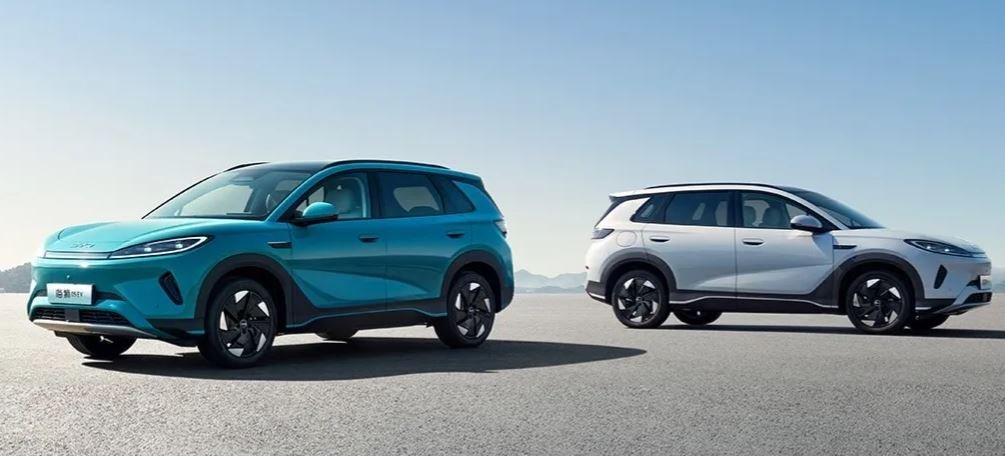
Ethiopia ranks as the fastest-growing EV country on the continent at a 58.92% CAGR, with a 96% hydro-powered grid that simultaneously eliminates tailpipe emissions and electricity-generation emissions. Consumers in Addis Ababa are shifting to battery-electric taxis, partly because ride-hail fleet mandates favour zero-emission vehicles. Chinese manufacturers like BYD and Chang’an dominate sales, while a 0% import duty on fully knocked-down kits has encouraged local assembly.
The risks are real though. Limited access to credit and rising electricity tariffs could slow growth. The ICE ban applies to private imports — much of Ethiopia’s vehicle market is still for used cars, and some drivers are finding ways around the rules with older gas vehicles.
Morocco — From Buyer to Manufacturer
Morocco is not just adopting EVs; it’s trying to build them. A $5.6 billion battery factory is opening in 2026, EV sales climbed 80.4% in 2025, and Tesla has entered the market. In June 2025, the Sino-Moroccan COBCO facility began EV-battery material production at 70 GWh annual capacity — enough for nearly one million vehicles per year.
Morocco’s 614,000-unit automotive output in 2024 positions it as a bridge between Africa and Europe, with duty-free access under EU-Mediterranean trade agreements. Global OEMs including Renault and Stellantis already have manufacturing bases there. The country’s goal to reach 2,500 public charging points by 2026 shows how firm policy commitments drive infrastructure at a different pace than market forces alone.
For African EV watchers, Morocco’s trajectory matters because it shows what’s possible when industrial policy, trade position, and renewable energy combine. Most sub-Saharan markets don’t have those same building blocks — but the model is instructive.
South Africa — A Complicated Picture
South Africa’s 2025 EV data is honestly confusing if you expected straight-line progress. BEV sales fell 17% in 2025, slipping from 1,231 units in 2024 to 1,018 units. PHEVs, on the other hand, jumped 280% — from 738 units to 2,808 units. Consumers are choosing range security over full electrification, which makes sense when grid reliability is still a genuine concern.
The government is moving to fix the structural problem rather than just subsidise demand. South Africa now offers a 150% tax deduction on investments in electric and hydrogen-powered vehicle production starting March 2026, backed by $54.27 million to boost local NEV production, battery manufacturing, and infrastructure. BYD is aggressively expanding there and plans to have as many as 70 dealerships in the country by end of 2026.
Toyota also stepped into the market in early 2026 with three electric models — its first in South Africa — as Chinese brands claimed more ground.
Kenya — The Two-Wheeler Lab
EV registrations in Kenya surged 2,700% from 2022 to 2025. The growth is almost entirely in electric motorcycles and scooters, not passenger cars, and Kenya has become the continent’s clearest testing ground for two-wheeler EV business models.
Kenya-based startup ROAM has introduced a universal fast-charging system that supports all small electric vehicles, adding 10 to 20 kilometres of range in just five minutes. Roam’s 10,000-square-metre Nairobi facility has annual production capacity exceeding 50,000 motorcycles. Uber launched an electric boda service in the country. BasiGo is running Kenya’s first inter-city electric matatu pilot. A $20 million Climate Action Initiative from Untapped Global is targeting EV expansion across the continent, using Kenya as the anchor market.
The government halved excise duty on EV imports from 20% to 10%, and the National E-Mobility Policy targets 100,000 electric motorcycles on the road. Kenya is not yet a passenger EV market in any serious sense, but as a two-wheeler market and business model incubator, it’s probably the most interesting country on the continent right now.
Nigeria — The Largest Market That Hasn’t Fully Arrived Yet
Nigeria should be Africa’s biggest EV market by population and economic weight. It’s not there yet, but the ingredients are assembling. As of 2026, the country hosts a growing network of manufacturers, assemblers, mobility startups, battery infrastructure operators, and global automotive brands positioning for a share of Africa’s clean transport sector.
BYD entered Nigeria through LOXEA, a subsidiary of CFAO Mobility, with models including the Atto 3 and Dolphin now available through official distribution and service channels in Lagos. In March 2025, Lagos inaugurated Africa’s largest assembled fast-charging station. The government partnered with BAIC Motor to implement battery swapping for electric buses and tricycles, with ₦151.9 billion in allocated funding. CIG Motors in Lagos is assembling EVs under a public-private model, producing around 2,000 vehicles annually.
Spiro has deployed over 60,000 electric motorbikes and established 1,500 battery swap stations across Nigeria and Kenya by October 2025. MAX.ng, the Lagos-based electric mobility startup, has enabled over 45,000 riders to acquire electric motorcycles through rent-to-own and subscription financing.
The blockers are structural and honest. Electricity reliability remains inconsistent — many EV operators deploy hybrid solar-public charging stations to work around grid instability. Battery costs account for nearly 50% of EV production costs. Technician capacity is limited. And a draft national EV transition plan exists but full implementation — including fiscal incentives and import duty clarity — remains pending.
If fiscal reforms accelerate, Nigeria could become Africa’s largest EV market within a few years. Private consumer adoption typically follows once fleet operators normalise EV usage. That sequencing is exactly what’s playing out.
Ghana — Quiet Leader, Underappreciated
Ghana led Africa’s EV market with a 29.31% revenue share in 2024, largely because of an eight-year zero-tariff window that eliminates customs duties on fully electric imports and has stimulated assembly investment commitments from global OEMs. Ghana currently operates only seven public charging stations despite having approximately 17,000 EVs on its roads as of end-2023 — a gap that limits intercity travel but hasn’t stopped urban EV growth.
Government targets aim for 35% EV penetration by 2035. Whether that’s achievable without a serious charging infrastructure push is a reasonable question.
Rwanda — Regulation as the Fastest Charger
Rwanda banned new petrol motorcycle registrations in Kigali and used that rule to push electric alternatives, particularly for commercial and delivery use. Rwanda targets 30% electric motorcycle penetration by 2030 and has waived import taxes on EVs. Battery swapping networks are expanding. It’s a small market by population, but Rwanda has proven something worth noting: simple, consistent regulation speeds up adoption faster than subsidies alone.
Charging Infrastructure: The Honest Assessment
Africa’s charging situation is developing — but not evenly, and not in the same way as Western markets. Battery-electric vehicles held 78.64% of market share in 2025, favored for simplicity and growing destination chargers. Commercial operators prefer BEVs for overnight charging. Plug-in hybrids bridge gaps in areas with unreliable grids.
By battery chemistry, AC slow charging commanded 68.61% of Africa’s EV market share in 2024, while DC fast charging will rise at a 57.21% CAGR to 2030. The fast-charger rollout is genuinely accelerating — but from a very low base outside Morocco and South Africa.
Battery swapping is doing more heavy lifting in Africa than anywhere else in the world. Spiro’s 9 million battery swaps generate recurring revenue that funds network expansion — a model that decouples vehicle cost from battery ownership and solves charging time in one move.
Who’s Selling EVs in Africa Right Now
The competitive landscape in 2026 tilts heavily Chinese. BYD is present across South Africa, Nigeria, Kenya, Ethiopia, and Morocco. Volkswagen invested USD 210 million to expand South African capacity and deployed e-tractors in Rwanda and Nigeria. Tesla’s entry into Morocco is mostly a signal about the country’s manufacturing ambitions rather than consumer sales.
Among African startups, the leaders are concentrated in two-wheelers: Spiro, Roam, Ampersand, BasiGo, and MAX.ng. Ampersand partnered with BYD to produce 40,000 electric motorcycles by 2026. Transsion, the Chinese smartphone giant operating as TankVolt, entered the African EV market with assembly operations in Uganda, Nigeria, Kenya, Tanzania, and Ethiopia.
What’s Actually Holding Africa Back
It’s worth being clear-eyed about the friction points.
High purchase prices continue to hinder widespread EV adoption in lower-income segments, despite cheaper batteries. Egypt’s EV share is only 0.1% due to limited financing and currency risks. Traditional lenders struggle to provide competitive EV loans due to a lack of benchmarks. In sub-Saharan Africa, microfinance is more focused on two-wheeler taxis, which limits four-wheeler EV scale economics.
Grid reliability is the other honest problem. Nigeria’s grid cannot sustain consistent overnight charging at scale right now. Ghana has EVs without chargers. South Africa’s grid has load-shedding history that made consumers hesitant to commit to full BEVs. Solar-integrated charging stations and battery swapping are workarounds, not permanent solutions.
Financing remains the structural gap that policy alone can’t close. Kenya’s $25-per-day EV lease and Ebikes Africa’s 11-month installment plans show what accessible financing looks like — but models like these need to reach further into Nigeria, Ghana, Tanzania, and across francophone West Africa to move the needle continent-wide.
The Africa-Specific Takeaway
Africa’s EV transition is not going to look like Europe’s, China’s, or America’s. The vehicle mix is different — two-wheelers and three-wheelers will likely account for most units sold through 2030. The infrastructure model is different — battery swapping, solar charging, and off-grid solutions matter more than public fast chargers. The buyer is different — fleet operators and commercial drivers, not consumer early adopters, are setting the pace.
Africa will not replicate the EV transitions of wealthier markets. Its electric future is being built from different starting points — and in 2026, that building is no longer theoretical.
For Nigeria specifically, the combination of fuel subsidy removal, growing local assembly, BYD’s distribution presence, and Spiro’s swapping network means the country is closer to an inflection point than it appears from the headline numbers. The infrastructure gap is real. So is the momentum.
Related EV News
- Chery Plans to Enter Nigeria’s Commercial Vehicle Market After Passenger Car Growth
- Roam Electric Orders Double as Kenya Fuel Prices Breach 200 Shillings Per Litre
- BYD vs Geely: Which Chinese EV Brand Is Actually Better in 2026?
- Cheapest Electric Cars You Can Buy in 2026 (Under $15,000)
- EV Charging Stations in Nigeria: Where Can You Charge in 2026?